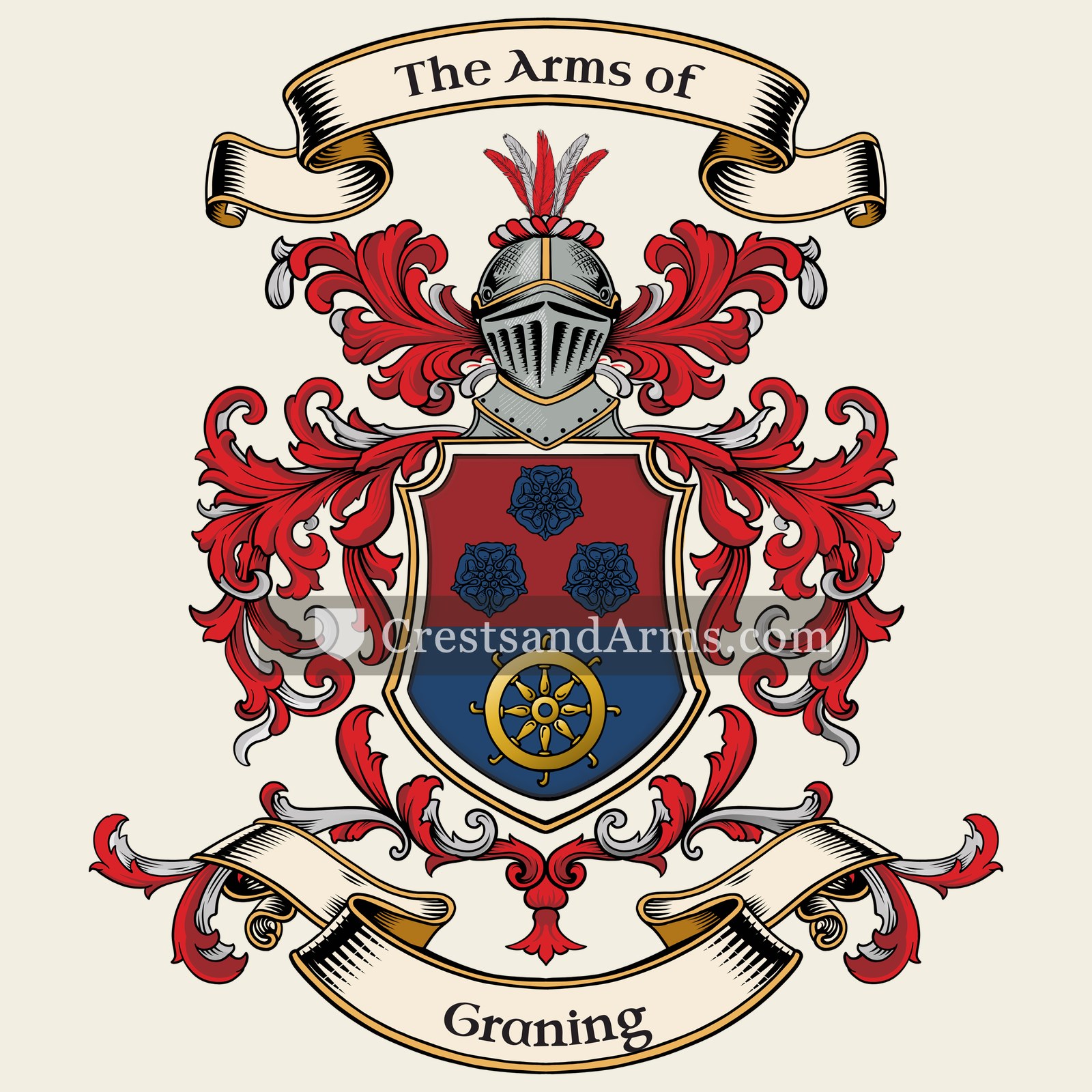
A record of documented arms, meaning and origin, researched for the Graning family of Germany.
Reg. 3487 · German, G–I
Coat of Arms & Family Crest Details
Symbols on this shield
roseThe seventh son, and beauty with grace
wheelFortune's turning, and the carter's trade
Colours
Red (Gules)Means: Military strength
Blue (Azure)Means: Loyalty and truth
Gold (Or)Means: Generosity
Historical info
Source
J. B. Rietstap, Armorial Général, Gouda: G. B. van Goor Zonen, 1884–87
Blazon (the actual original written record)
“Coupé: au 1 de gu. à une tige de sin., fleurie de trois bluettes mal-ordonnées d'azur et mouv. du coupé; au 2 d'azur à une roue de six rayons d'or. C.: cinq pl. d'aut.: de gu., d'or, d'azur, d'or et de gu. L. d'or et d'azur.”
HesseHesse, c. 1805
Digital archive packCoat of arms PNG, gold border print PDF, vector SVG and the certificate of authenticity. Sent to your email in minutes.
Map of Germany showing where the Graning arms are recorded
The Graning arms were recorded in Hesse, c. 1805.
Hesse was central German country, divided among a large number of small landowners and prosperous towns. So many separate households held ground there that the region produced an unusual number of coats of arms.
This is where the arms were entered in the register. Families often moved to other parts of the country, so the same name can turn up in more than one region.
The body that granted and recorded arms in Germany in this period.
Francis II, Holy Roman Emperor
Sovereign of the period
Francis II, Holy Roman Emperor
1792–1806
Reigning in Germany when the Graning arms are first recorded.
How Arms Worked in Germany
In the Holy Roman Empire, coats of arms were often granted to individuals by the Emperor or his representatives. These arms were then passed down through the generations to all legitimate descendants of the original holder. Younger branches of a family usually kept the same shield design without needing to change it, as the arms belonged to the entire lineage.
Granting authority
The Holy Roman Emperor held the sole power to grant new coats of arms throughout his vast imperial territories.
How they got arms
Families typically obtained their coats of arms through a formal imperial grant or by proving their noble status to the authorities.
Where arms were recorded
These grants were officially recorded in the Imperial Chancery registers, which began keeping formal records of such honors during the Middle Ages.
The family's standing
Recorded among the armigerous families of Hesse.
Origin & History of the Graning Family in Germany
The family name Graning traces its roots to the historic region of Hesse in central Germany. By the early 19th century, records confirm that members of the family were well-established within this landscape. The name likely originated as a descriptive term or a locational identifier common to the rural populations of the German states during that era. Families in Hesse at this time were often deeply connected to the land, working as farmers or skilled tradespeople in small village communities. As the region underwent political shifts and social changes in the early 1800s, the Graning family remained part of the local fabric, contributing to the agricultural and social life of their home territory. Over time, the name became a permanent marker of their ancestry and their long-standing presence in the heart of Germany.
Related Branches & Arms
Root word
Gran
Old High German word for pine tree or spruce.
This name
GraningA topographic name for someone who lived near a pine forest or a spruce grove.
also spelled
Gerninge
Gerningh
Documented Sources
J. B. Rietstap, Armorial Général, Gouda: G. B. van Goor Zonen, 1884–87
Hessisches Landesarchiv, Personenstandsregister der Zivilstandsverwaltung (1808–1813)
Knappe, Roland, Die Geschichte der hessischen Dörfer und ihrer Bewohner, 1995
Zimmermann, Friedrich, Die Namensgebung in Hessen während der napoleonischen Zeit, 1982
Digital archive packCoat of arms PNG, gold border print PDF, vector SVG and the certificate of authenticity. Sent to your email in minutes.


 roseThe seventh son, and beauty with grace
 wheelFortune's turning, and the carter's trade
 roseThe seventh son, and beauty with grace
 wheelFortune's turning, and the carter's trade