A record of documented arms, meaning and origin, researched for the Granito family lines. Documented in 3 countries.
Reg. 6071 · French, G–I
Coat of Arms & Family Crest Details
Symbols on this shield
chevronProtection, and faithful service completed
fessThe military belt, and readiness to serve
lionCourage, strength and royalty
crownSovereignty, authority and just reward
cockCourage, vigilance and readiness for battle
Colours
Gold (Or)Means: Generosity
ErmineMeans: Dignity
Red (Gules)Means: Military strength
Blue (Azure)Means: Loyalty and truth
Historical info
Source
J. B. Rietstap, Armorial Général, Gouda: G. B. van Goor Zonen, 1884–87
Blazon (the actual original written record)
“Ec.: au 1 d'or au lion de gu., enclos dans un double trêcheur fleur. et c-fleur. du même (Ecosse); au 2 d'herm. au chev. de gu., ch. de trois couronnes à l'antique d'or (Quetteville); au 3 d'arg. à la fasce d'azur, acc. de trois coqs au nat., 1 en chef”
Francec. 1725
Digital archive packCoat of arms PNG, gold border print PDF, vector SVG and the certificate of authenticity. Sent to your email in minutes.
Map of France showing where the Granito arms are recorded
The Granito arms were recorded in France, c. 1725.
Arms such as these were typically recorded in Bretagne.
More families held coats of arms in Bretagne than anywhere else in France. The land was divided into many small estates rather than a few large ones, so far more households counted as gentry, and each needed a shield of its own to be told apart.
This is where the arms were entered in the register. Families often moved to other parts of the country, so the same name can turn up in more than one region.
The body that granted and recorded arms in France in this period.
Louis XV of France
Sovereign of the period
Louis XV of France
1715–1774
Reigning in France when the Granito arms are first recorded.
How Arms Worked in France
In France, a coat of arms was a mark of honor that passed down through the male line to all legitimate descendants. Families often used the same shield without changes to show their shared heritage. If a branch wanted to stand out, they could add a small mark to their shield to show their specific place in the family tree.
Granting authority
The Juge d'armes de France acted as the official authority that regulated and verified coats of arms across the country.
How they got arms
Families typically inherited their arms from ancestors, though they could also receive them through royal grants or by proving their noble status.
Where arms were recorded
Coats of arms were officially recorded in the Armorial Général de France, which began its main collection in the year 1696.
The family's standing
Recorded among the armigerous families of France.
Origin & History of the Granito Family in France
The family name Granito is deeply rooted in the historical landscape of France, with documented evidence placing its members in the region of Bretagne as early as 1725. During this period, the name was likely associated with families living in rural or coastal communities where local records first began to track lineage through parish registers. Because the name shares a linguistic connection to the word for stone, it is possible that early ancestors were involved in masonry, architecture, or the trade of building materials, which were essential industries for the development of French towns and religious structures in the eighteenth century. As these individuals settled in Bretagne, they became part of a regional culture defined by strong maritime traditions and a unique linguistic heritage. By tracing their presence in these early church and civil documents, we can see how the Granito family established themselves as a stable part of the local population during a time of significant social change in France.
Coat of Arms & Family Crest Details
Symbols on this shield
bordureA difference between branches of one family
crownSovereignty, authority and just reward
Colours
Red (Gules)Means: Military strength
ErmineMeans: Dignity
Gold (Or)Means: Generosity
Historical info
Source
Sir Bernard Burke, The General Armory of England, Scotland, Ireland and Wales, London: Harrison & Sons, 1884
Blazon (the actual original written record)
“Gu. three antique crowns within a bordure erm”
AberdeenMonymusk · Aberdeen, c. 1705
Digital archive packCoat of arms PNG, gold border print PDF, vector SVG and the certificate of authenticity. Sent to your email in minutes.
Map of Scotland showing where the Granito arms are recorded
The Granito arms were recorded in Aberdeen, c. 1705.
Aberdeen was a granite trading town on the north-east coast with farming country behind it. Merchants who prospered bought estates inland, and buying an estate was what brought a family its arms.
This is where the arms were entered in the register. Families often moved to other parts of the country, so the same name can turn up in more than one region.
The body that granted and recorded arms in Scotland in this period.
Anne of Great Britain
Sovereign of the period
Anne of Great Britain
1702–1707
Reigning in France when the Granito arms are first recorded.
How Arms Worked in Scotland
Scottish heraldry is unique because it treats a coat of arms as a piece of personal property protected by law. Only one person can own a specific design at any given time. When a family grows, the head keeps the original shield while other relatives must apply for their own distinct version with slight changes to prove their specific identity.
Granting authority
The Court of the Lord Lyon acts as the official body that regulates and controls all heraldic matters throughout Scotland.
How they got arms
Individuals obtain a legal right to their arms through a formal petition process that confirms their identity and family connection.
Where arms were recorded
All valid coats of arms are officially entered into the Public Register of All Arms and Bearings starting from 1672.
The family's standing
Recorded among the armigerous families of Aberdeen.
Origin & History of the Granito Family in Scotland
The history of the Granito family in Scotland begins with a small but notable presence in Aberdeen during the early eighteenth century. Records confirm that members of the family were established in this coastal city by 1705, likely drawn to the region by the bustling maritime trade and the academic influence of the local universities. While the name itself is often associated with Mediterranean roots, its appearance in the granite-rich landscape of Aberdeen suggests a fascinating intersection between immigrant families and the industrial development of the Scottish northeast. During this era, Aberdeen was a growing center for commerce and stone masonry, providing a practical environment for families to integrate into the local economy. These early settlers contributed to the social fabric of the city, transitioning from newcomers to established residents who helped shape the character of the region over several generations.
Coat of Arms & Family Crest Details
Symbols on this shield
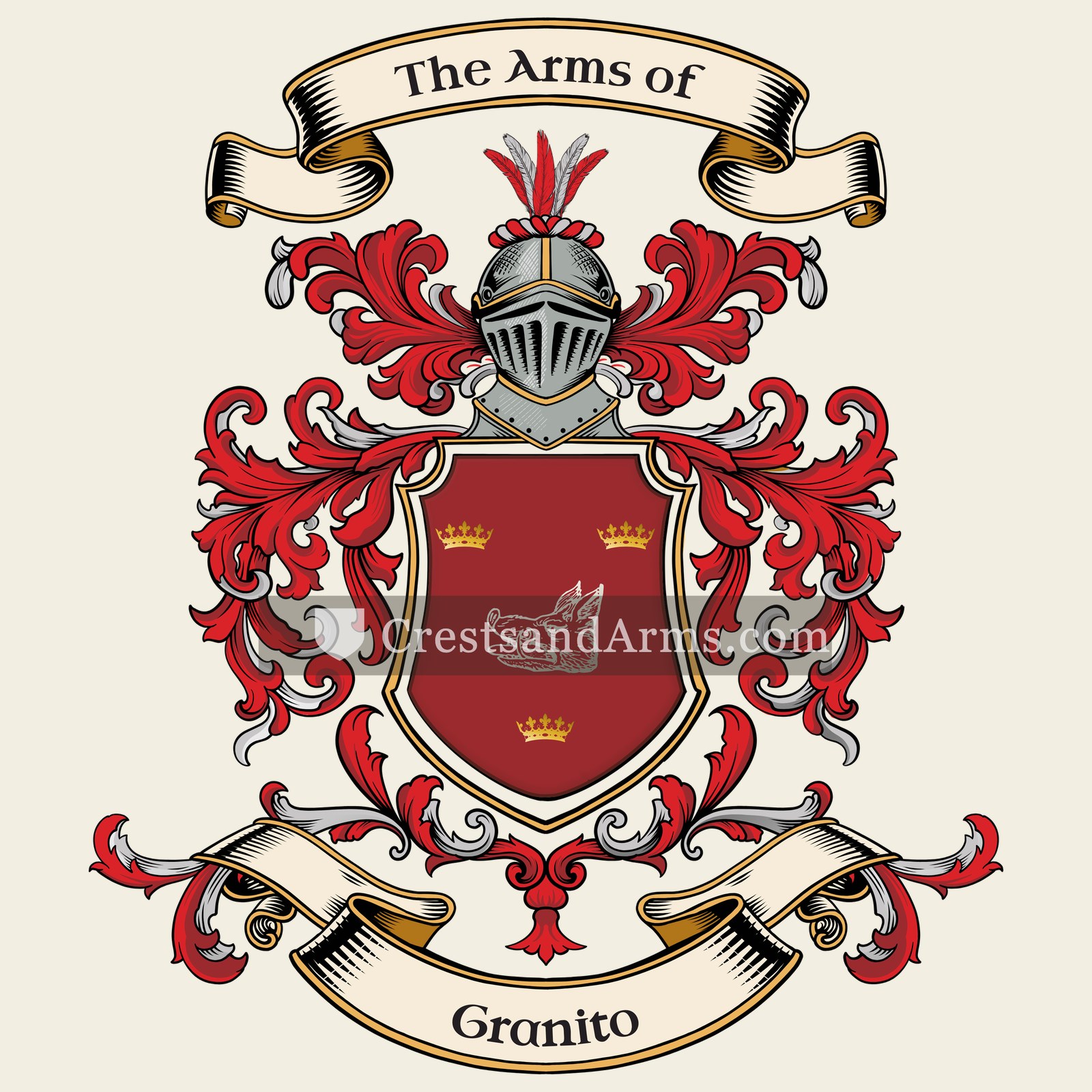
boars headA fierce fighter who battles to the end
crownSovereignty, authority and just reward
Colours
Red (Gules)Means: Military strength
Gold (Or)Means: Generosity
Historical info
Source
Sir Bernard Burke, The General Armory of England, Scotland, Ireland and Wales, London: Harrison & Sons, 1884
Blazon (the actual original written record)
“Gu. a boar's head couped in fesse betw. three eastern crowns or”
DownHillersdown House · Down, c. 1645
Digital archive packCoat of arms PNG, gold border print PDF, vector SVG and the certificate of authenticity. Sent to your email in minutes.
Map of Ireland showing where the Granito arms are recorded
The Granito arms were recorded in Down, c. 1645.
Down was north-eastern Irish country settled from Scotland in the seventeenth century. The new landowners took grants and had them recorded, which is why so many Down families carry documented shields.
This is where the arms were entered in the register. Families often moved to other parts of the country, so the same name can turn up in more than one region.
The body that granted and recorded arms in Ireland in this period.
Charles I of England
Sovereign of the period
Charles I of England
1625–1649
Reigning in France when the Granito arms are first recorded.
How Arms Worked in Ireland
The Ulster King of Arms granted coats of arms to individuals who proved their social standing and good character. These symbols were typically inherited by all legitimate descendants of the original holder. If a family branch wanted a unique look, they could apply for a specific change to their design through the office to ensure their identity remained distinct.
Granting authority
The Ulster King of Arms acted as the official body that regulated and issued all coats of arms throughout Ireland.
How they got arms
Families obtained their arms through formal grants issued by the office after proving their eligibility and paying the required fees.
Where arms were recorded
All official grants were recorded in the registers held by the Ulster King of Arms starting from the year 1552.
The family's standing
Recorded among the armigerous families of Down.
Origin & History of the Granito Family in Ireland
The history of the Granito family in Ireland is rooted in the mid-seventeenth century, with documented evidence placing members of the family in County Down as early as 1645. During this period, Ireland was undergoing significant social and political upheaval, which often led to the movement of families across the Irish Sea. The name Granito is of Mediterranean origin, suggesting that the family likely arrived in Ulster as part of the broader patterns of migration and trade that connected Ireland to continental Europe. By establishing themselves in County Down, these early settlers became part of a diverse local community that was navigating the complex religious and economic shifts of the 1600s. While the name remained relatively rare in the region, the presence of the family in official records from this era highlights their integration into the local administrative and social landscape of the time.
Related Branches & Arms
Root word
granum
Latin term referring to a grain, seed, or small particle.
This name
GranitoDerived from a topographic or occupational name for someone associated with granite stone or grain.
also spelled
Graunt
Graunte
Documented Sources
J. B. Rietstap, Armorial Général, Gouda: G. B. van Goor Zonen, 1884–87
Archives départementales du Morbihan, Registres paroissiaux et d'état civil
Archives départementales du Finistère, Collection de la série E (Familles et seigneuries)
Poisat, Roger, Étude sur les noms de famille en Bretagne, 1982
Digital archive packCoat of arms PNG, gold border print PDF, vector SVG and the certificate of authenticity. Sent to your email in minutes.


 chevronProtection, and faithful service completed
 fessThe military belt, and readiness to serve
 lionCourage, strength and royalty
 crownSovereignty, authority and just reward
 cockCourage, vigilance and readiness for battle
 chevronProtection, and faithful service completed
 fessThe military belt, and readiness to serve
 lionCourage, strength and royalty
 crownSovereignty, authority and just reward
 cockCourage, vigilance and readiness for battle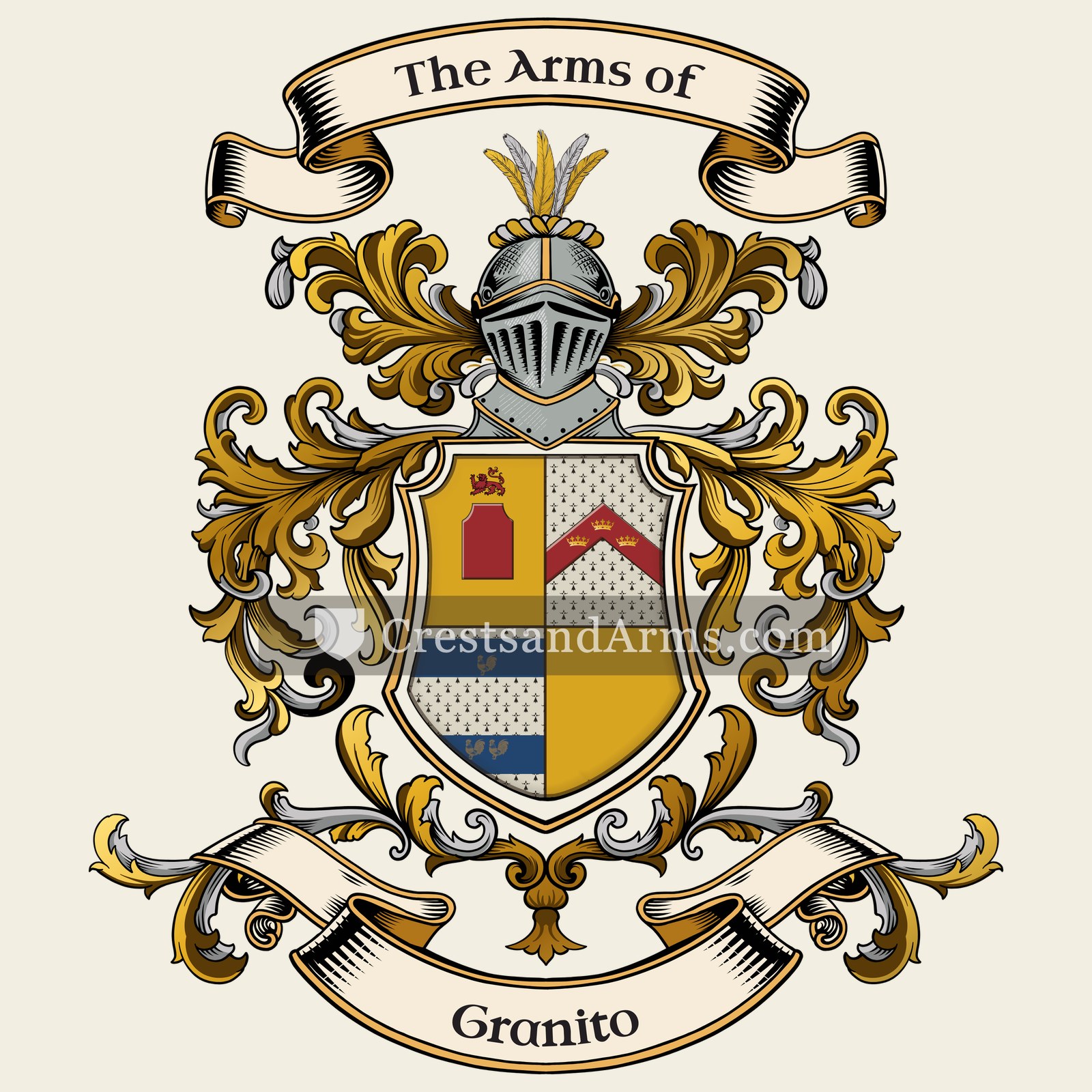


 bordureA difference between branches of one family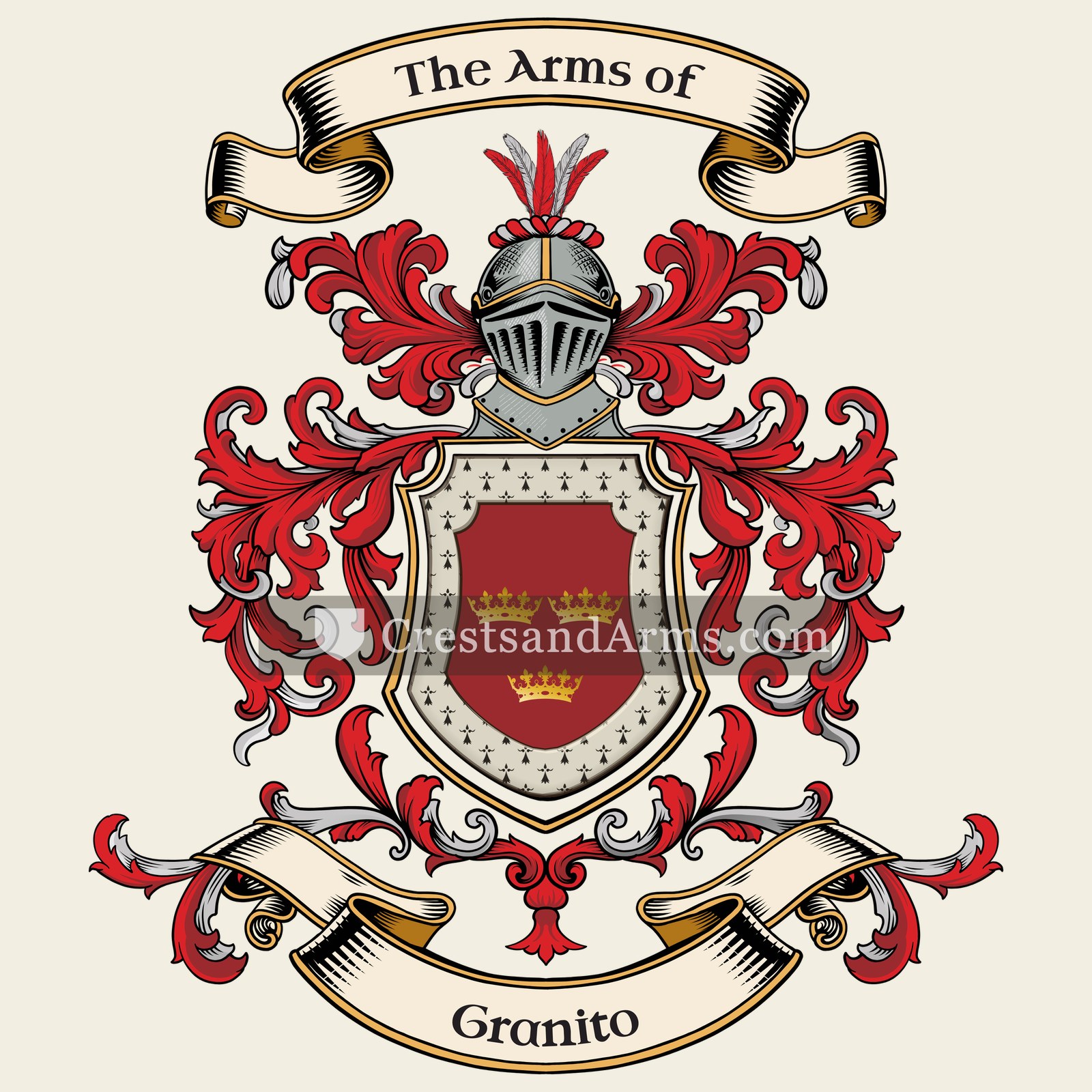


 boars headA fierce fighter who battles to the end