Map of France showing where the Grass arms are recorded
The Grass arms were recorded in Flandre, c. 1663.
Flandre grew rich on cloth, and its towns were among the busiest in Europe. Merchant families bought land with their profits and took arms to go with it, so trade put as many names in the registers here as land did.
This is where the arms were entered in the register. Families often moved to other parts of the country, so the same name can turn up in more than one region.
The body that granted and recorded arms in France in this period.
Louis XIV of France
Sovereign of the period
Louis XIV of France
1643–1715
Reigning in France when the Grass arms are first recorded.
How Arms Worked in France
In France, a coat of arms was a mark of honor that passed down through the male line to all legitimate descendants. Families often used the same shield without changes to show their shared heritage. If a branch wanted to stand out, they could add a small mark to their shield to show their specific place in the family tree.
Granting authority
The Juge d'armes de France acted as the official authority that regulated and verified coats of arms across the country.
How they got arms
Families typically inherited their arms from ancestors, though they could also receive them through royal grants or by proving their noble status.
Where arms were recorded
Coats of arms were officially recorded in the Armorial Général de France, which began its main collection in the year 1696.
The family's standing
Recorded among the armigerous families of Flandre.
Origin & History of the Grass Family in France
The surname Grass has deep roots in the northern regions of France, particularly within the historic territory of Flanders. By the year 1663, records confirm that members of the family were well-established in this area, which was a bustling center for trade and agriculture. The name itself is often linked to the Old French and Germanic linguistic traditions of the region, where it likely served as a descriptive nickname for a person of sturdy build or someone who lived near lush, grassy pastures. During the seventeenth century, families in Flanders often moved between rural farming communities and growing urban centers to work in the textile industry. This mobility helped the family name persist across generations as they adapted to the changing social and economic landscape of northern France. The presence of the family in official registers from this period suggests they were integrated into the local community, contributing to the daily life and labor that defined the Flemish borderlands.
Coat of Arms & Family Crest Details
Symbols on this shield
chequyConstancy, and the counting-board
chiefAuthority, wisdom and dominion
eagleNobility, strength and a keen mind
Colours
Black (Sable)Means: Constancy
Gold (Or)Means: Generosity
Silver (Argent)Means: Peace and sincerity
Historical info
Source
J. B. Rietstap, Armorial Général, Gouda: G. B. van Goor Zonen, 1884–87
Blazon (the actual original written record)
“Echiq. de sa. et d'arg.; au chef d'or, ch. d'une aigle de sa., bq. et m. de gu. Cq. cour. C.: l'aigle iss. L. d'arg. et de sa. [Comp. Grassis.]”
Germanyc. 1657
Digital archive packCoat of arms PNG, gold border print PDF, vector SVG and the certificate of authenticity. Sent to your email in minutes.
Map of Germany showing where the Grass arms are recorded
The Grass arms were recorded in Germany, c. 1657.
Arms such as these were typically recorded in Bavaria.
Bavaria was a country of old landed families and walled market towns. Estates passed down the same line for centuries, and both the landowners and the leading townsmen kept arms, which is why so many Bavarian names sit in the registers.
This is where the arms were entered in the register. Families often moved to other parts of the country, so the same name can turn up in more than one region.
The body that granted and recorded arms in Germany in this period.
Ferdinand III, Holy Roman Emperor
Sovereign of the period
Ferdinand III, Holy Roman Emperor
1637–1657
Reigning in France when the Grass arms are first recorded.
How Arms Worked in Germany
In the Holy Roman Empire, coats of arms were often granted to individuals by the Emperor or his representatives. These arms were then passed down through the generations to all legitimate descendants of the original holder. Younger branches of a family usually kept the same shield design without needing to change it, as the arms belonged to the entire lineage.
Granting authority
The Holy Roman Emperor held the sole power to grant new coats of arms throughout his vast imperial territories.
How they got arms
Families typically obtained their coats of arms through a formal imperial grant or by proving their noble status to the authorities.
Where arms were recorded
These grants were officially recorded in the Imperial Chancery registers, which began keeping formal records of such honors during the Middle Ages.
The family's standing
Recorded among the armigerous families of Germany.
Origin & History of the Grass Family in Germany
The family name Grass originated as a descriptive surname in the German-speaking regions of Europe, likely identifying individuals who lived near grassy meadows or worked as farmers. By the mid-seventeenth century, historical records confirm that members of the Grass family were firmly established in the region of Bavaria. During this era, life in Bavaria was heavily influenced by the aftermath of the Thirty Years' War, which had significantly reshaped the social and economic landscape of the German states. Families like the Grasses were often tied to the land, and their presence in 1657 suggests they were part of the rural population working to rebuild local communities and agricultural systems. As the name spread through the region, it became a common identifier for people living in the lush, green valleys of southern Germany. The history of the name reflects the deep connection between early German families and the geography of their ancestral homes.
Coat of Arms & Family Crest Details
Symbols on this shield
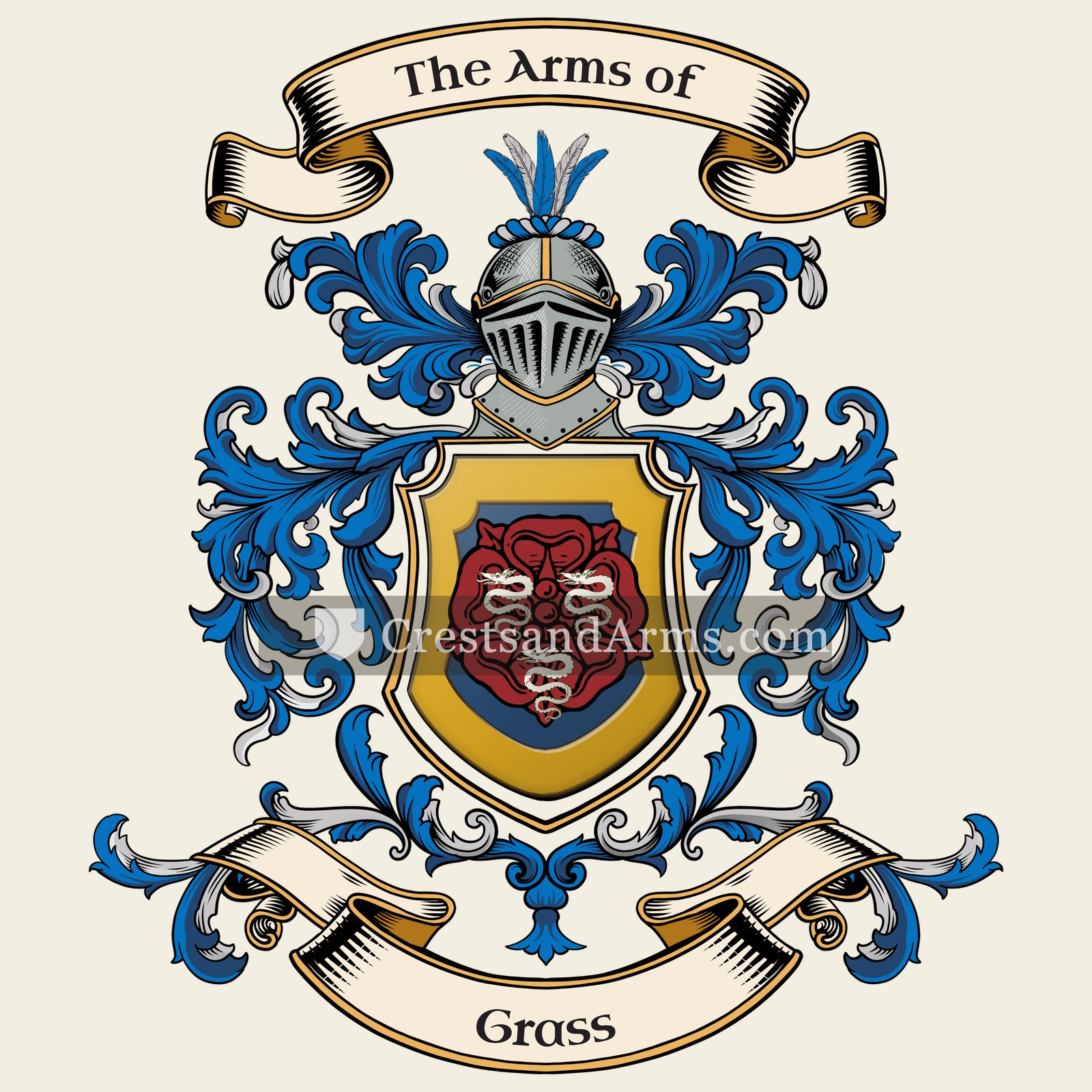
roseThe seventh son, and beauty with grace
serpentWisdom, healing and prudence
Colours
Blue (Azure)Means: Loyalty and truth
Gold (Or)Means: Generosity
Red (Gules)Means: Military strength
Silver (Argent)Means: Peace and sincerity
Historical info
Source
J. B. Rietstap, Armorial Général, Gouda: G. B. van Goor Zonen, 1884–87
Blazon (the actual original written record)
“D'azur à trois serpents ondoyants d'arg., cour. d'or, deux passés en saut., la tête en haut, et le troisième br. en pal, la tête en bas; à une rose de quatre feuilles de gu., br. sur le point d'intersection des serpents; l'écu bordé d'or. C.: trois bâtons d'arg., posés en pals, accolés chacun d'un serpent du même, cour. d'or, celui à dextre ayant la tête tournée à dextre, les deux autres cont.; le tout entre deux prob. d'azur. L. d'or, d'azur et de gu. — (Barons, 1689.) Ec.: aux 1 et 4 d'arg. à une rose naturelle de gu., tigée et feuillée de sin., posée en barre; aux 2 et 3 d'arg. à trois pattes d'ours au nat., les griffes en haut. Sur le tout les armes de famille. Deux cq. cour. C.: 1° le cimier de famille; 2° la rose du 1., posée en pal, entre un vol d'arg.”
LivoniaEsthonie · Livonia, c. 1772
Digital archive packCoat of arms PNG, gold border print PDF, vector SVG and the certificate of authenticity. Sent to your email in minutes.
Map of Poland showing where the Grass arms are recorded
The Grass arms were recorded in Livonia, c. 1772.
Livonia was Baltic country held by a small number of landed families who kept their estates for centuries. Land there passed down whole rather than being divided, and long unbroken tenure is what fills a register.
This is where the arms were entered in the register. Families often moved to other parts of the country, so the same name can turn up in more than one region.
Region
Livonia
Town
Esthonie
First recorded
1772
Granting Authority for the Grass Arms
Ennoblement by the Sejm
Author: Olek Remesz · CC BY-SA 3.0
The body that granted and recorded arms in Poland in this period.
Stanisław August Poniatowski
Sovereign of the period
Stanisław August Poniatowski
1764–1795
Reigning in France when the Grass arms are first recorded.
How Arms Worked in Poland
Polish noble families shared a single coat of arms across many different surnames, creating large clans rather than individual designs. These symbols were held collectively by all members of the clan regardless of their specific family name. When a new family joined the nobility, they were adopted into an existing clan and began using that group's established shield.
Granting authority
The Sejm, which was the Polish parliament, held the power to grant noble status and the right to bear arms.
How they got arms
Families typically received their coat of arms through a formal act of ennoblement granted by the Sejm for distinguished service.
Where arms were recorded
These grants were officially recorded in the Crown Metrica, which served as the central archive for state documents starting in the sixteenth century.
The family's standing
Recorded among the armigerous families of Livonia.
Origin & History of the Grass Family in Poland
The history of the Grass family in the Polish-Lithuanian Commonwealth is deeply tied to the movement of people across the Baltic region during the eighteenth century. By 1772, records confirm that members of the family were established in the territory of Livonia, a region that had long been a crossroads for German, Polish, and Baltic cultures. During this era, families with the name Grass often worked as skilled tradespeople, merchants, or land managers who moved between urban centers and rural estates to support the growing economy of the Polish borderlands. Because the name is rooted in Germanic linguistic origins, it likely arrived in the region through the migration of settlers seeking new opportunities in the fertile lands of the north. These early family members lived through a time of significant political change as the borders of Poland shifted, requiring them to adapt to new administrative systems while maintaining their presence in the Baltic provinces. Their story reflects the broader pattern of families who built stable lives by integrating into the diverse social fabric of the region before the major geopolitical upheavals of the late eighteenth century.
Grass Meaning & Related Branches
Root word
Crassus
Latin term meaning thick, fat, dense, or solid.
This name
GrassA topographic name for someone who lived on or near a grassy area or pasture.
also spelled
Gras
Grasse
Grasses
Related arms
de Grasvariant spelling
Grasvariant spelling
Documented Sources
J. B. Rietstap, Armorial Général, Gouda: G. B. van Goor Zonen, 1884–87
Archives Départementales du Nord, Série B: Cours et juridictions
Denis, Philippe, Histoire de la Flandre, 2002
Dauzat, Albert, Dictionnaire étymologique des noms de famille et prénoms de France, 1951
Digital archive packCoat of arms PNG, gold border print PDF, vector SVG and the certificate of authenticity. Sent to your email in minutes.


 eagleNobility, strength and a keen mind
 eagleNobility, strength and a keen mind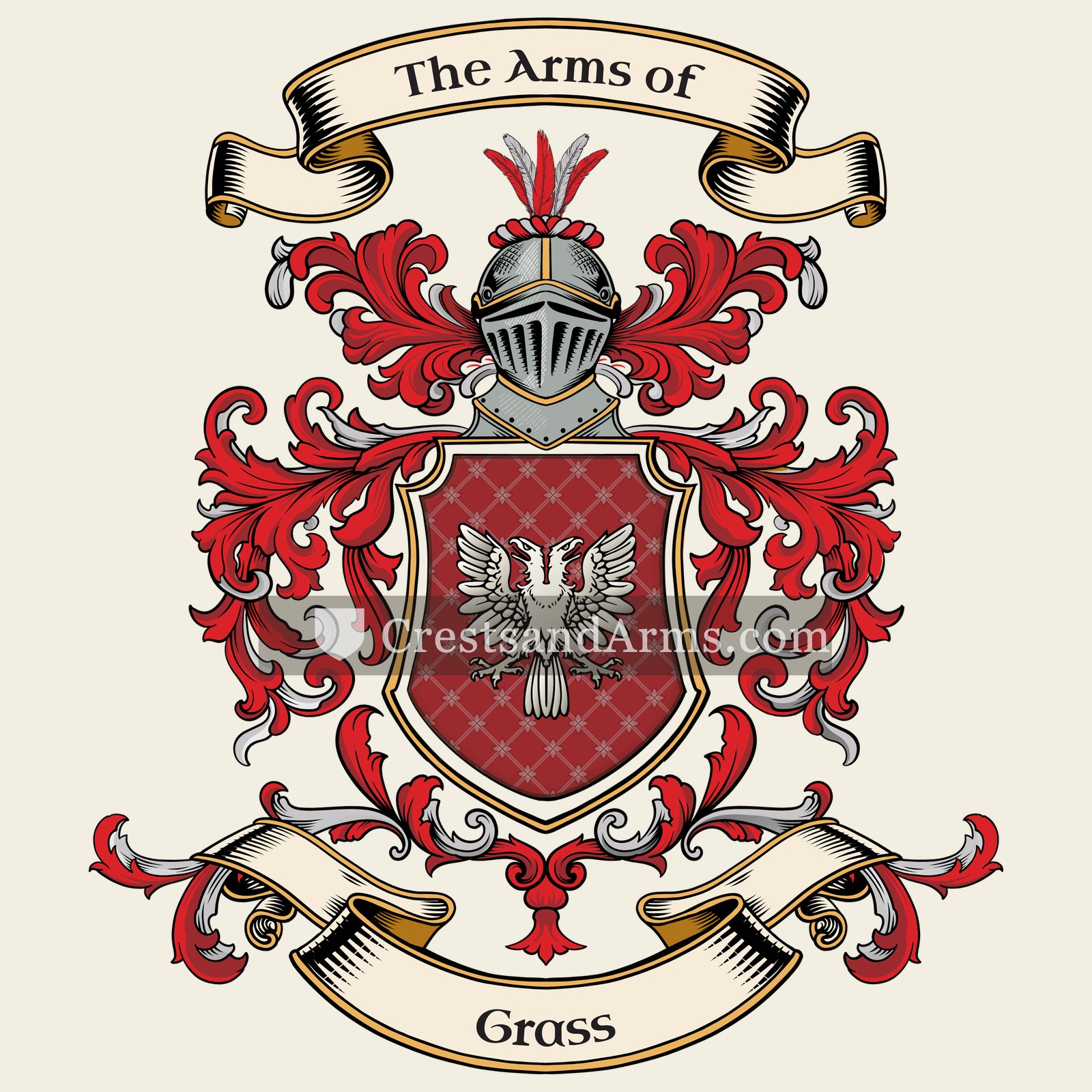


 chequyConstancy, and the counting-board
 chiefAuthority, wisdom and dominion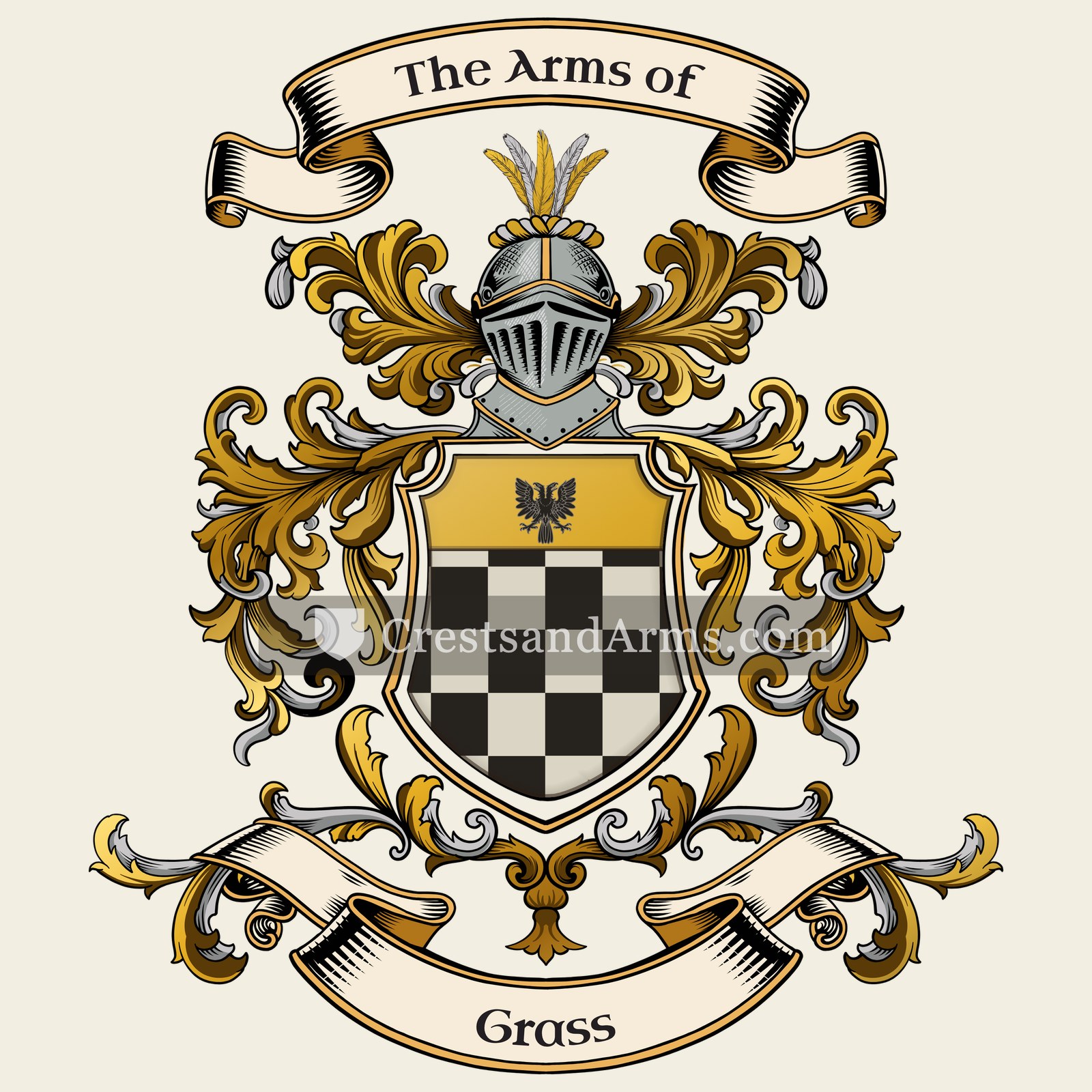


 roseThe seventh son, and beauty with grace
 serpentWisdom, healing and prudence