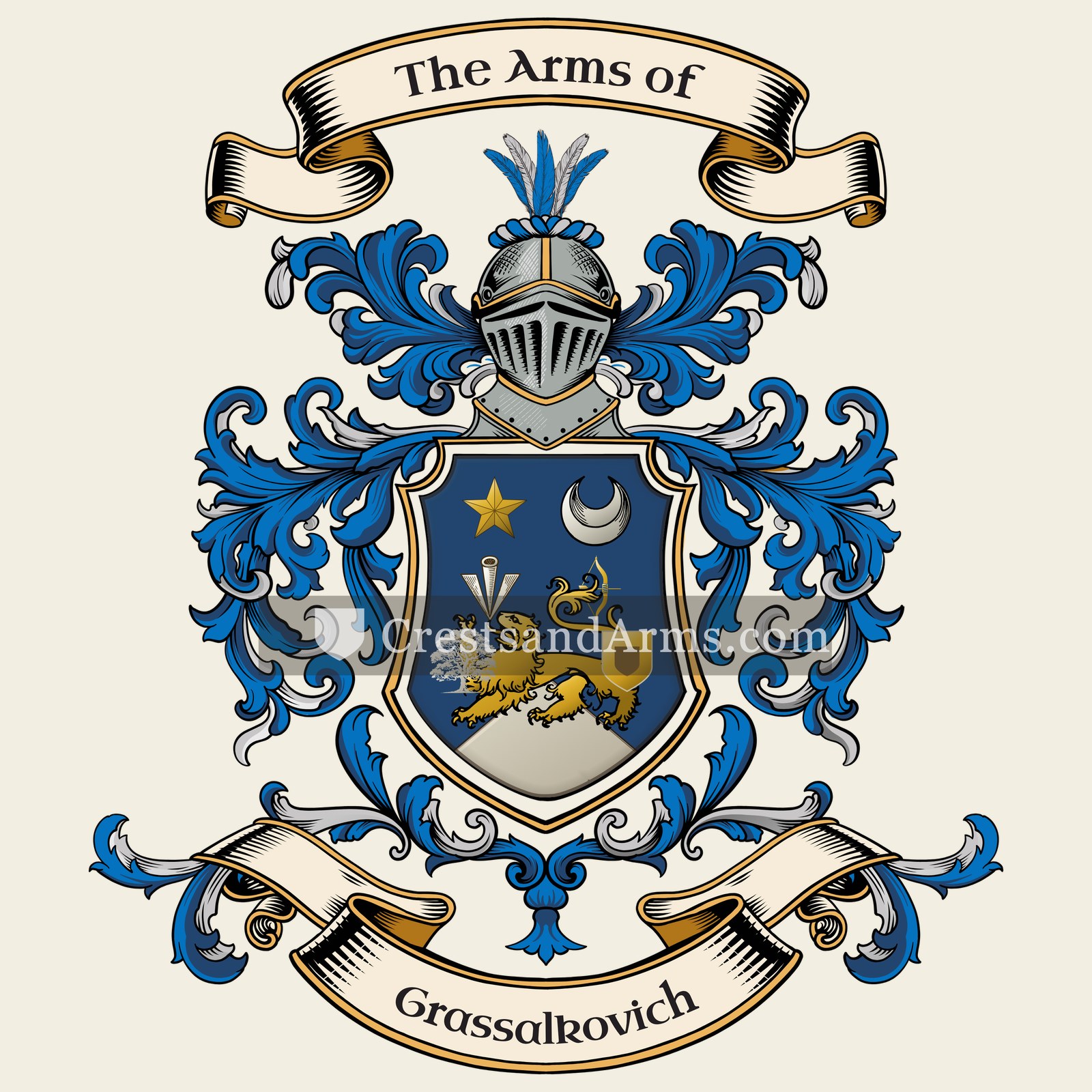
A record of documented arms, meaning and origin, researched for the Grassalkovich family of France.
Reg. 6857 · French, G–I
Coat of Arms & Family Crest Details
Symbols on this shield
arrowReadiness for battle, and affliction endured
bowReadiness, and the strength held in reserve
mulletThe third son, and a divine quality from above
crescentHonour by the sovereign, and the second son
lionCourage, strength and royalty
treeLife, endurance and deep roots
escutcheonA shield within a shield, and a claim inherited
Colours
Blue (Azure)Means: Loyalty and truth
Silver (Argent)Means: Peace and sincerity
Gold (Or)Means: Generosity
Historical info
Source
J. B. Rietstap, Armorial Général, Gouda: G. B. van Goor Zonen, 1884–87
Blazon (the actual original written record)
“d'azur à une flèche d'arg., en pal, encochée sur un arc en fasce d'or et accostée en chef d'une étoile d'or et d'un croiss. figuré et tourné d'arg.; au 4 de gu. à une panthère ramp. d'or, tenant de sa patte dextre un sabre d'arg., garni d'or. Enté en p. d'arg. à un rosier au nat., posé sur une terrasse de sin. et fleuri de trois pièces de gu. Sur le tout d'or aux lettres M. T. de gu. Cinq cq. cour., le 3 timbré d'une couronne princière. C.: 1° un lion iss. et cont. de gu.; 2° et 4° un Hongrois iss., hab. et coiffé d'azur, ceint d'or, tenant un sabre d'arg., garni d'or; le Hongrois du 2 cont.; 3° une aigle ép. de sa., bq., m. et chaque tête cour. d'or; 5° la panthère iss., moins le sabre. L.: des deux premiers cq., d'arg. et de gu.; du 3, d'or et de gu.; du 4, d'arg. et d'azur; du 5, d'or et d'azur. S.: deux lions reg. d'or. Manteau de gu., frangé d'or, doublé d'herm., sommé de la couronne princière.”
Francec. 1725
Digital archive packCoat of arms PNG, gold border print PDF, vector SVG and the certificate of authenticity. Sent to your email in minutes.
Map of France showing where the Grassalkovich arms are recorded
The Grassalkovich arms were recorded in France, c. 1725.
Arms such as these were typically recorded in Bretagne.
More families held coats of arms in Bretagne than anywhere else in France. The land was divided into many small estates rather than a few large ones, so far more households counted as gentry, and each needed a shield of its own to be told apart.
This is where the arms were entered in the register. Families often moved to other parts of the country, so the same name can turn up in more than one region.
The body that granted and recorded arms in France in this period.
Louis XV of France
Sovereign of the period
Louis XV of France
1715–1774
Reigning in France when the Grassalkovich arms are first recorded.
How Arms Worked in France
In France, a coat of arms was a mark of honor that passed down through the male line to all legitimate descendants. Families often used the same shield without changes to show their shared heritage. If a branch wanted to stand out, they could add a small mark to their shield to show their specific place in the family tree.
Granting authority
The Juge d'armes de France acted as the official authority that regulated and verified coats of arms across the country.
How they got arms
Families typically inherited their arms from ancestors, though they could also receive them through royal grants or by proving their noble status.
Where arms were recorded
Coats of arms were officially recorded in the Armorial Général de France, which began its main collection in the year 1696.
The family's standing
Recorded among the armigerous families of France.
Origin & History of the Grassalkovich Family in France
The Grassalkovich family name is most famously associated with the high nobility of the Kingdom of Hungary, yet historical records confirm that members of the family were present in the Brittany region of France as early as 1725. While the family rose to significant political prominence in Central Europe through their service to the Habsburg monarchy, their presence in western France suggests a history of movement and connection across European borders during the eighteenth century. This period was marked by shifting alliances and the migration of families seeking administrative or military roles in foreign courts. By maintaining a presence in both the eastern and western reaches of the continent, the family participated in the complex social networks that defined the era. These early records from Brittany provide a unique glimpse into the family’s mobility and their integration into different cultural landscapes long before they became a household name in the Hungarian aristocracy.
Grassalkovich Meaning & Related Branches
Root word
Grass
A common Germanic term referring to green vegetation or pasture land.
This name
GrassalkovichA topographic or occupational surname likely denoting someone who lived near or worked with grassy fields.
also spelled
Grassalkovich
Grassalkovits
Grasalkovics
Documented Sources
J. B. Rietstap, Armorial Général, Gouda: G. B. van Goor Zonen, 1884–87
Archives départementales d'Ille-et-Vilaine, Série B: Cours et juridictions
Archives nationales de France, Série E: Familles
Kovács, Tibor, A Grassalkovich család története (1987)
Le Moyne de La Borderie, Arthur, Histoire de Bretagne (1905)
Pálffy, Géza, A Grassalkovichok: Egy magyar arisztokrata család felemelkedése (2012)
Digital archive packCoat of arms PNG, gold border print PDF, vector SVG and the certificate of authenticity. Sent to your email in minutes.


 arrowReadiness for battle, and affliction endured
 bowReadiness, and the strength held in reserve
 mulletThe third son, and a divine quality from above
 crescentHonour by the sovereign, and the second son
 lionCourage, strength and royalty
 treeLife, endurance and deep roots
 escutcheonA shield within a shield, and a claim inherited