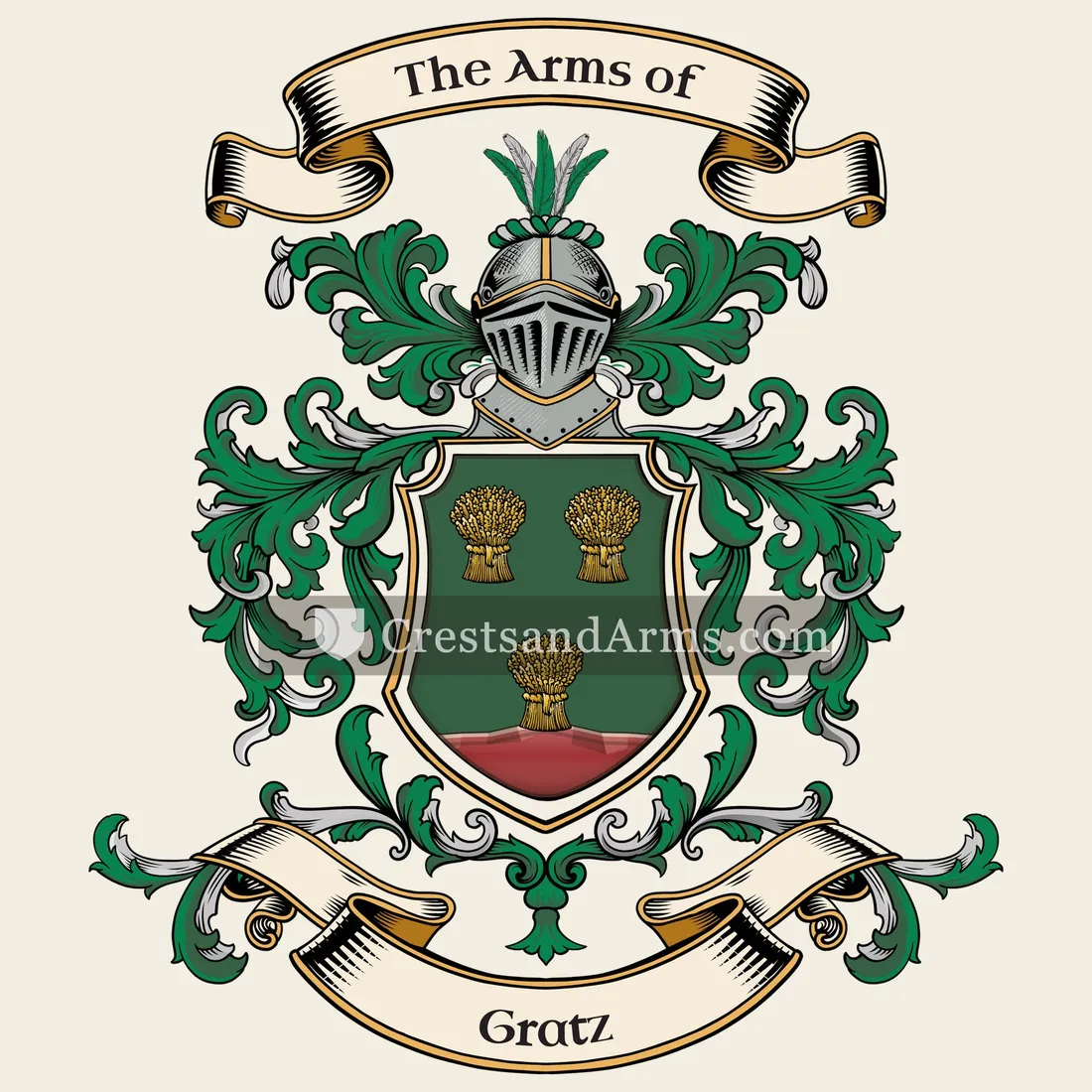
A record of documented arms, meaning and origin, researched for the Gratz family of Switzerland.
Reg. 8497 · Swiss, G–I
Meaning of the Gratz family crest colors & symbols
Symbols on this shield
mountThe ground held, and steadfastness upon it
wheatsheafPlenty, and the harvest of one's own labour
Colours
Green (Vert)Means: Hope
Red (Gules)Means: Military strength
Gold (Or)Means: Generosity
Historical info
Source
J. B. Rietstap, Armorial Général, Gouda: G. B. van Goor Zonen, 1884–87
Blazon (the actual original written record)
“De sin. à trois épis feuillés d'or, posés sur les trois coupeaux d'un tertre de gu. C.: un épi feuillé d'or, posé sur un tertre de trois coupeaux de gu. L. d'or et de sin.”
SwitzerlandSoleure, c. 1745
Digital archive packCoat of arms PNG, gold border print PDF, vector SVG and the certificate of authenticity. Sent to your email in minutes.
Map of Switzerland showing where the Gratz arms are recorded
The Gratz arms were recorded in Soleure, c. 1745.
This is where the arms were entered in the register. Families often moved to other parts of the country, so the same name can turn up in more than one region.
The body that granted and recorded arms in Switzerland in this period.
How Arms Worked in Switzerland
In Switzerland, coats of arms were not restricted to the nobility and were often adopted by common citizens and families. These symbols were passed down through generations to show family identity. When branches of a family grew, they often changed small details of the design to distinguish their own line from the original group.
Granting authority
Cantonal and civic authorities managed the use of coats of arms within their specific regions and local jurisdictions.
How they got arms
Families typically assumed their own coats of arms based on local custom rather than receiving them from a central monarch.
Where arms were recorded
Arms were recorded in various cantonal and civic registers starting from the fourteenth century throughout the Swiss region.
The family's standing
Recorded among the armigerous families of Switzerland.
Origin & History of the Gratz Family in Switzerland
The family name Gratz originates from the German-speaking regions of Central Europe and is often linked to the city of Graz in modern-day Austria. Historically, the name functioned as a topographic surname, which meant it was given to individuals who lived in or near a specific town or location. By the mid-eighteenth century, members of the Gratz family had established a notable presence in the Swiss city of Soleure, also known as Solothurn. During this era, Soleure served as a significant political and cultural hub where families often integrated into the local guild systems or civic administration. The movement of the family to this region suggests they were part of the broader migration patterns that defined European life before the industrial age. These early ancestors likely contributed to the local economy and social fabric of the city as they settled into their new community during the 1740s.
Gratz Meaning & Related Branches
Root word
Grad
Old Slavic term for a fortified settlement or castle.
This name
GratzA topographic name for someone who lived near a castle or town.
also spelled
Grytz
Grits
Documented Sources
J. B. Rietstap, Armorial Général, Gouda: G. B. van Goor Zonen, 1884–87
Bahlow, Hans, Deutsches Namenlexikon: Familien- und Vornamen nach Ursprung und Sinn erklärt, 1967
Staatsarchiv des Kantons Solothurn, Bürgerrodel der Stadt Solothurn, 1745
Zoder, Rudolf, Familiennamen in Ostfalen, 1968
Digital archive packCoat of arms PNG, gold border print PDF, vector SVG and the certificate of authenticity. Sent to your email in minutes.


 mountThe ground held, and steadfastness upon it
 wheatsheafPlenty, and the harvest of one's own labour
 mountThe ground held, and steadfastness upon it
 wheatsheafPlenty, and the harvest of one's own labour