Map of Spain showing where the Graus arms are recorded
The Graus arms were recorded in Catalonia, c. 1722.
Catalonia lived by sea trade, and its merchant houses were as powerful as its landowners. Both sorts of family took arms, and Barcelona kept records of the houses entitled to bear them.
This is where the arms were entered in the register. Families often moved to other parts of the country, so the same name can turn up in more than one region.
The body that granted and recorded arms in Spain in this period.
Philip V of Spain
Sovereign of the period
Philip V of Spain
1714–1724
Reigning in Spain when the Graus arms are first recorded.
How Arms Worked in Spain
In Spain, a coat of arms was considered a form of property that belonged to the entire family line. These arms were passed down from a father to all his children equally. Younger branches of the family usually kept the original design without needing to add any special marks to distinguish their specific line.
Granting authority
The Cronista Rey de Armas was the official body that regulated and granted coats of arms throughout Spain.
How they got arms
Families often obtained their arms through royal grants or by proving their noble status to the official heraldic authority.
Where arms were recorded
Coats of arms were officially recorded in the registers of the Cronista Rey de Armas starting in 1496.
The family's standing
Recorded among the armigerous families of Catalonia.
Origin & History of the Graus Family in Spain
The family name Graus originates from the rugged landscape of the Pyrenees mountains in northeastern Spain. Etymologists believe the name is derived from the Catalan word for gray, which likely served as a descriptive nickname for an ancestor with gray hair or someone who lived near gray-colored rock formations. By the early 18th century, the family was well-established in the Catalonia region, where they were deeply integrated into the local agrarian society. Records from 1722 confirm that members of the Graus family were active participants in the social and economic life of their community during this period. As the family grew, they maintained strong ties to the land and the unique cultural traditions of the Catalan people. Their history reflects the broader movement of families who transitioned from small mountain settlements to the expanding towns and villages of the Spanish Mediterranean coast.
Graus Meaning & Related Branches
Root word
Gradus
Latin term meaning a step, degree, or a flight of stairs.
This name
GrausRefers to a person who lived near a steep path or stairs.
also spelled
Graux
Graue
Graus
Grow
Documented Sources
J. B. Rietstap, Armorial Général, Gouda: G. B. van Goor Zonen, 1884–87
Alcover, Antoni Maria and Moll, Francesc de Borja. Diccionari català-valencià-balear. 1962
Moll, Francesc de Borja. Els llinatges catalans. 1959
Arxiu de la Corona d'Aragó, Registres de la Reial Audiència
Digital archive packCoat of arms PNG, gold border print PDF, vector SVG and the certificate of authenticity. Sent to your email in minutes.


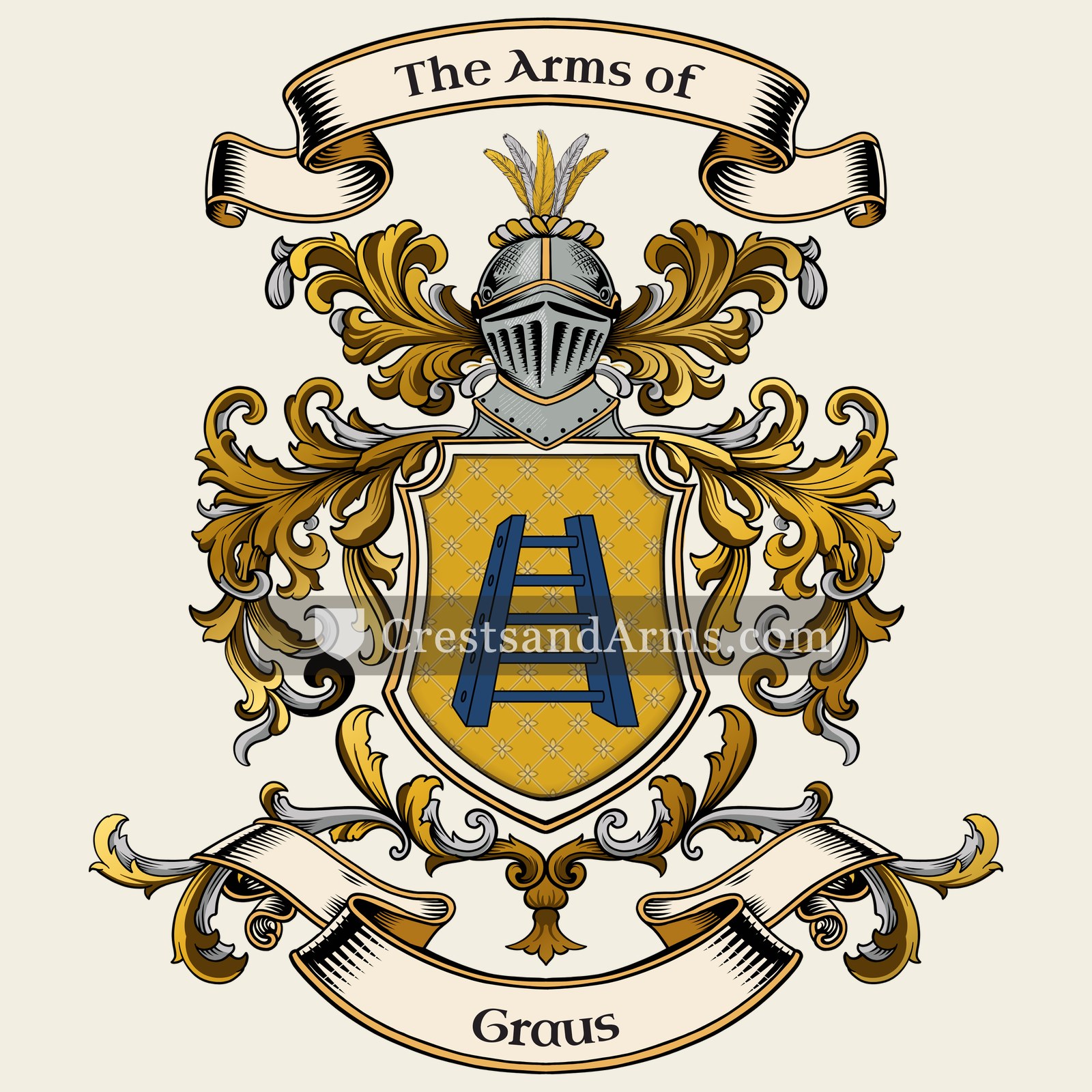
 ladderAmbition, and a fearless assault
 ladderAmbition, and a fearless assault