Map of Switzerland showing where the Grazier arms are recorded
The Grazier arms were recorded in Switzerland, c. 1745.
Arms such as these were typically recorded in Bern.
Bern was the largest of the Swiss cantons and ran itself, with its own council and its own courts. Its governing families held office for generations, and office of that kind carried a shield with it.
This is where the arms were entered in the register. Families often moved to other parts of the country, so the same name can turn up in more than one region.
The body that granted and recorded arms in Switzerland in this period.
How Arms Worked in Switzerland
In Switzerland, coats of arms were not restricted to the nobility and were often adopted by common citizens and families. These symbols were passed down through generations to show family identity. When branches of a family grew, they often changed small details of the design to distinguish their own line from the original group.
Granting authority
Cantonal and civic authorities managed the use of coats of arms within their specific regions and local jurisdictions.
How they got arms
Families typically assumed their own coats of arms based on local custom rather than receiving them from a central monarch.
Where arms were recorded
Arms were recorded in various cantonal and civic registers starting from the fourteenth century throughout the Swiss region.
The family's standing
Recorded among the armigerous families of Switzerland.
Origin & History of the Grazier Family in Switzerland
The surname Grazier is an occupational name that historically identified individuals who worked with livestock. In the German-speaking regions of Europe, such as the canton of Bern, Switzerland, this name was often linked to families who managed grazing lands or traded in cattle. By 1745, records confirm that members of the Grazier family were well-established residents of Bern. During this era, families in the region were deeply connected to the local agricultural economy, which relied heavily on the seasonal movement of herds between mountain pastures and valley farms. This lifestyle required a specialized knowledge of land management and animal husbandry, traits that likely defined the family’s social and economic standing within their community. As the family grew, they became part of the long tradition of Swiss pastoral life that shaped the culture of the Bernese highlands for generations.
Grazier Meaning & Related Branches
Root word
graser
derived from the Middle High German word for grass or pasture
This name
Grazieran occupational surname for someone who worked as a herdsman or grazed livestock on pastureland
also spelled
Graizier
Grazier
Documented Sources
J. B. Rietstap, Armorial Général, Gouda: G. B. van Goor Zonen, 1884–87
Historisches Lexikon der Schweiz, Historisches Lexikon der Schweiz, 2002
Staatsarchiv des Kantons Bern, Kirchenbücher der Stadt Bern, 1745
Digital archive packCoat of arms PNG, gold border print PDF, vector SVG and the certificate of authenticity. Sent to your email in minutes.


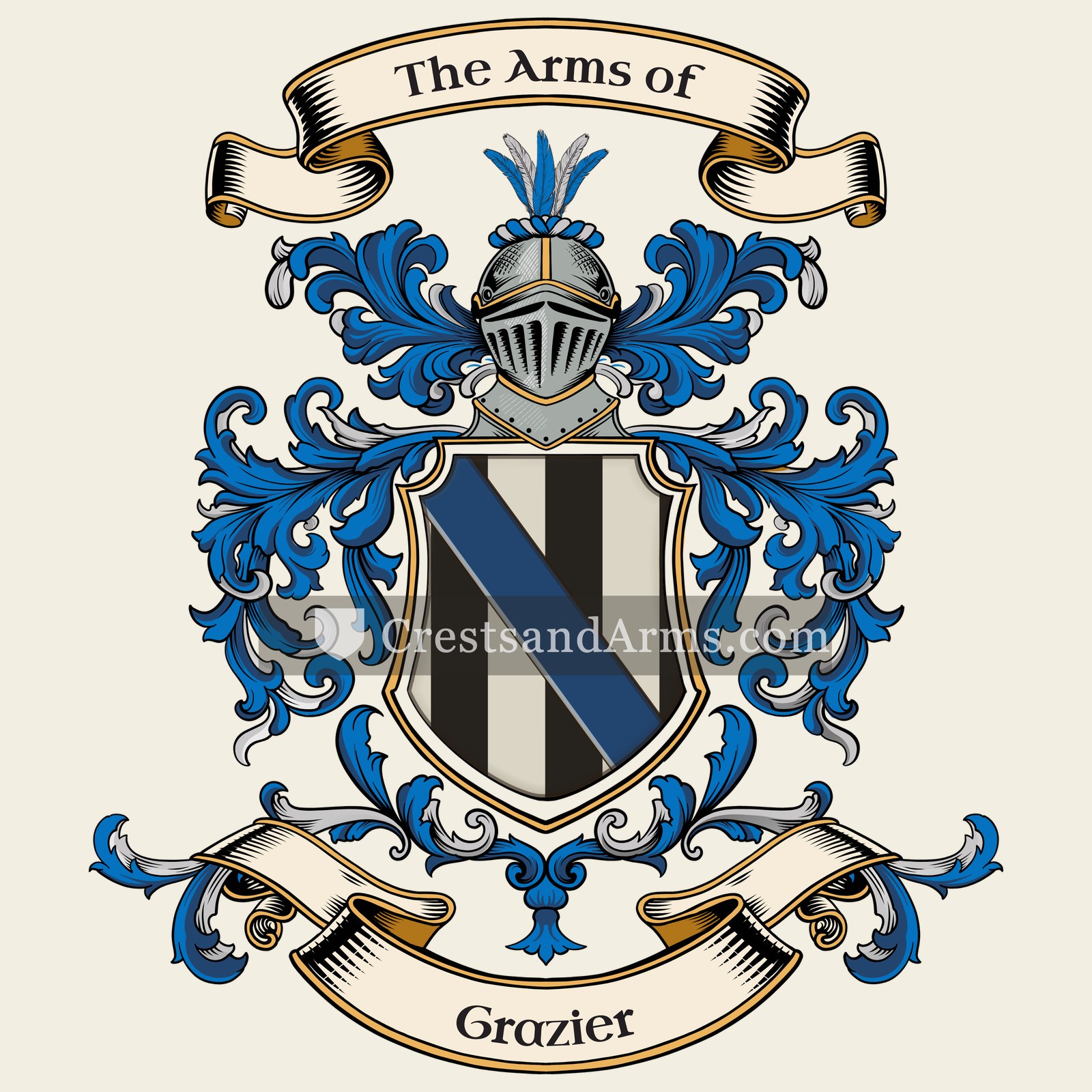
 paleMilitary strength, and a fortified defence
 bendDefence, and the scarf of a commander
 paleMilitary strength, and a fortified defence
 bendDefence, and the scarf of a commander