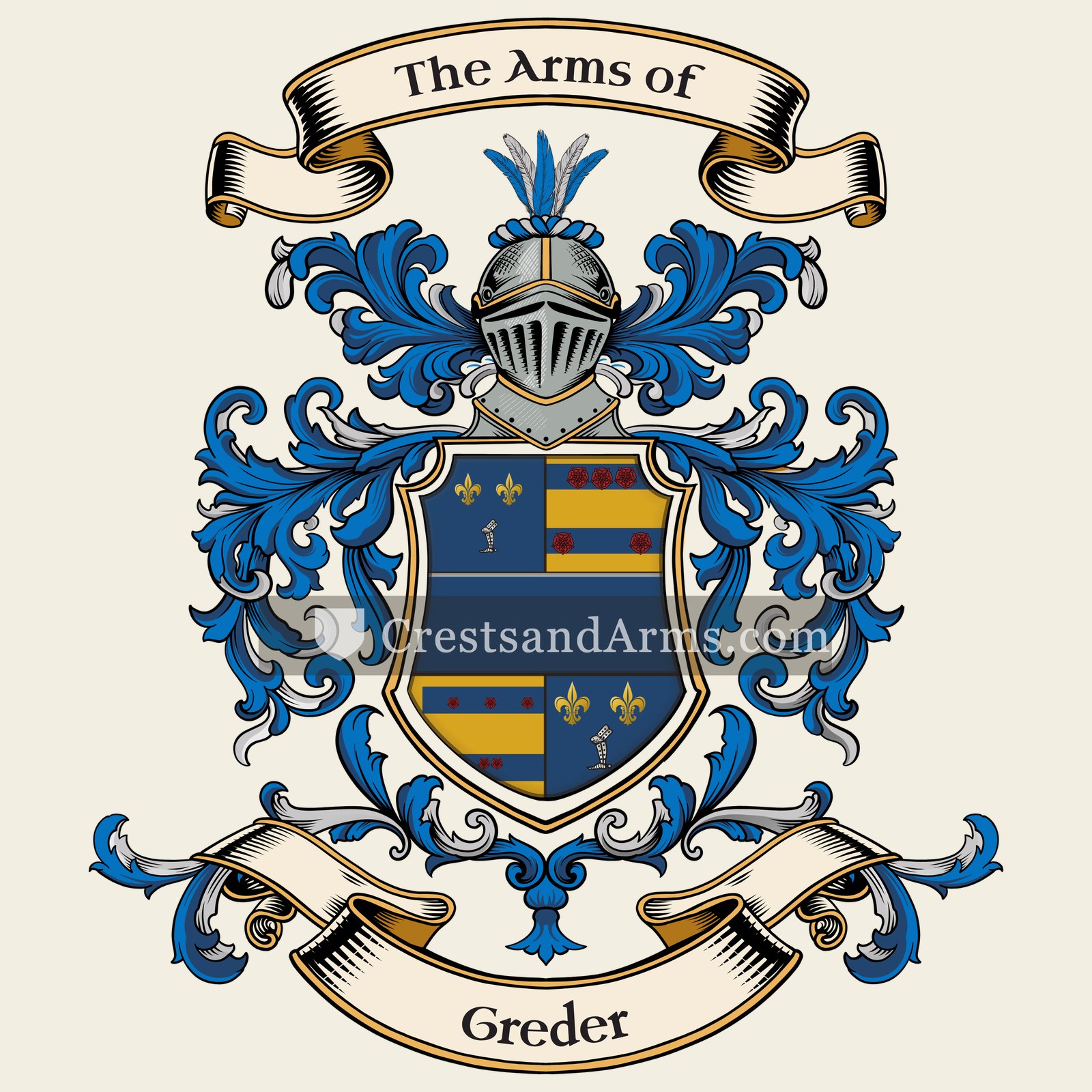
A record of documented arms, meaning and origin, researched for the Greder family of Switzerland.
Reg. 2403 · Swiss, G–I
Coat of Arms & Family Crest Details
Symbols on this shield
fessThe military belt, and readiness to serve
legStrength and swiftness
fleur de lisPurity, light, and the sixth son
roseThe seventh son, and beauty with grace
Colours
Blue (Azure)Means: Loyalty and truth
Gold (Or)Means: Generosity
Silver (Argent)Means: Peace and sincerity
Red (Gules)Means: Military strength
Historical info
Source
J. B. Rietstap, Armorial Général, Gouda: G. B. van Goor Zonen, 1884–87
Blazon (the actual original written record)
“Ec.: aux 1 et 4 d'azur à un membre d'aigle d'arg., coupé à la cuisse de gu., le genou à dextre, la serre en bas, la patte accostée de deux fleurs-de-lis d'or; aux 2 et 3 d'or à la fasce d'azur, acc. de cinq roses de gu., 3 rangées en chef et 2 rangées en p. Brl. d'azur et d'or. C.: un cygne iss. d'arg., le vol levé. L.: à dextre d'arg. et d'azur, à sen. d'or et d'azur.”
SwitzerlandNeufchâtel, c. 1745
Digital archive packCoat of arms PNG, gold border print PDF, vector SVG and the certificate of authenticity. Sent to your email in minutes.
Map of Switzerland showing where the Greder arms are recorded
The Greder arms were recorded in Neufchâtel, c. 1745.
This is where the arms were entered in the register. Families often moved to other parts of the country, so the same name can turn up in more than one region.
The body that granted and recorded arms in Switzerland in this period.
How Arms Worked in Switzerland
In Switzerland, coats of arms were not restricted to the nobility and were often adopted by common citizens and families. These symbols were passed down through generations to show family identity. When branches of a family grew, they often changed small details of the design to distinguish their own line from the original group.
Granting authority
Cantonal and civic authorities managed the use of coats of arms within their specific regions and local jurisdictions.
How they got arms
Families typically assumed their own coats of arms based on local custom rather than receiving them from a central monarch.
Where arms were recorded
Arms were recorded in various cantonal and civic registers starting from the fourteenth century throughout the Swiss region.
The family's standing
Recorded among the armigerous families of Switzerland.
Origin & History of the Greder Family in Switzerland
The Greder family name has deep roots in the Swiss region of Neuchâtel, where members of the family were firmly established by the year 1745. The name is believed to have originated as a descriptive term, likely referring to a person who lived on or worked with gravelly soil, as the root word relates to grit or coarse sand. During the eighteenth century, families in this area were often tied to the land or specific trades that supported the growing local economy. By the mid-1700s, the Greders were integrated into the social and civic life of the region, participating in the local customs and administrative systems of the Swiss cantons. Their presence in historical records from this era suggests they were part of a stable community that valued record-keeping and family lineage. Over time, the family name became a permanent fixture in the local history of Neuchâtel, reflecting the broader patterns of settlement and identity in the Jura mountain region.
Greder Meaning & Related Branches
Root word
Grad
Old High German term referring to a degree, step, or boundary.
This name
GrederAn occupational surname for someone who lived near a boundary or a stepped terrain.
also spelled
Gredder
Documented Sources
J. B. Rietstap, Armorial Général, Gouda: G. B. van Goor Zonen, 1884–87
Archives: Archives de l'État de Neuchâtel, Registres paroissiaux de Neuchâtel
Book: Montandon, Charles, Histoire de l'ancien comté de Neuchâtel, 1850
Digital archive packCoat of arms PNG, gold border print PDF, vector SVG and the certificate of authenticity. Sent to your email in minutes.


 fessThe military belt, and readiness to serve
 legStrength and swiftness
 fleur de lisPurity, light, and the sixth son
 roseThe seventh son, and beauty with grace
 fessThe military belt, and readiness to serve
 legStrength and swiftness
 fleur de lisPurity, light, and the sixth son
 roseThe seventh son, and beauty with grace