Map of Germany showing where the Green arms are recorded
The Green arms were recorded in Germany, c. 1696.
Arms such as these were typically recorded in Bavaria.
Bavaria was a country of old landed families and walled market towns. Estates passed down the same line for centuries, and both the landowners and the leading townsmen kept arms, which is why so many Bavarian names sit in the registers.
This is where the arms were entered in the register. Families often moved to other parts of the country, so the same name can turn up in more than one region.
The body that granted and recorded arms in Germany in this period.
Leopold I, Holy Roman Emperor
Sovereign of the period
Leopold I, Holy Roman Emperor
1658–1705
Reigning in Germany when the Green arms are first recorded.
How Arms Worked in Germany
In the Holy Roman Empire, coats of arms were often granted to individuals by the Emperor or his representatives. These arms were then passed down through the generations to all legitimate descendants of the original holder. Younger branches of a family usually kept the same shield design without needing to change it, as the arms belonged to the entire lineage.
Granting authority
The Holy Roman Emperor held the sole power to grant new coats of arms throughout his vast imperial territories.
How they got arms
Families typically obtained their coats of arms through a formal imperial grant or by proving their noble status to the authorities.
Where arms were recorded
These grants were officially recorded in the Imperial Chancery registers, which began keeping formal records of such honors during the Middle Ages.
The family's standing
Recorded among the armigerous families of Germany.
Origin & History of the Green Family in Germany
The family name Green, often appearing in German records as Grün, traces its roots to the descriptive naming traditions common in the Holy Roman Empire. In the late 17th century, the name was frequently used as a topographic surname to identify individuals who lived near a village green or a lush, grassy area. By 1696, records confirm that members of the family were established in the region of Bavaria. During this period, Bavaria was recovering from the devastation of the Thirty Years' War, and families often moved within the region to find fertile land or new opportunities in local trade. Because the name was tied to the landscape, it was likely adopted by families living in rural farming communities where the color of the local fields served as a natural landmark. As these families settled into their communities, the name became a permanent marker of their geographic identity and their connection to the Bavarian countryside.
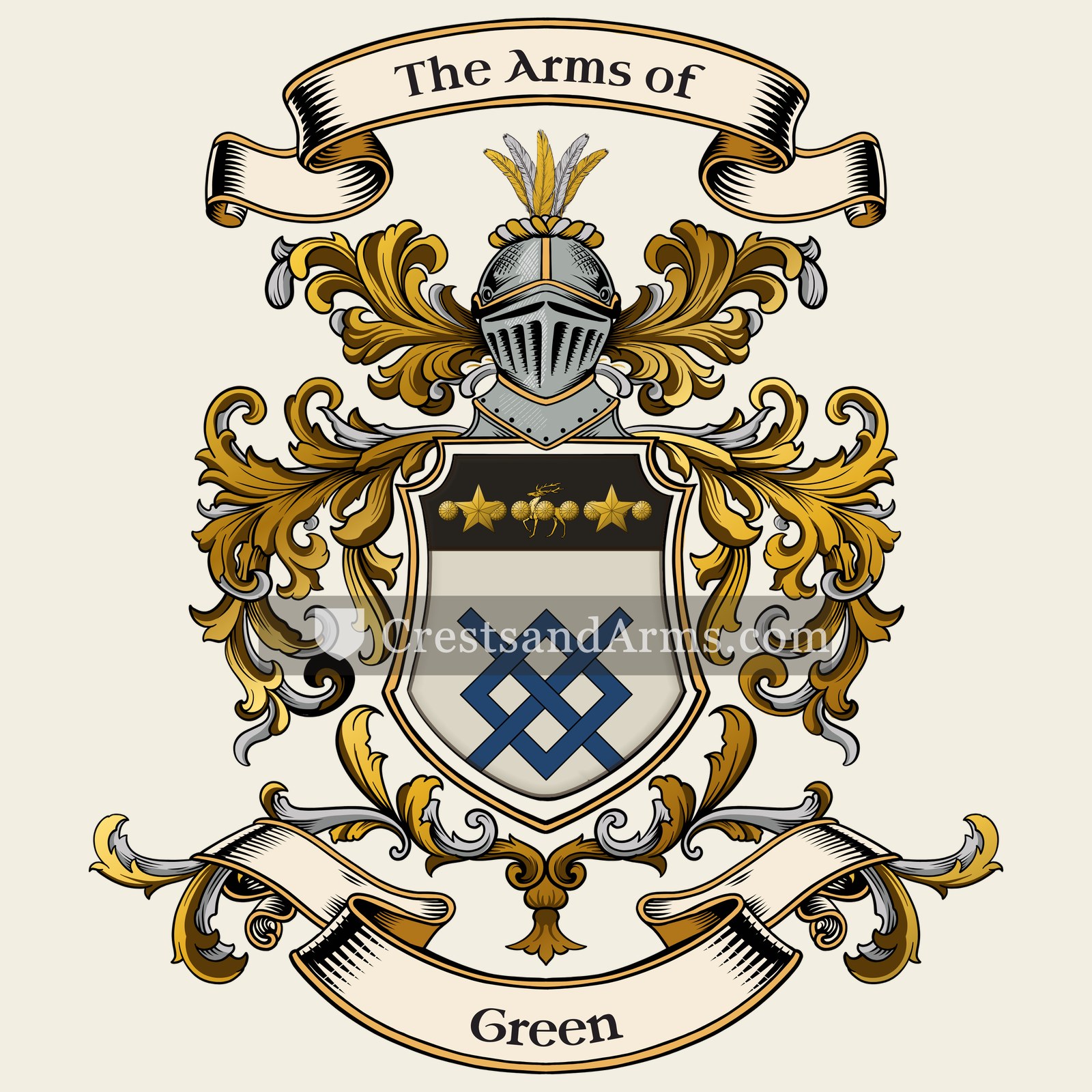
Coat of Arms & Family Crest Details
Symbols on this shield
stagPeace and harmony, and one who will not fight unprovoked
Colours
Silver (Argent)Means: Peace and sincerity
Red (Gules)Means: Military strength
Historical info
Source
J. B. Rietstap, Armorial Général, Gouda: G. B. van Goor Zonen, 1884–87
Blazon (the actual original written record)
“D'arg. à un cerf élancé de gu. C.: le cerf, iss.”
Denmarkc. 1722
Digital archive packCoat of arms PNG, gold border print PDF, vector SVG and the certificate of authenticity. Sent to your email in minutes.
Map of Denmark showing where the Green arms are recorded
The Green arms were recorded in Denmark, c. 1722.
Arms such as these were typically recorded in Sjaælland.
Zealand held the Danish court, the crown's offices and Copenhagen itself. Families who served the king kept estates within reach of it, and royal service was the ordinary route to a coat of arms.
This is where the arms were entered in the register. Families often moved to other parts of the country, so the same name can turn up in more than one region.
The body that granted and recorded arms in Denmark in this period.
Frederik IV of Denmark
Sovereign of the period
Frederik IV of Denmark
1699–1730
Reigning in Germany when the Green arms are first recorded.
How Arms Worked in Denmark
Danish heraldry during this period was closely tied to noble status and royal favor rather than being open to all citizens. Arms were typically granted by the monarch to individuals, and these symbols were then shared by all members of the noble house. If a family line died out, the right to use those specific arms ended with them.
Granting authority
The Danish royal chancery held the power to issue and regulate official coats of arms for the kingdom.
How they got arms
Families usually received their arms through a formal royal grant that confirmed their noble status and rights.
Where arms were recorded
These grants were officially recorded in the Danish Royal Chancery records starting in the sixteenth century.
The family's standing
Recorded among the armigerous families of Denmark.
Origin & History of the Green Family in Denmark
The family name Green has deep roots in the Danish landscape, with documented evidence placing members of the family on the island of Sjælland as early as 1722. During this period, the name likely functioned as a descriptive identifier, often used to distinguish individuals based on their physical surroundings or their connection to the lush, green pastures common in the Danish countryside. Life for the family in the early 18th century was defined by the rigid social structures of the Danish monarchy, where most people lived in small rural communities and relied on agriculture for their survival. As the family established their presence on Sjælland, they became part of the local fabric of parish life, which was the primary way the government tracked citizens through church records. Over the following generations, the name persisted as a marker of their regional identity, reflecting a quiet but steady history of families working the land and contributing to the development of local Danish society.
Coat of Arms & Family Crest Details
Symbols on this shield
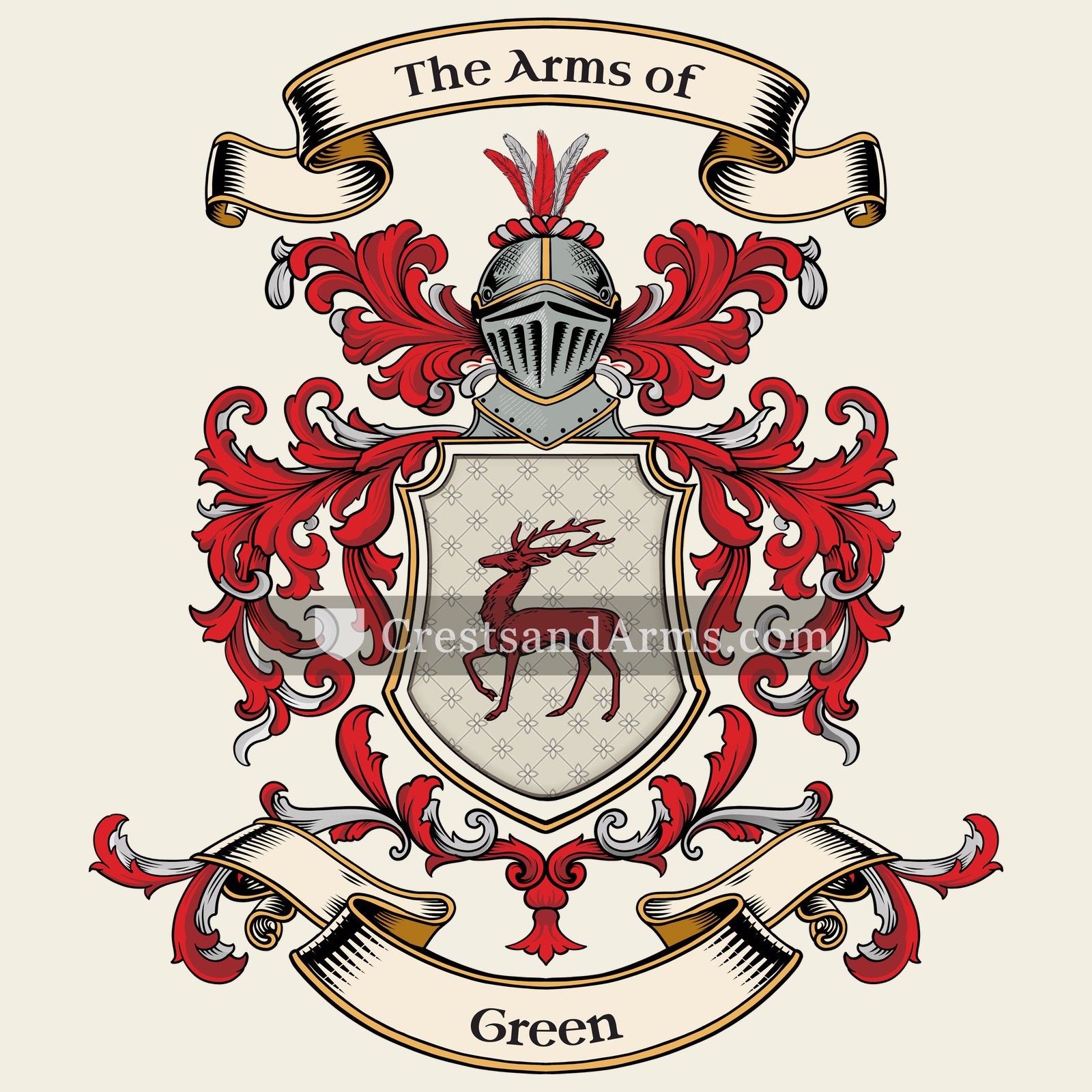
chiefAuthority, wisdom and dominion
stagPeace and harmony, and one who will not fight unprovoked
roundelA coin, and one who has been to the crusades
mulletThe third son, and a divine quality from above
fretPersuasion, and the net that holds
Colours
Silver (Argent)Means: Peace and sincerity
Black (Sable)Means: Constancy
Gold (Or)Means: Generosity
Blue (Azure)Means: Loyalty and truth
Historical info
Source
Sir Bernard Burke, The General Armory of England, Scotland, Ireland and Wales, London: Harrison & Sons, 1884
Blazon (the actual original written record)
“Ar. a fret az. charged with nine bezants, on a chief sa. a stag trippant or, betw. two mullets of the last pierced gu”
SomersetMilton-Chevsdon · Somerset, c. 1529
Digital archive packCoat of arms PNG, gold border print PDF, vector SVG and the certificate of authenticity. Sent to your email in minutes.
Map of England showing where the Green arms are recorded
The Green arms were recorded in Somerset, c. 1529.
Somerset was rich farming country with a thick scattering of manor houses. Its gentry were numerous and long-settled, and a settled landed family almost always ended up with arms.
This is where the arms were entered in the register. Families often moved to other parts of the country, so the same name can turn up in more than one region.
The body that granted and recorded arms in England in this period.
Henry VIII of England
Sovereign of the period
Henry VIII of England
1509–1547
Reigning in Germany when the Green arms are first recorded.
How Arms Worked in England
English heraldry allowed arms to be shared by all legitimate descendants of the original owner. These symbols were treated as personal property that moved through the generations to all children. While the eldest son kept the original design, other family members could use the same shield without needing to change it or register their own unique versions.
Granting authority
The College of Arms in London has regulated the use of coats of arms throughout England and Wales since 1484.
How they got arms
Families typically obtained their coats of arms through a formal grant from the Crown or by proving their ancient right to them.
Where arms were recorded
All official coats of arms are recorded in the registers kept at the College of Arms, which date back to the fifteenth century.
The family's standing
Recorded among the armigerous families of Somerset.
Origin & History of the Green Family in England
The surname Green is a classic example of a locative name, which means it was originally used to describe where a person lived. In medieval England, most villages featured a central grassy area known as the village green, where neighbors gathered for markets, festivals, and public meetings. People who lived near this common land were often identified by their neighbors as living "at the Green," eventually adopting the name as a permanent family identifier. By the time records confirm the presence of the family in Somerset in 1529, the name had already become well-established across the English countryside. Because the village green was such a common feature in almost every parish, the name emerged independently in many different regions rather than originating from a single ancestor. This makes the history of the Green family a reflection of the everyday lives of rural English villagers who were deeply connected to the land they cultivated and the communities they built.
Green Meaning & Related Branches
Root word
Gruoni
Old High German term referring to the color green or verdant.
This name
GreenA topographic name for someone who lived near a green pasture or meadow.
also spelled
Greene
Greenn
Greane
Grene
Related arms
Brennesame arms
Gressinghamsame arms
Grevesame arms
Grènevariant spelling
Documented Sources
J. B. Rietstap, Armorial Général, Gouda: G. B. van Goor Zonen, 1884–87
Bahlow, Hans, Deutsches Namenlexikon: Familien- und Vornamen nach Ursprung und Sinn erklärt, 1967


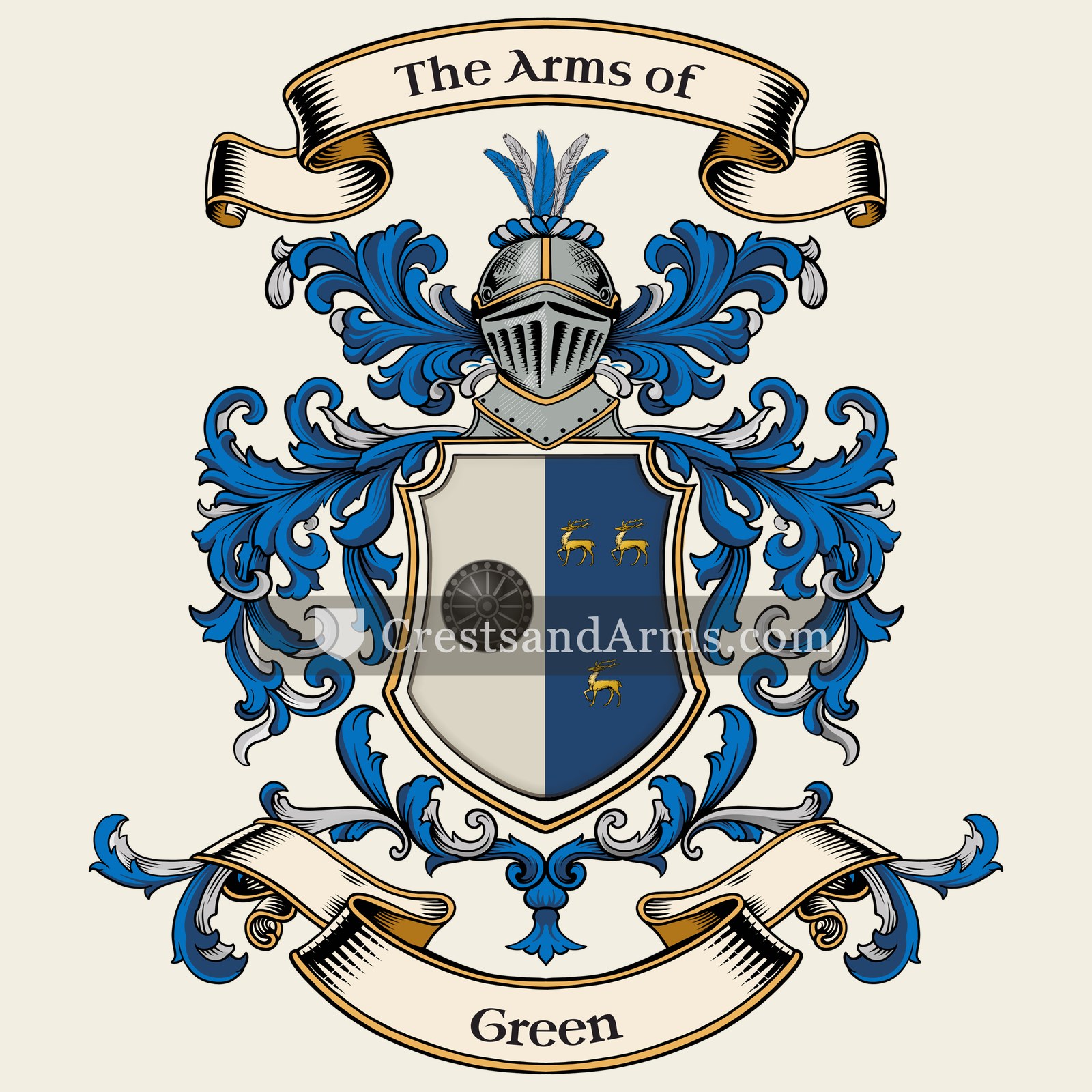
 roundelA coin, and one who has been to the crusades
 stagPeace and harmony, and one who will not fight unprovoked
 roundelA coin, and one who has been to the crusades
 stagPeace and harmony, and one who will not fight unprovoked




 chiefAuthority, wisdom and dominion
 mulletThe third son, and a divine quality from above
 fretPersuasion, and the net that holds