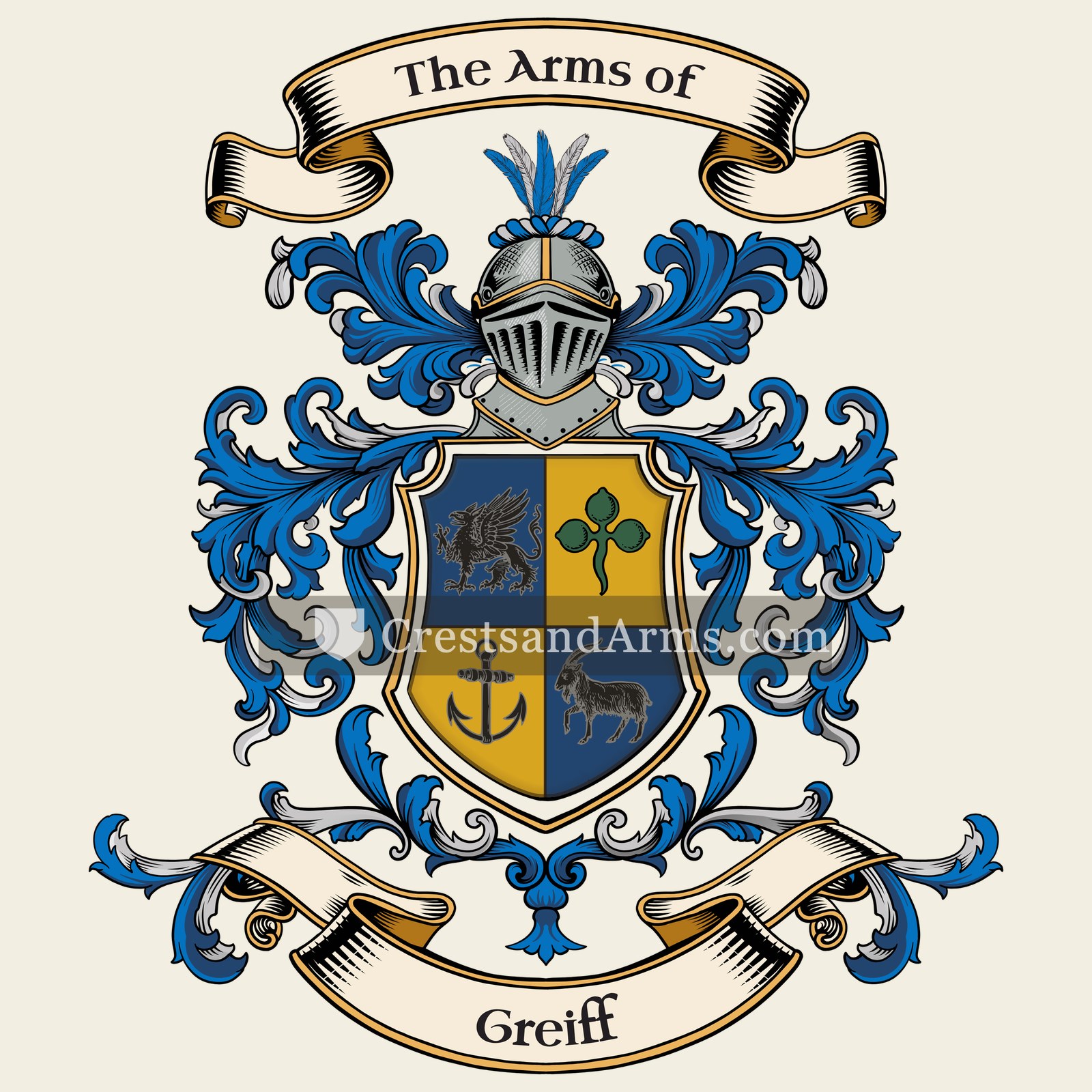
A record of documented arms, meaning and origin, researched for the Greiff family of Germany.
Reg. 3448 · German, G–I
Coat of Arms & Family Crest Details
Symbols on this shield
griffinValour and vigilance, guarding great treasure
trefoilPerpetuity, and the Trinity
anchorHope, and steadfastness in trouble
goatOne who wins by diplomacy rather than force
Colours
Blue (Azure)Means: Loyalty and truth
Gold (Or)Means: Generosity
Black (Sable)Means: Constancy
Green (Vert)Means: Hope
Historical info
Source
J. B. Rietstap, Armorial Général, Gouda: G. B. van Goor Zonen, 1884–87
Blazon (the actual original written record)
“Ec.: au 1 d'azur à un griffon de sa.; au 2 d'or à un trèfle de sin.; au 3 d'or à une ancre de sa; au 4 d'azur à un bouquetin ramp. de sa. Cq. cour. C.: un griffon iss. d'or. L. d'or et d'azur.”
WurttembergWurttemberg, c. 1697
Digital archive packCoat of arms PNG, gold border print PDF, vector SVG and the certificate of authenticity. Sent to your email in minutes.
Map of Germany showing where the Greiff arms are recorded
The Greiff arms were recorded in Wurttemberg, c. 1697.
Wurttemberg was southern German country of small estates and well-off market towns. Both landowners and leading townsmen kept arms there, so the region carries far more names than its size suggests.
This is where the arms were entered in the register. Families often moved to other parts of the country, so the same name can turn up in more than one region.
The body that granted and recorded arms in Germany in this period.
Leopold I, Holy Roman Emperor
Sovereign of the period
Leopold I, Holy Roman Emperor
1658–1705
Reigning in Germany when the Greiff arms are first recorded.
How Arms Worked in Germany
In the Holy Roman Empire, coats of arms were often granted to individuals by the Emperor or his representatives. These arms were then passed down through the generations to all legitimate descendants of the original holder. Younger branches of a family usually kept the same shield design without needing to change it, as the arms belonged to the entire lineage.
Granting authority
The Holy Roman Emperor held the sole power to grant new coats of arms throughout his vast imperial territories.
How they got arms
Families typically obtained their coats of arms through a formal imperial grant or by proving their noble status to the authorities.
Where arms were recorded
These grants were officially recorded in the Imperial Chancery registers, which began keeping formal records of such honors during the Middle Ages.
The family's standing
Recorded among the armigerous families of Wurttemberg.
Origin & History of the Greiff Family in Germany
The surname Greiff originates from the German word for griffin, a mythical creature often associated with strength and vigilance in folklore. During the late seventeenth century, the family was well-established in the region of Württemberg, which was then a powerful duchy in southwestern Germany. Historical records confirm the presence of the Greiff family in this area by 1697, a time when many families were rebuilding their lives following the devastation of the Thirty Years' War. Life in Württemberg during this period was centered around agricultural communities and small craft guilds, where families often identified themselves through occupational names or descriptive nicknames. As the family grew, they became part of the local social fabric, contributing to the development of the rural villages that defined the landscape of the Black Forest and the surrounding river valleys. By tracing their roots to this specific time and place, we can see that the Greiff family was deeply connected to the traditions and regional identity of early modern Germany.
Greiff Meaning & Related Branches
Root word
Grif
Old High German term referring to a claw or a griffin.
This name
GreiffAn occupational or descriptive name for a person with claw-like hands or a griffin-like nature.
also spelled
Greif
Gryff
Grife
Related arms
Greifvariant spelling
Documented Sources
J. B. Rietstap, Armorial Général, Gouda: G. B. van Goor Zonen, 1884–87
Bader, Karl S., Der deutsche Südwesten in seiner territorialstaatlichen Entwicklung, 1950
Hauptstaatsarchiv Stuttgart, Bestand A 202: Württembergische Regierungsakten, 1697
Müller, Hermann, Die Geschichte des Landes Württemberg, 1922
Digital archive packCoat of arms PNG, gold border print PDF, vector SVG and the certificate of authenticity. Sent to your email in minutes.


 griffinValour and vigilance, guarding great treasure
 trefoilPerpetuity, and the Trinity
 anchorHope, and steadfastness in trouble
 goatOne who wins by diplomacy rather than force
 griffinValour and vigilance, guarding great treasure
 trefoilPerpetuity, and the Trinity
 anchorHope, and steadfastness in trouble
 goatOne who wins by diplomacy rather than force