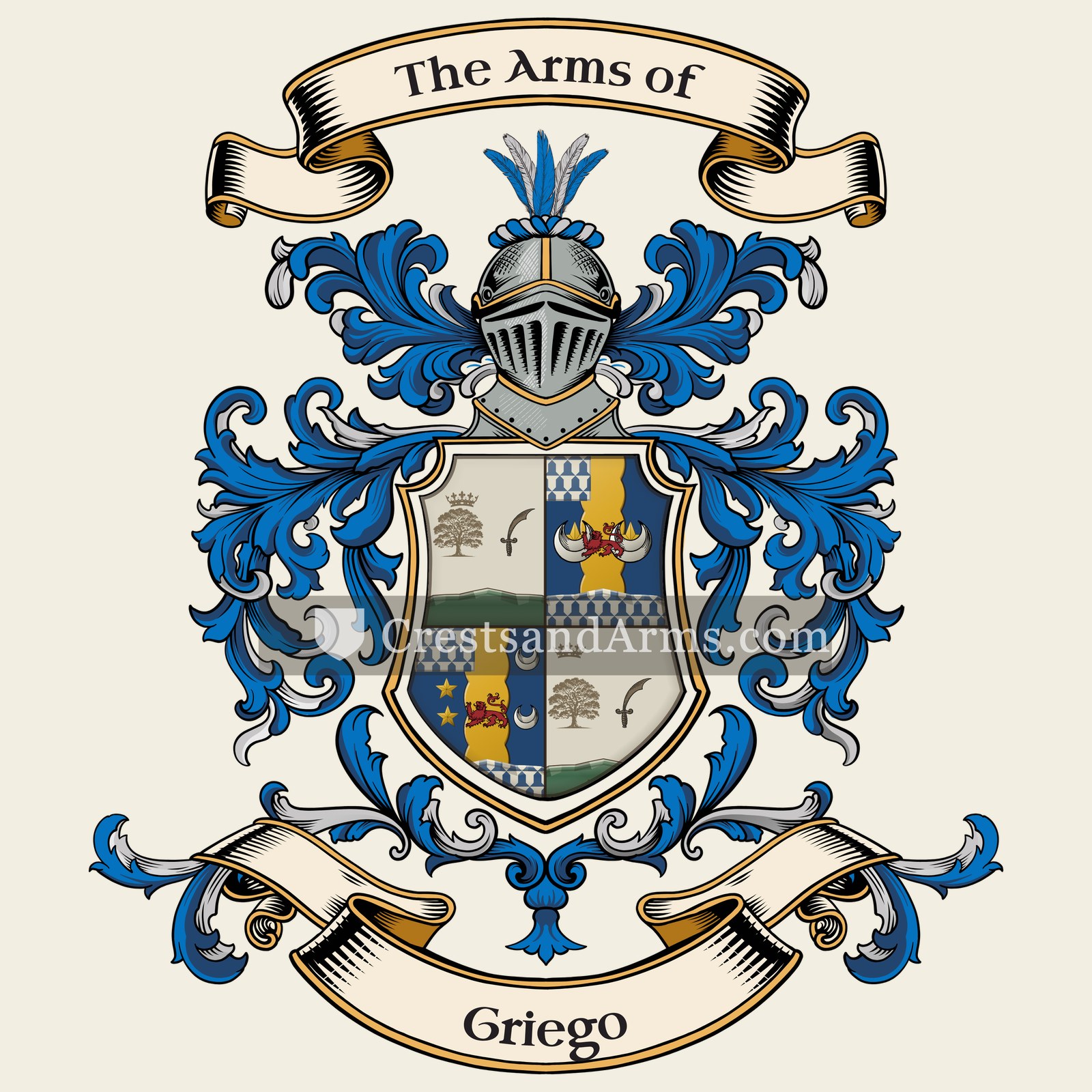
A record of documented arms, meaning and origin, researched for the Griego family of England.
Reg. 2777 · English, G–I
Coat of Arms & Family Crest Details
Symbols on this shield
mountThe ground held, and steadfastness upon it
cantonA mark of honour granted by the sovereign
paleMilitary strength, and a fortified defence
treeLife, endurance and deep roots
swordJustice, and military honour
crownSovereignty, authority and just reward
mulletThe third son, and a divine quality from above
crescentHonour by the sovereign, and the second son
lionCourage, strength and royalty
Colours
Silver (Argent)Means: Peace and sincerity
Blue (Azure)Means: Loyalty and truth
Green (Vert)Means: Hope
Gold (Or)Means: Generosity
Red (Gules)Means: Military strength
Historical info
Source
Sir Bernard Burke, The General Armory of England, Scotland, Ireland and Wales, London: Harrison & Sons, 1884
Blazon (the actual original written record)
“Quarterly, 1st and 4th, ar. out of a mount in base vert a fir tree surmounted by a sword bendwise ppr. on a canton az. an antique crown also ppr., for GREG; 2nd and 3rd, az. on a pale engr. or, betw. two mullets in chief of the second, and as many crescents in base ar. a lion ramp. gu., for LIGHTBODY”
ChesterNorcliffe Hall · Chester, c. 1875
Digital archive packCoat of arms PNG, gold border print PDF, vector SVG and the certificate of authenticity. Sent to your email in minutes.
Map of England showing where the Griego arms are recorded
The Griego arms were recorded in Chester, c. 1875.
Cheshire was governed apart from the rest of England for much of its history, with its own courts and its own gentry. That separateness bred a strong local landed class, and landed families carried arms.
This is where the arms were entered in the register. Families often moved to other parts of the country, so the same name can turn up in more than one region.
The body that granted and recorded arms in England in this period.
Victoria
Sovereign of the period
Victoria
1837–1901
Reigning in England when the Griego arms are first recorded.
How Arms Worked in England
English heraldry allowed arms to be shared by all legitimate descendants of the original owner. These symbols were treated as personal property that moved through the generations to all children. While the eldest son kept the original design, other family members could use the same shield without needing to change it or register their own unique versions.
Granting authority
The College of Arms in London has regulated the use of coats of arms throughout England and Wales since 1484.
How they got arms
Families typically obtained their coats of arms through a formal grant from the Crown or by proving their ancient right to them.
Where arms were recorded
All official coats of arms are recorded in the registers kept at the College of Arms, which date back to the fifteenth century.
The family's standing
Recorded among the armigerous families of Chester.
Origin & History of the Griego Family in England
The surname Griego is historically linked to the Spanish word for Greek, which suggests that the name was originally used as a descriptor for someone who either came from Greece or had a strong connection to that region. Over many generations, this name became established within Spanish-speaking populations and eventually spread across the globe through migration. By the late nineteenth century, members of the Griego family were documented as residents of Chester, Pennsylvania, in 1875. This indicates that the family was part of the broader movement of people seeking new opportunities in American industrial centers during the post-Civil War era. Their presence in this region reflects the diverse cultural shifts occurring in the United States at that time as families moved to establish roots in growing cities.
Related Branches & Arms
Root word
Graecus
Latin term meaning a person from Greece.
This name
GriegoAn occupational or habitational name for someone of Greek origin or descent.
also spelled
Greig
Documented Sources
Sir Bernard Burke, The General Armory of England, Scotland, Ireland and Wales, London: Harrison & Sons, 1884
United States Census Bureau, 1870 Census Records, Chester, Pennsylvania
Delaware County Historical Society, Chester City Tax Assessment Records, 1875
García Carraffa, Alberto y Arturo, Diccionario heráldico y genealógico de apellidos españoles y americanos, 1952
Digital archive packCoat of arms PNG, gold border print PDF, vector SVG and the certificate of authenticity. Sent to your email in minutes.


 mountThe ground held, and steadfastness upon it
 cantonA mark of honour granted by the sovereign
 paleMilitary strength, and a fortified defence
 treeLife, endurance and deep roots
 swordJustice, and military honour
 crownSovereignty, authority and just reward
 mulletThe third son, and a divine quality from above
 crescentHonour by the sovereign, and the second son
 lionCourage, strength and royalty
 mountThe ground held, and steadfastness upon it
 cantonA mark of honour granted by the sovereign
 paleMilitary strength, and a fortified defence
 treeLife, endurance and deep roots
 swordJustice, and military honour
 crownSovereignty, authority and just reward
 mulletThe third son, and a divine quality from above
 crescentHonour by the sovereign, and the second son
 lionCourage, strength and royalty