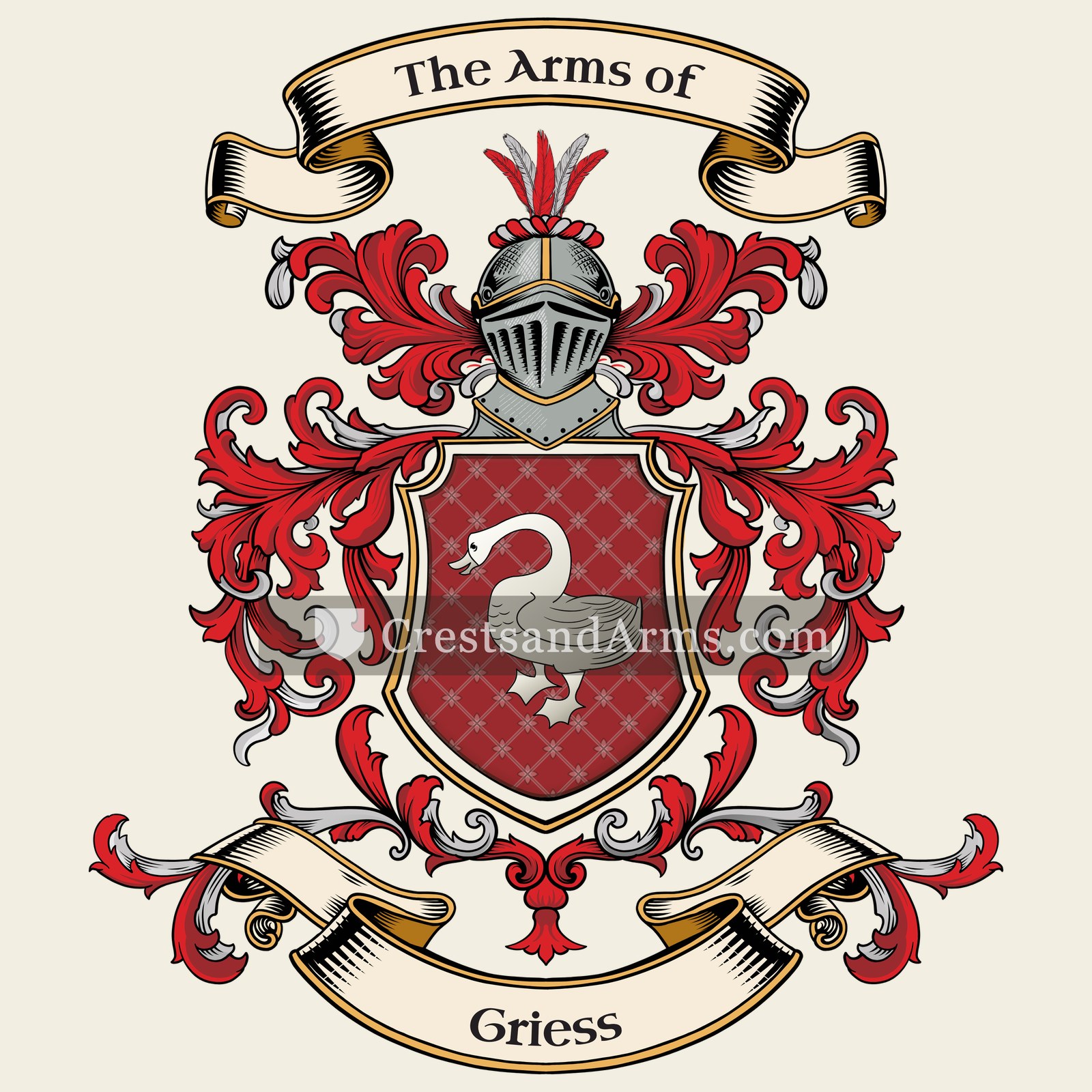
A record of documented arms, meaning and origin, researched for the Griess family of Switzerland.
Reg. 6645 · Swiss, G–I
Coat of Arms & Family Crest Details
Symbols on this shield
swanGrace, light and the poet's art
Colours
Red (Gules)Means: Military strength
Silver (Argent)Means: Peace and sincerity
Historical info
Source
J. B. Rietstap, Armorial Général, Gouda: G. B. van Goor Zonen, 1884–87
Blazon (the actual original written record)
“De gu. à un cygne d'arg., les pieds tronqués, le pied sen. attaché à une corde de sa., mouv. du canton dextre de la p. C.: une tête et col de cygne d'arg., le dos longé d'une crête de six angles de gu.”
Switzerlandc. 1745
Digital archive packCoat of arms PNG, gold border print PDF, vector SVG and the certificate of authenticity. Sent to your email in minutes.
Map of Switzerland showing where the Griess arms are recorded
The Griess arms were recorded in Switzerland, c. 1745.
Arms such as these were typically recorded in Bern.
Bern was the largest of the Swiss cantons and ran itself, with its own council and its own courts. Its governing families held office for generations, and office of that kind carried a shield with it.
This is where the arms were entered in the register. Families often moved to other parts of the country, so the same name can turn up in more than one region.
The body that granted and recorded arms in Switzerland in this period.
How Arms Worked in Switzerland
In Switzerland, coats of arms were not restricted to the nobility and were often adopted by common citizens and families. These symbols were passed down through generations to show family identity. When branches of a family grew, they often changed small details of the design to distinguish their own line from the original group.
Granting authority
Cantonal and civic authorities managed the use of coats of arms within their specific regions and local jurisdictions.
How they got arms
Families typically assumed their own coats of arms based on local custom rather than receiving them from a central monarch.
Where arms were recorded
Arms were recorded in various cantonal and civic registers starting from the fourteenth century throughout the Swiss region.
The family's standing
Recorded among the armigerous families of Switzerland.
Origin & History of the Griess Family in Switzerland
The family name Griess originates from the German word for gravel or coarse sand. In medieval times, names were often descriptive, and this surname likely identified people who lived near a sandy riverbank or worked in a gravel pit. By the mid-eighteenth century, the family was well-established in the city of Bern, Switzerland. Records confirm that members of the Griess family were active citizens there by 1745. During this period, Bern was a powerful city-state, and families like the Griess were often involved in the local trades or agricultural life that supported the region. As the family grew, they integrated into the social and economic fabric of the Swiss canton, leaving behind a legacy rooted in the geography and daily labor of the Alpine landscape.
Griess Meaning & Related Branches
Root word
Gries
Middle High German term for sand, gravel, or a sandy shore.
This name
GriessA topographic name for someone who lived near a sandy area, gravel pit, or riverbank.
also spelled
Griesse
Gries
Grees
Documented Sources
J. B. Rietstap, Armorial Général, Gouda: G. B. van Goor Zonen, 1884–87
Brechenmacher, Josef Karlmann. Etymologisches Wörterbuch der deutschen Familiennamen. 1957
Staatsarchiv des Kantons Bern. Bürgerrodel der Stadt Bern. 1745
Digital archive packCoat of arms PNG, gold border print PDF, vector SVG and the certificate of authenticity. Sent to your email in minutes.


 swanGrace, light and the poet's art
 swanGrace, light and the poet's art