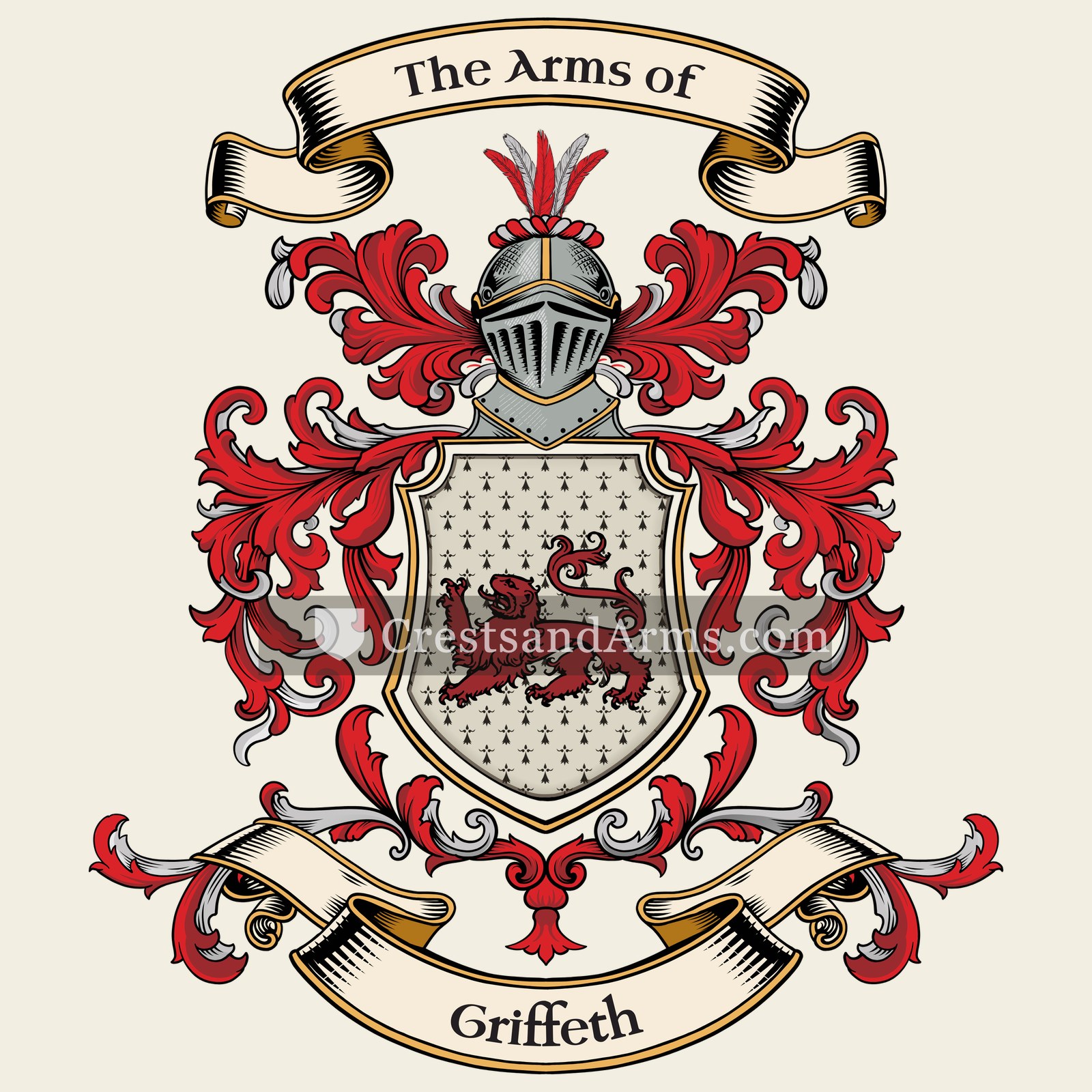
A record of documented arms, meaning and origin, researched for the Griffeth family of Wales.
Reg. 5716 · Welsh, G–I
Coat of Arms & Family Crest Details
Symbols on this shield
lionCourage, strength and royalty
Colours
ErmineMeans: Dignity
Red (Gules)Means: Military strength
Historical info
Source
Sir Bernard Burke, The General Armory of England, Scotland, Ireland and Wales, London: Harrison & Sons, 1884
Blazon (the actual original written record)
“Erm. a lion ramp. gu”
Walesc. 1647
Where the Griffeth Arms Were Recorded
Denbigh
Map of Wales showing where the Griffeth arms are recorded
The Griffeth arms were recorded in Wales, c. 1647.
Arms such as these were typically recorded in Denbigh.
Denbighshire was north Welsh country of hills and small estates. Land was held by a great many families rather than a few, and each holding brought its own claim to a coat of arms.
This is where the arms were entered in the register. Families often moved to other parts of the country, so the same name can turn up in more than one region.
The body that granted and recorded arms in Wales in this period.
Charles I of England
Sovereign of the period
Charles I of England
1625–1649
Reigning in Wales when the Griffeth arms are first recorded.
How Arms Worked in Wales
English heraldry allowed arms to be shared by all legitimate descendants of the original owner. These symbols were treated as personal property that moved through the generations to all children. While the eldest son kept the original design, other family members could use the same shield without needing to change it or register their own unique versions.
Granting authority
The College of Arms in London has regulated the use of coats of arms throughout England and Wales since 1484.
How they got arms
Families typically obtained their coats of arms through a formal grant from the Crown or by proving their ancient right to them.
Where arms were recorded
All official coats of arms are recorded in the registers kept at the College of Arms, which date back to the fifteenth century.
The family's standing
Recorded among the armigerous families of Wales.
Origin & History of the Griffeth Family in Wales
The surname Griffeth is a variant of the ancient Welsh name Gruffudd, which likely originates from the Old Welsh words for strong lord or prince. By the mid-seventeenth century, the family had established a notable presence in the market town of Denbigh in North Wales. Records from 1647 confirm that members of the family were living in this area during a time of significant political upheaval in Britain. As the name evolved from its original Welsh roots, it became Anglicized to the spelling used today. Families in this region during the 1600s were often deeply connected to the local agricultural economy and the social structures of the Denbighshire countryside. This history reflects a long tradition of Welsh ancestry that transitioned from traditional naming customs to the more permanent surnames recognized in official government documents of the era.
Related Branches & Arms
Root word
Gruffudd
Derived from the Old Welsh words for strong lord or prince.
This name
GriffethA Welsh patronymic surname signifying a descendant of a strong or fierce leader.
also spelled
Griffith
Griffithe
Gryffeth
Related arms
David ap Griffithvariant spelling
Documented Sources
Sir Bernard Burke, The General Armory of England, Scotland, Ireland and Wales, London: Harrison & Sons, 1884
Morgan, Prys. Enwau Lleoedd. 1987
Richards, Melville. Enwau Tir a Gwlad. 1998
National Library of Wales, Denbighshire Quarter Sessions Records
National Library of Wales, Diocese of St Asaph Probate Records
Digital archive packCoat of arms PNG, gold border print PDF, vector SVG and the certificate of authenticity. Sent to your email in minutes.


 lionCourage, strength and royalty
 lionCourage, strength and royalty