Map of England showing where the Griffin arms are recorded
The Griffin arms were recorded in Chester, c. 1620.
Cheshire was governed apart from the rest of England for much of its history, with its own courts and its own gentry. That separateness bred a strong local landed class, and landed families carried arms.
This is where the arms were entered in the register. Families often moved to other parts of the country, so the same name can turn up in more than one region.
The body that granted and recorded arms in England in this period.
James VI and I
Sovereign of the period
James VI and I
1603–1625
Reigning in England when the Griffin arms are first recorded.
How Arms Worked in England
English heraldry allowed arms to be shared by all legitimate descendants of the original owner. These symbols were treated as personal property that moved through the generations to all children. While the eldest son kept the original design, other family members could use the same shield without needing to change it or register their own unique versions.
Granting authority
The College of Arms in London has regulated the use of coats of arms throughout England and Wales since 1484.
How they got arms
Families typically obtained their coats of arms through a formal grant from the Crown or by proving their ancient right to them.
Where arms were recorded
All official coats of arms are recorded in the registers kept at the College of Arms, which date back to the fifteenth century.
The family's standing
Recorded among the armigerous families of Chester.
Origin & History of the Griffin Family in England
The surname Griffin has deep roots in the English landscape, evolving from a nickname that likely described a person with a fierce or watchful temperament. By the early 17th century, the family was well-established in the historic city of Chester, which served as a major hub for trade and regional administration in the northwest of England. Records from 1620 show that members of the Griffin family were active participants in the social and economic life of this walled city. During this period, families often lived near the city gates or within the bustling market districts, where they contributed to the local craft and merchant guilds. As the family grew, they became woven into the fabric of Chester’s community, moving from their origins as local residents to becoming a recognized part of the city’s long-standing history.
Meaning of the Griffin family crest colors & symbols
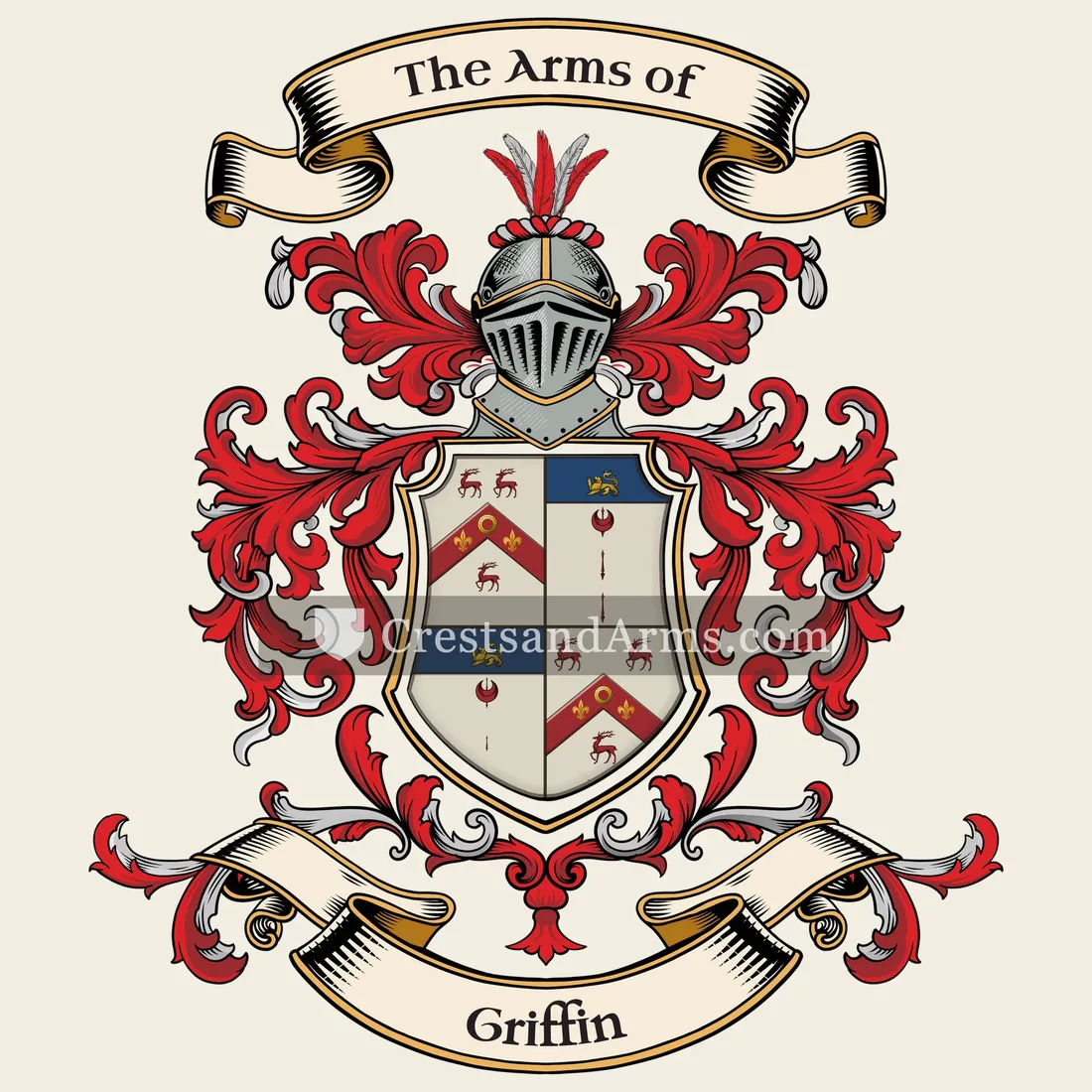
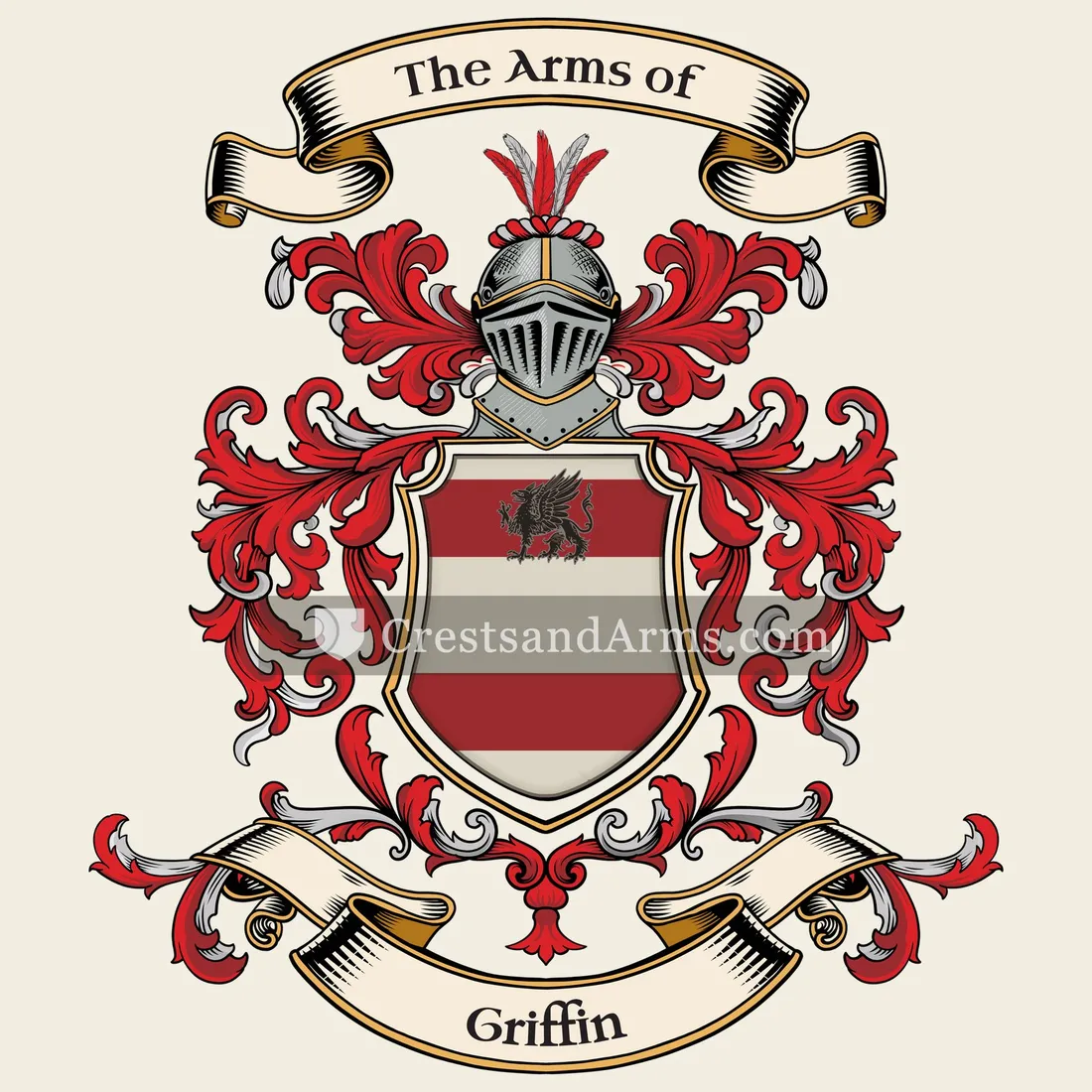
Symbols on this shield
fessThe military belt, and readiness to serve
lozengeHonour and nobility, and the arms of a woman
griffinValour and vigilance, guarding great treasure
Colours
Red (Gules)Means: Military strength
Gold (Or)Means: Generosity
Historical info
Source
Sir Bernard Burke, The General Armory of England, Scotland, Ireland and Wales, London: Harrison & Sons, 1884
Blazon (the actual original written record)
“Gu. on a fesse betw. three lozenges or, each charged with a fleur-de-lis of the first, a demi rose betw. two griffins segreant of the field”
WalesPenrith, c. 1647
Digital archive packCoat of arms PNG, gold border print PDF, vector SVG and the certificate of authenticity. Sent to your email in minutes.
Map of Wales showing where the Griffin arms are recorded
The Griffin arms were recorded in Penrith, c. 1647.
Arms such as these were typically recorded in Denbigh.
Denbighshire was north Welsh country of hills and small estates. Land was held by a great many families rather than a few, and each holding brought its own claim to a coat of arms.
This is where the arms were entered in the register. Families often moved to other parts of the country, so the same name can turn up in more than one region.
The body that granted and recorded arms in Wales in this period.
Charles I of England
Sovereign of the period
Charles I of England
1625–1649
Reigning in England when the Griffin arms are first recorded.
How Arms Worked in Wales
English heraldry allowed arms to be shared by all legitimate descendants of the original owner. These symbols were treated as personal property that moved through the generations to all children. While the eldest son kept the original design, other family members could use the same shield without needing to change it or register their own unique versions.
Granting authority
The College of Arms in London has regulated the use of coats of arms throughout England and Wales since 1484.
How they got arms
Families typically obtained their coats of arms through a formal grant from the Crown or by proving their ancient right to them.
Where arms were recorded
All official coats of arms are recorded in the registers kept at the College of Arms, which date back to the fifteenth century.
The family's standing
Recorded among the armigerous families of Wales.
Origin & History of the Griffin Family in Wales
The history of the Griffin name in Wales is deeply connected to the cultural shifts of the seventeenth century. While the name itself has roots in older Welsh naming traditions, records confirm that members of the family were firmly established in the town of Denbigh by 1647. During this period, Denbigh was a significant market town that served as a hub for trade and local governance in North Wales. Families living there often navigated the transition from traditional Welsh patronymic naming systems, where children took their father’s first name as a surname, toward the more permanent, hereditary surnames used today. By settling in a prominent location like Denbigh, the Griffin family became part of the local social fabric, participating in the agricultural and civic life that defined the region during the mid-1600s. Their presence in the town archives during this era reflects a time of growth and stability for families who were helping to shape the identity of North Wales.
Meaning of the Griffin family crest colors & symbols
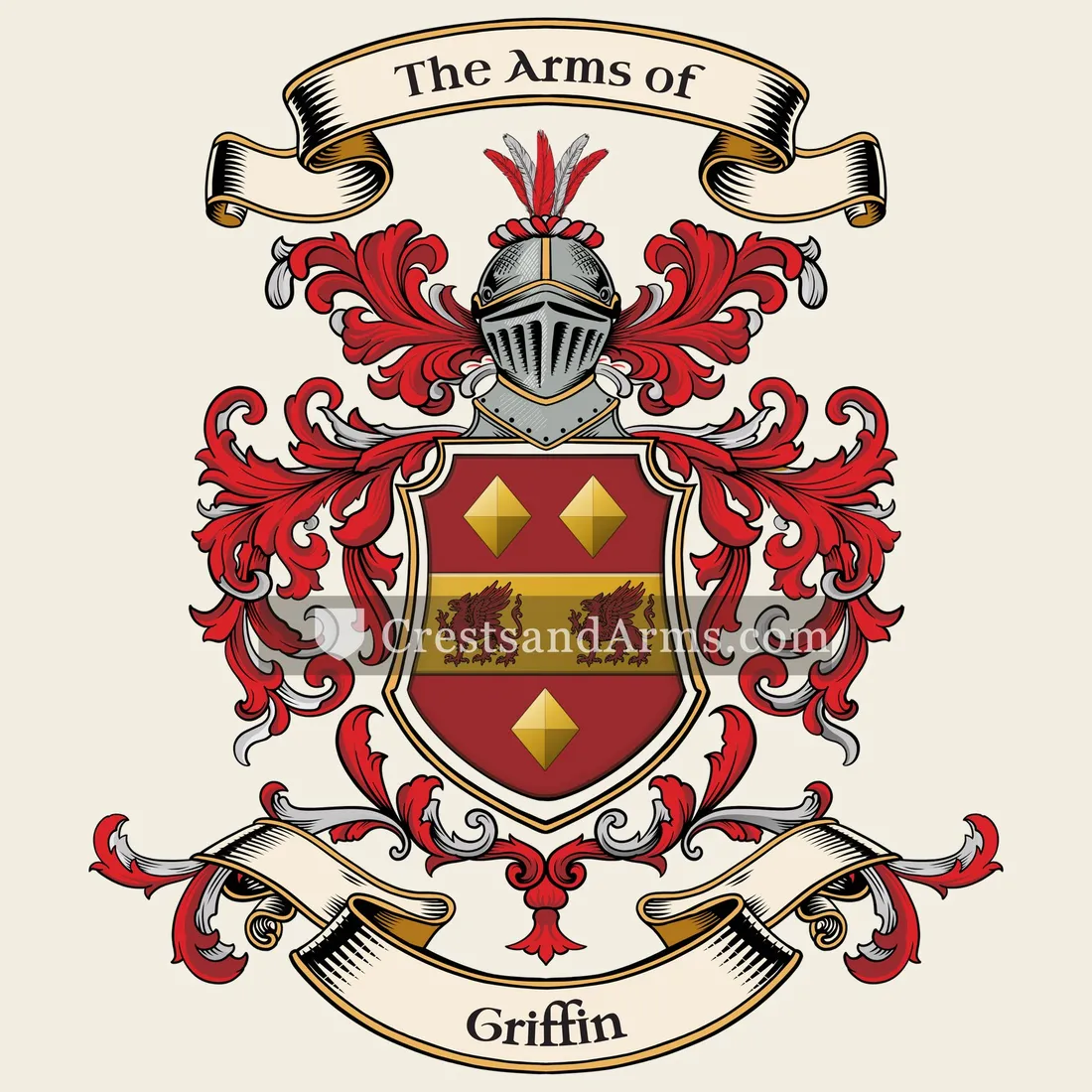
Symbols on this shield
chevronProtection, and faithful service completed
chiefAuthority, wisdom and dominion
ringFidelity, and a promise kept
stagPeace and harmony, and one who will not fight unprovoked
fleur de lisPurity, light, and the sixth son
lanceKnightly service and the tilt
lionCourage, strength and royalty
crescentHonour by the sovereign, and the second son
Colours
Silver (Argent)Means: Peace and sincerity
Red (Gules)Means: Military strength
Blue (Azure)Means: Loyalty and truth
Gold (Or)Means: Generosity
Historical info
Source
Sir Bernard Burke, The General Armory of England, Scotland, Ireland and Wales, London: Harrison & Sons, 1884
Blazon (the actual original written record)
“Quarterly, 1st and 4th, ar. on a chev. betw. three bucks' heads erased gu. an annulet betw. two fleurs-de-lis or, for GRIFFIN; 2nd and 3rd, ar. three spears erect in fess gu. on a chief az. a lion pass. guard. or, a crescent for diff., for LYSAGHT”
IrelandBarrister-at-law, c. 1645
Digital archive packCoat of arms PNG, gold border print PDF, vector SVG and the certificate of authenticity. Sent to your email in minutes.
Map of Ireland showing where the Griffin arms are recorded
The Griffin arms were recorded in Barrister-at-law, c. 1645.
Arms such as these were typically recorded in Dublin.
Dublin was the seat of government in Ireland and the place where grants were sought and recorded. Families with business at the castle or the courts settled nearby, and settling there put their arms on record.
This is where the arms were entered in the register. Families often moved to other parts of the country, so the same name can turn up in more than one region.
The body that granted and recorded arms in Ireland in this period.
Charles I of England
Sovereign of the period
Charles I of England
1625–1649
Reigning in England when the Griffin arms are first recorded.
How Arms Worked in Ireland
The Ulster King of Arms granted coats of arms to individuals who proved their social standing and good character. These symbols were typically inherited by all legitimate descendants of the original holder. If a family branch wanted a unique look, they could apply for a specific change to their design through the office to ensure their identity remained distinct.
Granting authority
The Ulster King of Arms acted as the official body that regulated and issued all coats of arms throughout Ireland.
How they got arms
Families obtained their arms through formal grants issued by the office after proving their eligibility and paying the required fees.
Where arms were recorded
All official grants were recorded in the registers held by the Ulster King of Arms starting from the year 1552.
The family's standing
Recorded among the armigerous families of Ireland.
Origin & History of the Griffin Family in Ireland
The Griffin name has a long and complex history in Ireland, rooted in both native Gaelic traditions and later waves of migration. While the name is often associated with the Welsh word for a mythical beast, many Irish families named Griffin actually descend from the Gaelic name Ó Gríobhtha, which translates to descendant of the griffin-like warrior. By the mid-seventeenth century, the family had established a clear presence in the urban landscape of Dublin. Records from 1645 show members of the family living in the city during a time of intense political upheaval and social change. As the seventeenth century progressed, these families became part of the growing merchant and administrative classes that helped shape the capital. Their presence in Dublin during this era suggests that they were well-integrated into the city's economic life, moving between the traditional rural roots of their ancestors and the expanding opportunities found in Ireland’s primary port city.
Griffin Meaning & Related Branches
Root word
Gruffudd
A Welsh personal name derived from words meaning strong lord or prince.
This name
GriffinAn Anglicized form of a Welsh name often associated with the mythical creature.
also spelled
Griffen
Griffyn
Griffith
Gryffin
Related arms
Apenrithsimilar arms
Griffenvariant spelling
David ap Griffithvariant spelling
Griffynvariant spelling
Documented Sources
Sir Bernard Burke, The General Armory of England, Scotland, Ireland and Wales, London: Harrison & Sons, 1884
Bardsley, Charles Wareing, A Dictionary of English and Welsh Surnames, 1901
Cheshire Archives and Local Studies, Chester City Records (G/1620)
Reaney, P.H., A Dictionary of British Surnames, 1958
Digital archive packCoat of arms PNG, gold border print PDF, vector SVG and the certificate of authenticity. Sent to your email in minutes.


 griffinValour and vigilance, guarding great treasure
 griffinValour and vigilance, guarding great treasure


 fessThe military belt, and readiness to serve
 lozengeHonour and nobility, and the arms of a woman

 chevronProtection, and faithful service completed
 chiefAuthority, wisdom and dominion
 ringFidelity, and a promise kept
 stagPeace and harmony, and one who will not fight unprovoked
 fleur de lisPurity, light, and the sixth son
 lanceKnightly service and the tilt
 lionCourage, strength and royalty
 crescentHonour by the sovereign, and the second son