Map of France showing where the Griffon arms are recorded
The Griffon arms were recorded in Ponthieu, c. 1663.
Ponthieu was small coastal country in northern France, on the road armies took between the Channel and Paris. Its families held land in return for service, and men who served carried shields.
This is where the arms were entered in the register. Families often moved to other parts of the country, so the same name can turn up in more than one region.
The body that granted and recorded arms in France in this period.
Louis XIV of France
Sovereign of the period
Louis XIV of France
1643–1715
Reigning in France when the Griffon arms are first recorded.
How Arms Worked in France
In France, a coat of arms was a mark of honor that passed down through the male line to all legitimate descendants. Families often used the same shield without changes to show their shared heritage. If a branch wanted to stand out, they could add a small mark to their shield to show their specific place in the family tree.
Granting authority
The Juge d'armes de France acted as the official authority that regulated and verified coats of arms across the country.
How they got arms
Families typically inherited their arms from ancestors, though they could also receive them through royal grants or by proving their noble status.
Where arms were recorded
Coats of arms were officially recorded in the Armorial Général de France, which began its main collection in the year 1696.
The family's standing
Recorded among the armigerous families of Ponthieu.
Origin & History of the Griffon Family in France
The family name Griffon has deep roots in the northern regions of France, particularly within the historic county of Ponthieu. By the mid-17th century, records confirm that members of the family were well-established in this area, living as part of the local social fabric during the reign of King Louis XIV. The name itself is linked to the medieval French word for a griffin, a legendary creature often used in folklore to represent strength and guardianship. Families during this period frequently adopted names based on animal symbolism or physical traits to help distinguish themselves in growing rural communities. As the Griffon family settled in Ponthieu, they likely participated in the agricultural and trade activities that defined the region, contributing to the local economy and the evolving history of northern France.
Coat of Arms & Family Crest Details
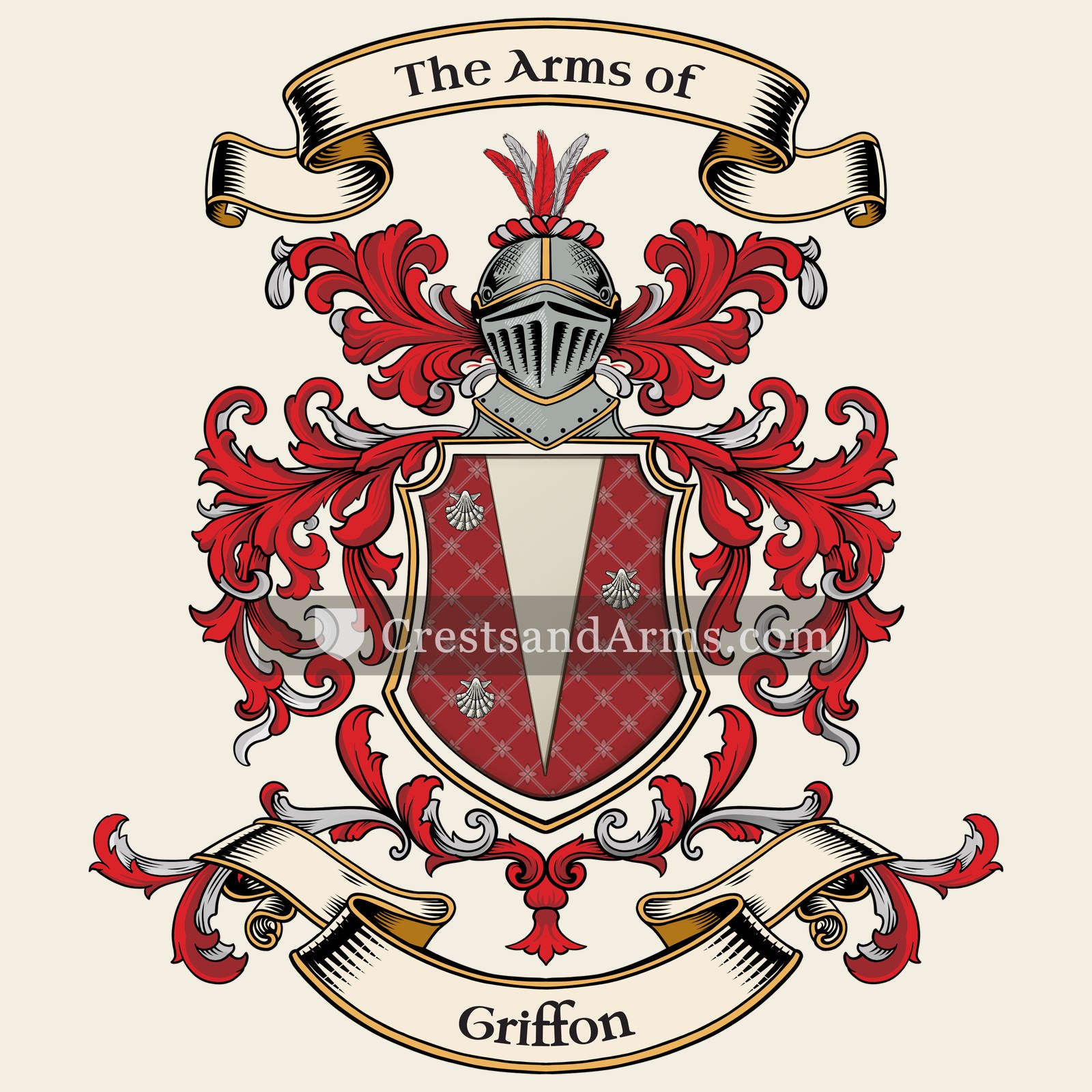
Symbols on this shield
pileWell-doing, and a mark of distinction
escallopThe pilgrim's shell, and a long journey made
Colours
Red (Gules)Means: Military strength
Silver (Argent)Means: Peace and sincerity
Historical info
Source
Sir Bernard Burke, The General Armory of England, Scotland, Ireland and Wales, London: Harrison & Sons, 1884
Blazon (the actual original written record)
“Gu. three escallops ar. in chief three piles of the last”
Irelandc. 1645
Digital archive packCoat of arms PNG, gold border print PDF, vector SVG and the certificate of authenticity. Sent to your email in minutes.
Map of Ireland showing where the Griffon arms are recorded
The Griffon arms were recorded in Ireland, c. 1645.
Arms such as these were typically recorded in Dublin.
Dublin was the seat of government in Ireland and the place where grants were sought and recorded. Families with business at the castle or the courts settled nearby, and settling there put their arms on record.
This is where the arms were entered in the register. Families often moved to other parts of the country, so the same name can turn up in more than one region.
The body that granted and recorded arms in Ireland in this period.
Charles I of England
Sovereign of the period
Charles I of England
1625–1649
Reigning in France when the Griffon arms are first recorded.
How Arms Worked in Ireland
The Ulster King of Arms granted coats of arms to individuals who proved their social standing and good character. These symbols were typically inherited by all legitimate descendants of the original holder. If a family branch wanted a unique look, they could apply for a specific change to their design through the office to ensure their identity remained distinct.
Granting authority
The Ulster King of Arms acted as the official body that regulated and issued all coats of arms throughout Ireland.
How they got arms
Families obtained their arms through formal grants issued by the office after proving their eligibility and paying the required fees.
Where arms were recorded
All official grants were recorded in the registers held by the Ulster King of Arms starting from the year 1552.
The family's standing
Recorded among the armigerous families of Ireland.
Origin & History of the Griffon Family in Ireland
The history of the Griffon name in Ireland is deeply connected to the turbulent political landscape of the seventeenth century. While the name has roots in various parts of Europe, records confirm that members of the family were firmly established in Dublin by 1645. During this period, Dublin served as a central hub for trade and administration, placing the family at the heart of a city undergoing significant social change. As the mid-1600s progressed, Ireland faced intense conflict and shifting land ownership, which often forced families to adapt their livelihoods to survive. The presence of the Griffon name in official city records suggests that these early ancestors were likely involved in the urban professional or merchant classes that kept the capital functioning during these difficult years. By settling in Dublin, the family became part of the city’s evolving demographic, contributing to the diverse cultural fabric that defined the capital throughout the seventeenth century.
Griffon Meaning & Related Branches
Root word
Gryphus
A mythical creature with the body of a lion and eagle head.
This name
GriffonA nickname for a person with a fierce or vigilant temperament like the legendary beast.
also spelled
Griffonn
Griffone
Grifon
Griffen
Gryffon
Related arms
Griffynvariant spelling
Documented Sources
J. B. Rietstap, Armorial Général, Gouda: G. B. van Goor Zonen, 1884–87
Archives départementales de la Somme, Registres paroissiaux de l'état civil de Ponthieu, 1663
Albert Dauzat, Dictionnaire étymologique des noms et prénoms de France, 1951
Marie-Thérèse Morlet, Dictionnaire étymologique des noms de famille, 1991
Digital archive packCoat of arms PNG, gold border print PDF, vector SVG and the certificate of authenticity. Sent to your email in minutes.


 griffinValour and vigilance, guarding great treasure
 griffinValour and vigilance, guarding great treasure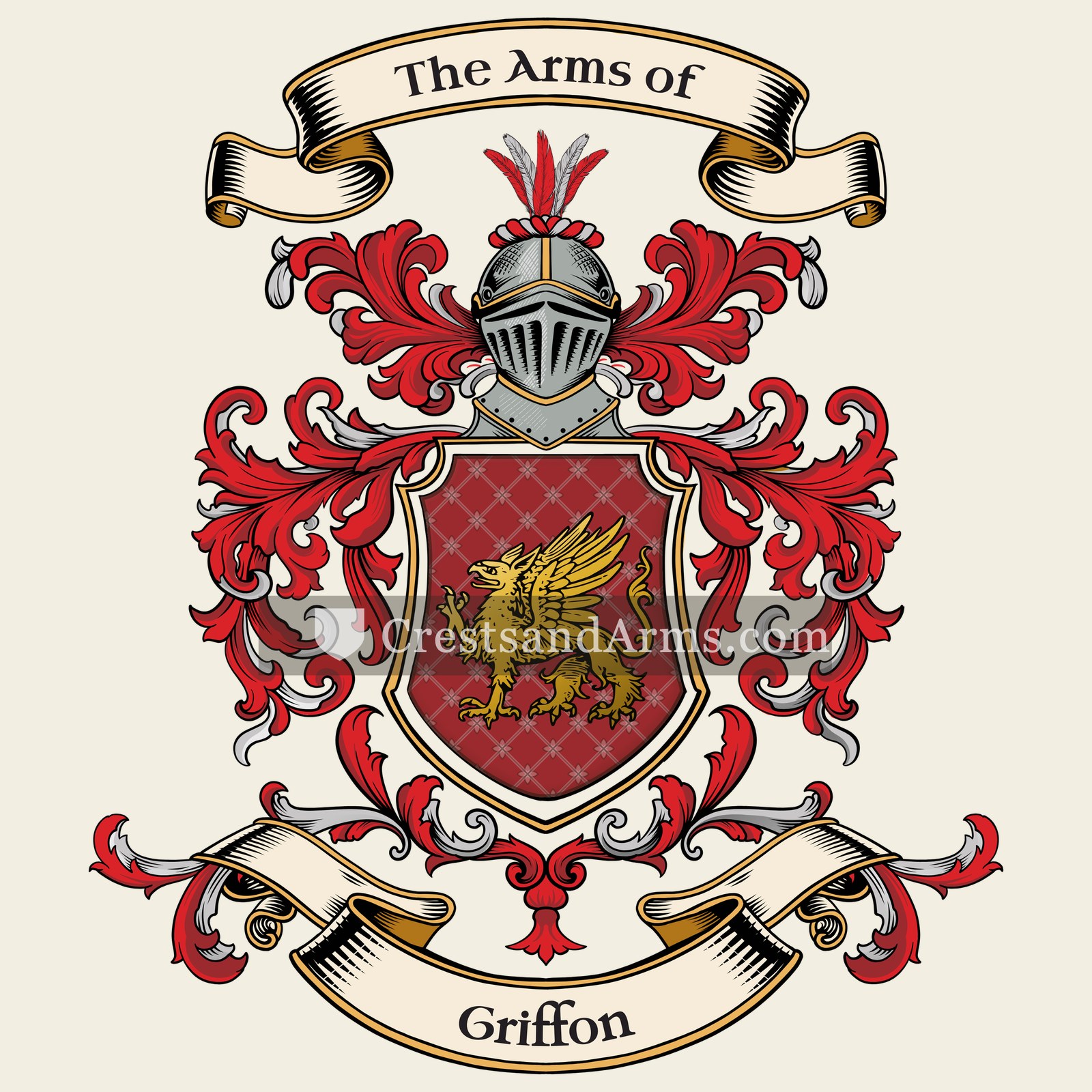


 pileWell-doing, and a mark of distinction
 escallopThe pilgrim's shell, and a long journey made