Map of Sweden showing where the Grill arms are recorded
The Grill arms were recorded in Sweden, c. 1700.
Arms such as these were typically recorded in Stockholm.
Stockholm held the Swedish court and the House of Nobility, where every noble family's arms were entered and kept. Families ennobled for service registered there, which is why so many are recorded around the city.
This is where the arms were entered in the register. Families often moved to other parts of the country, so the same name can turn up in more than one region.
The body that granted and recorded arms in Sweden in this period.
Carl XII of Sweden
Sovereign of the period
Carl XII of Sweden
1697–1718
Reigning in Sweden when the Grill arms are first recorded.
How Arms Worked in Sweden
In Sweden, a coat of arms belonged to a noble family as a whole rather than just one individual. These arms were passed down through the generations to all legitimate descendants. Younger branches of the family used the same shield without needing to change it. This system ensured that the entire lineage shared the same identity and status under the law.
Granting authority
The Riddarhuset, or House of Nobility, regulated all noble coats of arms in Sweden under royal authority.
How they got arms
Families received their coats of arms through royal grants of nobility which were then officially registered with the House.
Where arms were recorded
Coats of arms were officially recorded in the Swedish House of Nobility register starting in the year 1626.
The family's standing
Recorded among the armigerous families of Sweden.
Origin & History of the Grill Family in Sweden
The Grill family became a prominent force in Swedish history after arriving in Stockholm around the year 1700. The family originated from the Netherlands and brought with them a deep expertise in international trade and finance. Upon settling in Sweden, they quickly established themselves as influential merchants and bankers who played a vital role in the country’s economic growth during the eighteenth century. They were particularly well-known for their involvement with the Swedish East India Company, which allowed them to build a vast network of global commerce. Beyond their business success, the family became known for their dedication to the arts and their role as significant patrons of Swedish culture. Their integration into the upper levels of Stockholm society helped shape the city into a bustling hub of European trade and intellectual exchange.
Coat of Arms & Family Crest Details
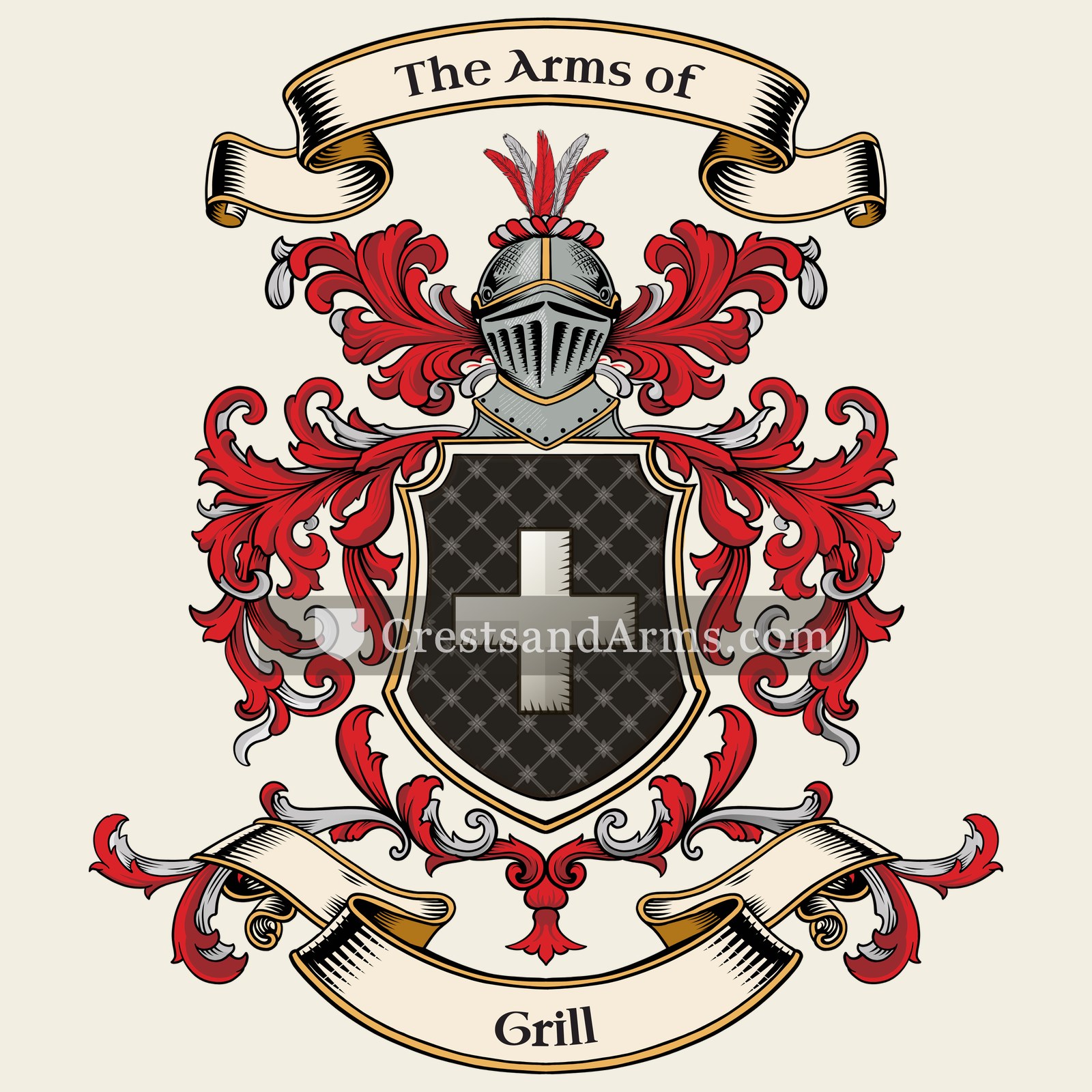
Symbols on this shield
cross symbolChristian faith and service
Colours
Black (Sable)Means: Constancy
Silver (Argent)Means: Peace and sincerity
Historical info
Source
Sir Bernard Burke, The General Armory of England, Scotland, Ireland and Wales, London: Harrison & Sons, 1884
Blazon (the actual original written record)
“Sa. a cross couped and pierced ar”
Englandc. 1620
Digital archive packCoat of arms PNG, gold border print PDF, vector SVG and the certificate of authenticity. Sent to your email in minutes.
Map of England showing where the Grill arms are recorded
The Grill arms were recorded in England, c. 1620.
Arms such as these were typically recorded in York.
Yorkshire is the largest of the English counties, and it held more gentry families than any other. Land there was split among a great many households rather than a few, so a great many of them carried arms.
This is where the arms were entered in the register. Families often moved to other parts of the country, so the same name can turn up in more than one region.
The body that granted and recorded arms in England in this period.
James VI and I
Sovereign of the period
James VI and I
1603–1625
Reigning in Sweden when the Grill arms are first recorded.
How Arms Worked in England
English heraldry allowed arms to be shared by all legitimate descendants of the original owner. These symbols were treated as personal property that moved through the generations to all children. While the eldest son kept the original design, other family members could use the same shield without needing to change it or register their own unique versions.
Granting authority
The College of Arms in London has regulated the use of coats of arms throughout England and Wales since 1484.
How they got arms
Families typically obtained their coats of arms through a formal grant from the Crown or by proving their ancient right to them.
Where arms were recorded
All official coats of arms are recorded in the registers kept at the College of Arms, which date back to the fifteenth century.
The family's standing
Recorded among the armigerous families of England.
Origin & History of the Grill Family in England
The history of the Grill family in England is rooted in the vibrant social landscape of seventeenth-century York. By the year 1620, records indicate that members of the family were already established residents within this historic northern city. During this period, York served as a major hub for trade and administration, which likely provided the family with opportunities to engage in local commerce or skilled craftsmanship. The name itself often evolved from occupational or descriptive roots common in medieval naming traditions, reflecting the ways families identified themselves within their local parishes. As the family settled into the rhythms of life in York, they became part of the growing urban population that defined the city during the early modern era. Their presence in such a significant regional center suggests they were integrated into the daily economic and social fabric of northern England long before the industrial shifts of later centuries.
Grill Meaning & Related Branches
Root word
Grille
Old French term referring to a grate, lattice, or iron grid.
This name
GrillLikely an occupational name for a gatekeeper or someone living near a distinctive iron gate or fence.
also spelled
Grille
Gril
Gryll
Griles
Grylls
Related arms
Grilesvariant spelling
Gryllsvariant spelling
Documented Sources
J. B. Rietstap, Armorial Général, Gouda: G. B. van Goor Zonen, 1884–87
Gillingstam, Hans, Grill, släkt, 1967
Kjellberg, Sven T., Svenska Ostindiska Compagnierna 1731–1813, 1974
Lundström, Ragnhild, Grillska handelshuset under 1700-talet, 1964
National Archives of Sweden (Riksarkivet), Grillska arkivet
Stockholm City Archives (Stockholms stadsarkiv), Handelshuset Grills korrespondens
Digital archive packCoat of arms PNG, gold border print PDF, vector SVG and the certificate of authenticity. Sent to your email in minutes.


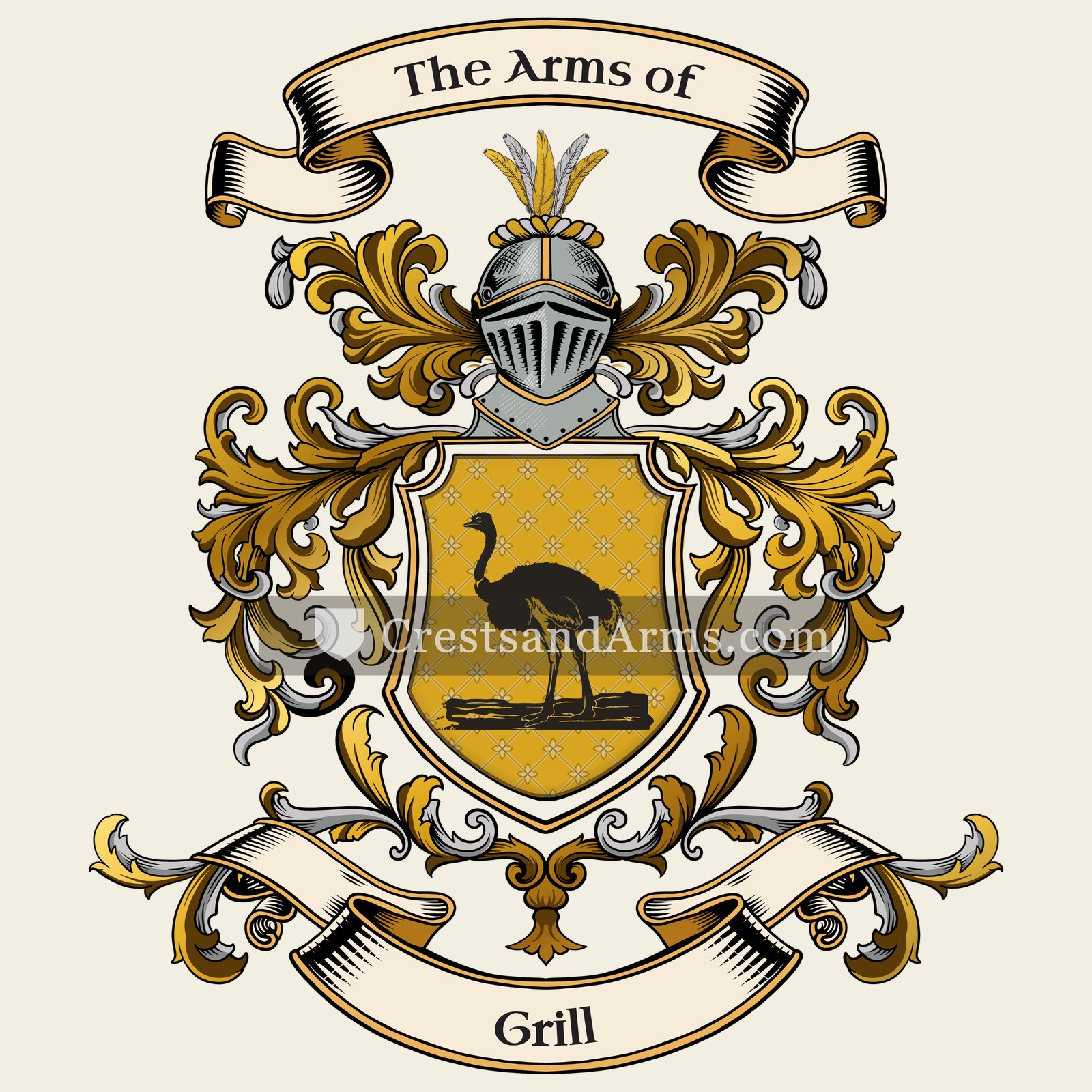
 ostrichWilling obedience and serious thought
 ostrichWilling obedience and serious thought


 cross symbolChristian faith and service