Map of Switzerland showing where the Grilo arms are recorded
The Grilo arms were recorded in Bâle, c. 1745.
This is where the arms were entered in the register. Families often moved to other parts of the country, so the same name can turn up in more than one region.
The body that granted and recorded arms in Switzerland in this period.
How Arms Worked in Switzerland
In Switzerland, coats of arms were not restricted to the nobility and were often adopted by common citizens and families. These symbols were passed down through generations to show family identity. When branches of a family grew, they often changed small details of the design to distinguish their own line from the original group.
Granting authority
Cantonal and civic authorities managed the use of coats of arms within their specific regions and local jurisdictions.
How they got arms
Families typically assumed their own coats of arms based on local custom rather than receiving them from a central monarch.
Where arms were recorded
Arms were recorded in various cantonal and civic registers starting from the fourteenth century throughout the Swiss region.
The family's standing
Recorded among the armigerous families of Switzerland.
Origin & History of the Grilo Family in Switzerland
The family name Grilo carries a history deeply rooted in the linguistic traditions of the Iberian Peninsula, where it functioned as a descriptive nickname derived from the Portuguese and Galician word for cricket. While the name is most frequently associated with regions in Portugal, the presence of the family in Bâle by 1745 suggests a period of significant migration and movement across European borders during the eighteenth century. Families often moved during this era to seek new opportunities in trade or to escape local political instability. By settling in a major commercial hub like Bâle, the early members of the Grilo family likely integrated into a diverse urban society that valued craftsmanship and mercantile connections. This transition from their historical origins to a central European setting highlights the adaptability of the family as they established a new life in a different cultural and linguistic landscape.
Grilo Meaning & Related Branches
Root word
Grillus
Latin term referring to a cricket or a grasshopper.
This name
GriloA nickname likely given to a person who was lively, chirpy, or noisy like a cricket.
also spelled
Grilloh
Grilloe
Grilo
Documented Sources
J. B. Rietstap, Armorial Général, Gouda: G. B. van Goor Zonen, 1884–87
Machado, José Pedro, Dicionário Onomástico Etimológico da Língua Portuguesa, 1981
Staatsarchiv Basel-Stadt, Bürgerverzeichnisse und Einwohnerregister, 1745
Digital archive packCoat of arms PNG, gold border print PDF, vector SVG and the certificate of authenticity. Sent to your email in minutes.


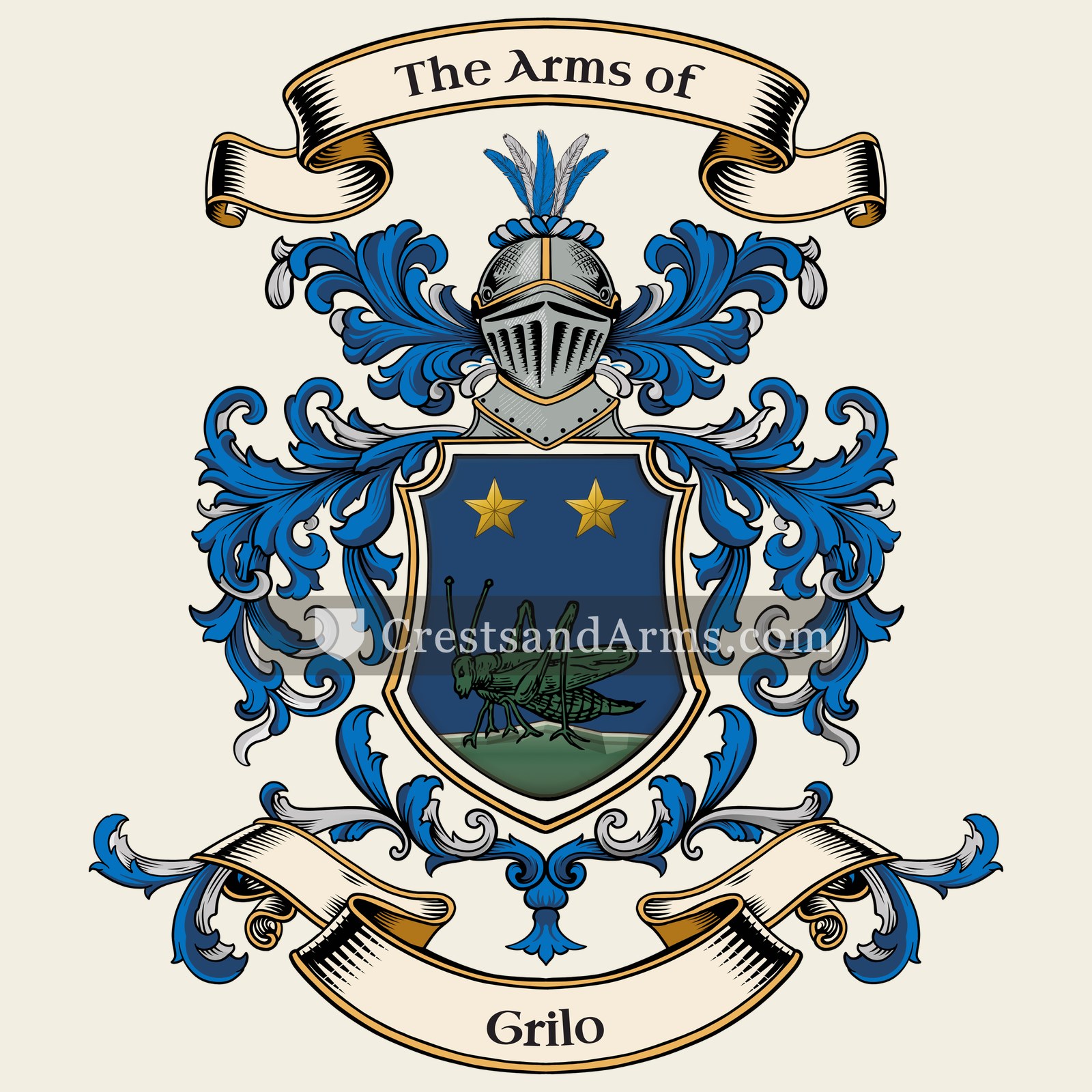
 mountThe ground held, and steadfastness upon it
 grasshopperNobility of birth and joy in the summer of life
 mulletThe third son, and a divine quality from above
 mountThe ground held, and steadfastness upon it
 grasshopperNobility of birth and joy in the summer of life
 mulletThe third son, and a divine quality from above