Map of France showing where the Grima arms are recorded
The Grima arms were recorded in Roussillon, c. 1663.
Roussillon was Pyrenean country that belonged to Spain before it belonged to France. Its families held small estates under both crowns, and serving either one brought a shield.
This is where the arms were entered in the register. Families often moved to other parts of the country, so the same name can turn up in more than one region.
The body that granted and recorded arms in France in this period.
Louis XIV of France
Sovereign of the period
Louis XIV of France
1643–1715
Reigning in France when the Grima arms are first recorded.
How Arms Worked in France
In France, a coat of arms was a mark of honor that passed down through the male line to all legitimate descendants. Families often used the same shield without changes to show their shared heritage. If a branch wanted to stand out, they could add a small mark to their shield to show their specific place in the family tree.
Granting authority
The Juge d'armes de France acted as the official authority that regulated and verified coats of arms across the country.
How they got arms
Families typically inherited their arms from ancestors, though they could also receive them through royal grants or by proving their noble status.
Where arms were recorded
Coats of arms were officially recorded in the Armorial Général de France, which began its main collection in the year 1696.
The family's standing
Recorded among the armigerous families of Roussillon.
Origin & History of the Grima Family in France
The family name Grima has deep roots in the Mediterranean region, with significant historical evidence placing the family in the province of Roussillon by 1663. During this period, Roussillon was a unique cultural crossroads following the Treaty of the Pyrenees, which shifted the territory from Spanish to French control. Families like the Grimas often navigated this transition by maintaining strong ties to local agriculture and trade networks within the foothills of the Pyrenees. The name itself is thought to be linked to ancient linguistic traditions in Southern Europe, possibly originating from descriptive nicknames or occupational titles common in the medieval era. By the mid-seventeenth century, members of the Grima family were well-established as part of the local social fabric, contributing to the development of the region through their roles in village life and land management.
Related Branches & Arms
Root word
Grim
Old Norse term meaning mask, helmet, or fierce.
This name
GrimaDerived from a nickname for a person with a stern or masked appearance.
also spelled
Grimaux
Grimault
Grimo
Documented Sources
J. B. Rietstap, Armorial Général, Gouda: G. B. van Goor Zonen, 1884–87
Archives Départementales des Pyrénées-Orientales, Registres paroissiaux de la commune de Roussillon, 1663
Capeille, Jean, Dictionnaire de biographies roussillonnaises, 1914
Pélissier, Jean-Pierre, Paroisses et communes de France: Pyrénées-Orientales, 1986
Digital archive packCoat of arms PNG, gold border print PDF, vector SVG and the certificate of authenticity. Sent to your email in minutes.


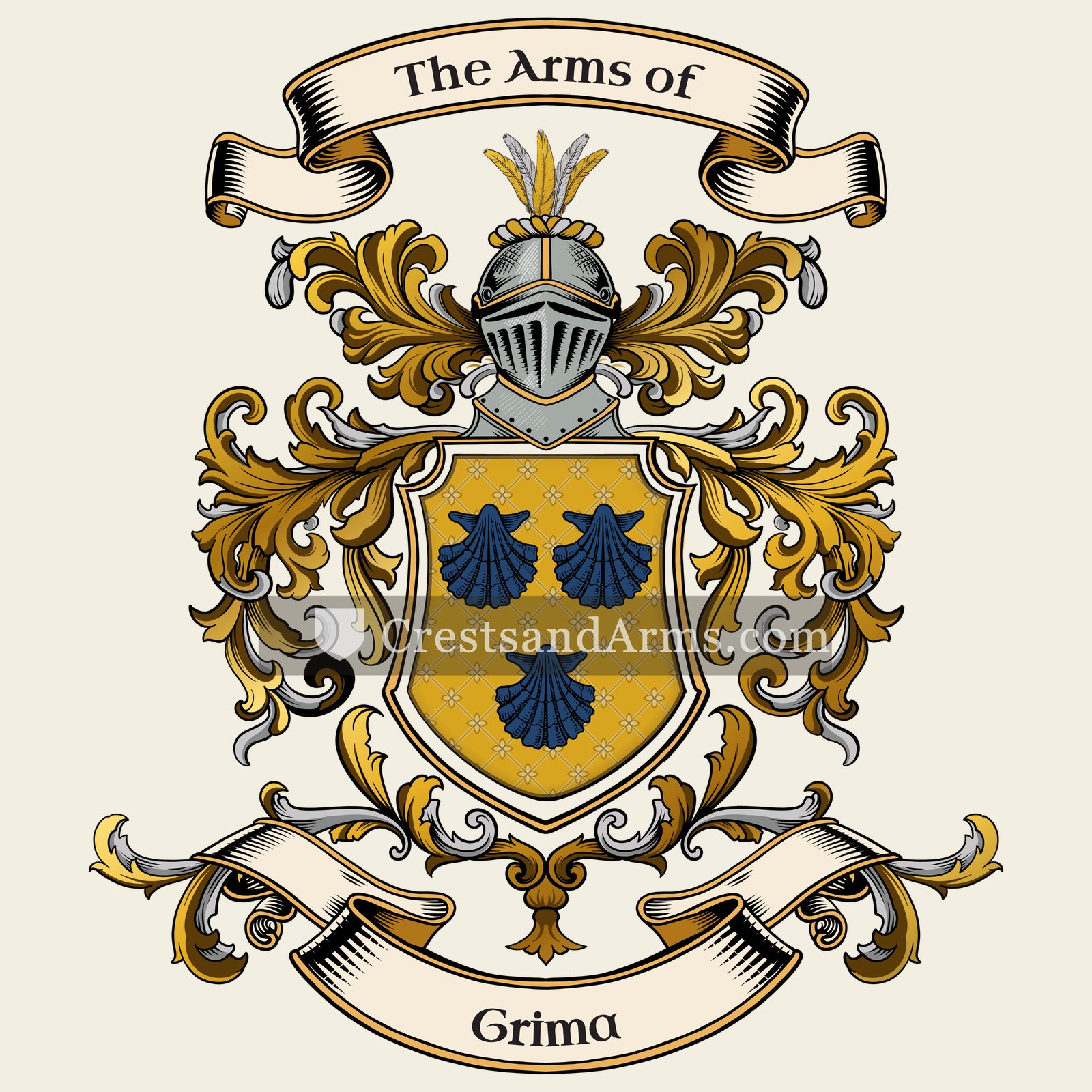
 escallopThe pilgrim's shell, and a long journey made
 escallopThe pilgrim's shell, and a long journey made