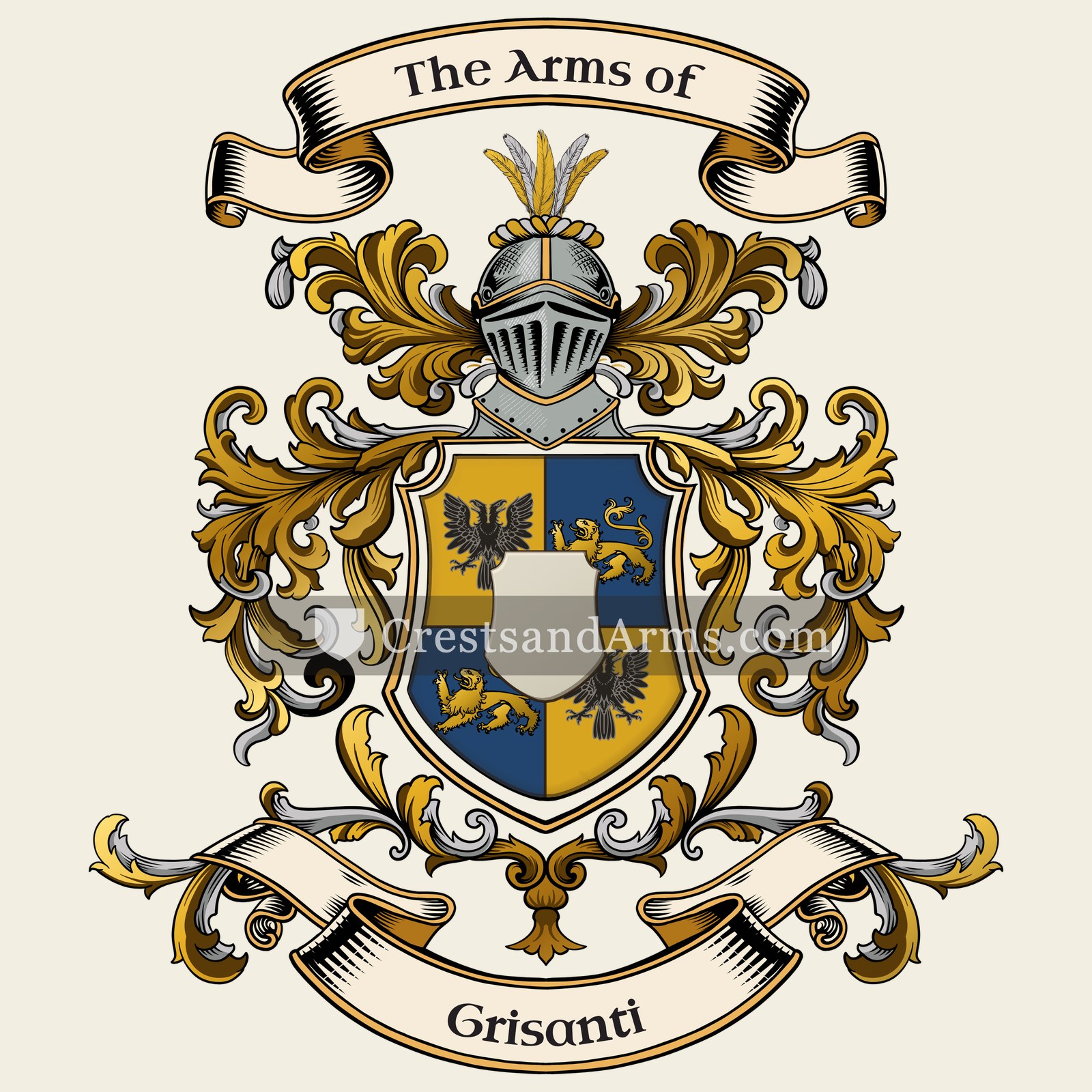
A record of documented arms, meaning and origin, researched for the Grisanti family of Switzerland.
Reg. 4510 · Swiss, G–I
Coat of Arms & Family Crest Details
Symbols on this shield
eagleNobility, strength and a keen mind
lionCourage, strength and royalty
Colours
Gold (Or)Means: Generosity
Blue (Azure)Means: Loyalty and truth
Silver (Argent)Means: Peace and sincerity
Black (Sable)Means: Constancy
Historical info
Source
J. B. Rietstap, Armorial Général, Gouda: G. B. van Goor Zonen, 1884–87
Blazon (the actual original written record)
“Ec.: aux 1 et 4 d'or à la demi-aigle de sa., bq. et cour. d'or, mouv. du parti; aux 2 et 3 d'azur au lion d'or, celui du 3 cont. Sur le tout d'arg., ch. en chef de trois croisettes mal-ordonnées de sa. et en p. d'un annelet du même. Cq. cour. C.: une aigle de sa., bq. et cour. d'or. L.: à dextre d'or et de sa., à sen. d'or et d'azur.”
SwitzerlandBâle, c. 1745
Digital archive packCoat of arms PNG, gold border print PDF, vector SVG and the certificate of authenticity. Sent to your email in minutes.
Map of Switzerland showing where the Grisanti arms are recorded
The Grisanti arms were recorded in Bâle, c. 1745.
This is where the arms were entered in the register. Families often moved to other parts of the country, so the same name can turn up in more than one region.
The body that granted and recorded arms in Switzerland in this period.
How Arms Worked in Switzerland
In Switzerland, coats of arms were not restricted to the nobility and were often adopted by common citizens and families. These symbols were passed down through generations to show family identity. When branches of a family grew, they often changed small details of the design to distinguish their own line from the original group.
Granting authority
Cantonal and civic authorities managed the use of coats of arms within their specific regions and local jurisdictions.
How they got arms
Families typically assumed their own coats of arms based on local custom rather than receiving them from a central monarch.
Where arms were recorded
Arms were recorded in various cantonal and civic registers starting from the fourteenth century throughout the Swiss region.
The family's standing
Recorded among the armigerous families of Switzerland.
Origin & History of the Grisanti Family in Switzerland
The family name Grisanti traces its roots to the cultural crossroads of Europe, with significant historical ties to the city of Bâle, Switzerland, by the year 1745. The name itself is of Italian origin and is traditionally linked to the word "grigio," which means gray. This suggests that the name may have originally served as a descriptive nickname for an ancestor who had gray hair or wore gray clothing. By the mid-eighteenth century, members of the family had established a presence in the bustling trade centers of the Rhine Valley. As they moved through these regions, they integrated into the local merchant and artisan classes, adapting to the social and economic life of the Swiss cantons. This migration pattern reflects the broader movement of families across borders during the Enlightenment, as people sought new opportunities in growing urban centers. Through these early records in Bâle, we see a family that successfully navigated the transition between their Mediterranean heritage and the evolving landscape of Central Europe.
Grisanti Meaning & Related Branches
Root word
Gris
Derived from the Germanic word for gray or hoary.
This name
GrisantiA locative or descriptive surname referring to someone with gray hair or a gray complexion.
also spelled
Grisantie
Grisanty
Documented Sources
J. B. Rietstap, Armorial Général, Gouda: G. B. van Goor Zonen, 1884–87
Staatsarchiv Basel-Stadt, Kirchenbücher der Stadt Basel (Tauf-, Ehe- und Totenregister), 1745
Fah, Albert, Die Einwanderung italienischer Familien in die Schweiz, 1922
Digital archive packCoat of arms PNG, gold border print PDF, vector SVG and the certificate of authenticity. Sent to your email in minutes.


 eagleNobility, strength and a keen mind
 lionCourage, strength and royalty
 eagleNobility, strength and a keen mind
 lionCourage, strength and royalty