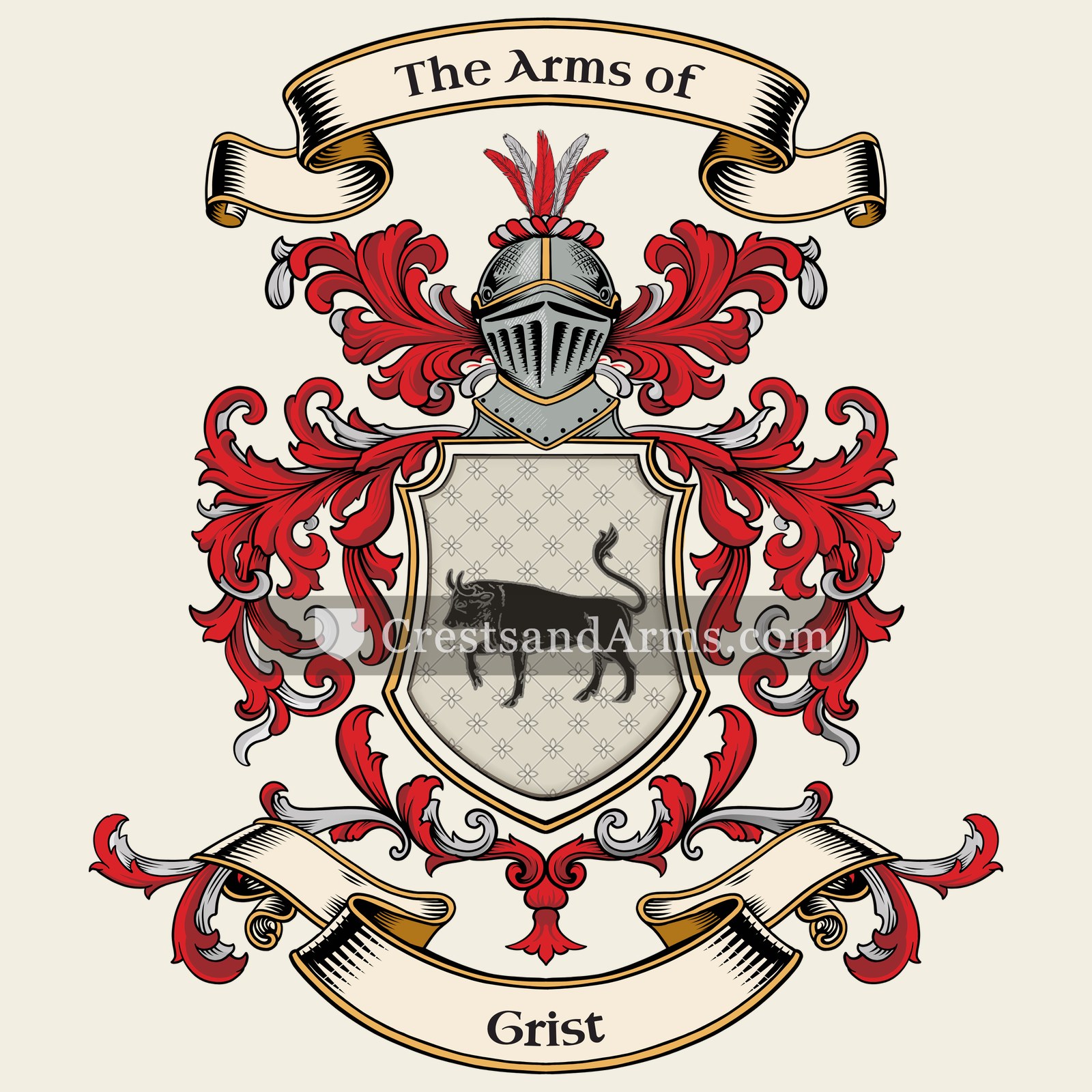
A record of documented arms, meaning and origin, researched for the Grist family of Germany.
Reg. 7440 · German, G–I
Coat of Arms & Family Crest Details
Symbols on this shield
bullValour and generosity
Colours
Silver (Argent)Means: Peace and sincerity
Black (Sable)Means: Constancy
Historical info
Source
J. B. Rietstap, Armorial Général, Gouda: G. B. van Goor Zonen, 1884–87
Blazon (the actual original written record)
“D'arg. à un rencontre de boeuf de sa., sommé d'un vol du même. C.: un tronc d'arbre de sa., poussant six branches du même; chaque branche enfilée d'une couronne d'or, et le tronc sommé d'une couronne pareille.”
PomeraniaPomerania, c. 1765
Digital archive packCoat of arms PNG, gold border print PDF, vector SVG and the certificate of authenticity. Sent to your email in minutes.
Map of Germany showing where the Grist arms are recorded
The Grist arms were recorded in Pomerania, c. 1765.
Pomerania was flat farming country on the Baltic coast, held in large estates by a small number of families. They kept their land for generations, and generations of landholding is what fills the registers.
This is where the arms were entered in the register. Families often moved to other parts of the country, so the same name can turn up in more than one region.
The body that granted and recorded arms in Germany in this period.
Francis I, Holy Roman Emperor
Sovereign of the period
Francis I, Holy Roman Emperor
1745–1765
Reigning in Germany when the Grist arms are first recorded.
How Arms Worked in Germany
In the Holy Roman Empire, coats of arms were often granted to individuals by the Emperor or his representatives. These arms were then passed down through the generations to all legitimate descendants of the original holder. Younger branches of a family usually kept the same shield design without needing to change it, as the arms belonged to the entire lineage.
Granting authority
The Holy Roman Emperor held the sole power to grant new coats of arms throughout his vast imperial territories.
How they got arms
Families typically obtained their coats of arms through a formal imperial grant or by proving their noble status to the authorities.
Where arms were recorded
These grants were officially recorded in the Imperial Chancery registers, which began keeping formal records of such honors during the Middle Ages.
The family's standing
Recorded among the armigerous families of Pomerania.
Origin & History of the Grist Family in Germany
The name Grist is rooted in the occupational history of Northern Europe, specifically within the region of Pomerania. By the year 1765, records confirm that families bearing this name were established in this coastal area, which was then part of the Kingdom of Prussia. The name itself is derived from the Middle English and Germanic terms related to grain and the milling process. It is highly likely that the earliest ancestors were millers or individuals who managed the processing of cereal crops. Because Pomerania was a vital agricultural hub during the eighteenth century, the Grist family would have played a crucial role in the local economy by turning raw harvests into the flour needed for daily survival. This connection to the land and the essential trade of milling suggests a family history defined by hard work and a steady contribution to the food supply of their rural communities.
Related Branches & Arms
Root word
Gerst
Old High German term referring to the cereal grain barley.
This name
GristAn occupational name for a grower, dealer, or processor of barley.
also spelled
Gristowe
Grystow
Gristau
Documented Sources
J. B. Rietstap, Armorial Général, Gouda: G. B. van Goor Zonen, 1884–87
Landesarchiv Greifswald, Kirchenbücher der Provinz Pommern
Geheimes Staatsarchiv Preußischer Kulturbesitz, General-Tabellen der preußischen Provinzen
Heitz, Gerhard, Ländliche Struktur und bäuerlicher Widerstand in Mecklenburg und Pommern, 1963
Müller, Friedrich, Die Familiennamen in Pommern, 1928
Digital archive packCoat of arms PNG, gold border print PDF, vector SVG and the certificate of authenticity. Sent to your email in minutes.


 bullValour and generosity
 bullValour and generosity