A record of documented arms, meaning and origin, researched for the Gro family lines. Documented in 3 countries.
Reg. 7607 · French, G–I
Coat of Arms & Family Crest Details
Symbols on this shield
ringFidelity, and a promise kept
fleur de lisPurity, light, and the sixth son
Colours
Gold (Or)Means: Generosity
Blue (Azure)Means: Loyalty and truth
Historical info
Source
J. B. Rietstap, Armorial Général, Gouda: G. B. van Goor Zonen, 1884–87
Blazon (the actual original written record)
“d'or et d'azur, à trois annelets de l'un à l'autre, 2 et 1; au 4 parti d'or et d'azur, à trois fleurs-de-lis de l'un à l'autre, 2 et 1. Cq. cour. C.: trois bâtons fleurdelisés, celui à dextre d'or, celui à sen. d'azur, celui du milieu parti d'or et d'azur.”
Francec. 1663
Digital archive packCoat of arms PNG, gold border print PDF, vector SVG and the certificate of authenticity. Sent to your email in minutes.
Map of France showing where the Gro arms are recorded
The Gro arms were recorded in France, c. 1663.
Arms such as these were typically recorded in Bretagne.
More families held coats of arms in Bretagne than anywhere else in France. The land was divided into many small estates rather than a few large ones, so far more households counted as gentry, and each needed a shield of its own to be told apart.
This is where the arms were entered in the register. Families often moved to other parts of the country, so the same name can turn up in more than one region.
The body that granted and recorded arms in France in this period.
Louis XIV of France
Sovereign of the period
Louis XIV of France
1643–1715
Reigning in France when the Gro arms are first recorded.
How Arms Worked in France
In France, a coat of arms was a mark of honor that passed down through the male line to all legitimate descendants. Families often used the same shield without changes to show their shared heritage. If a branch wanted to stand out, they could add a small mark to their shield to show their specific place in the family tree.
Granting authority
The Juge d'armes de France acted as the official authority that regulated and verified coats of arms across the country.
How they got arms
Families typically inherited their arms from ancestors, though they could also receive them through royal grants or by proving their noble status.
Where arms were recorded
Coats of arms were officially recorded in the Armorial Général de France, which began its main collection in the year 1696.
The family's standing
Recorded among the armigerous families of France.
Origin & History of the Gro Family in France
The family name Gro has deep roots in the historical landscape of Brittany, where records confirm the presence of family members as early as 1663. In the context of seventeenth-century France, the name likely functioned as a descriptive surname, often used to distinguish individuals based on physical stature or personality traits. During this era, Brittany was a culturally distinct province with its own social structures, and families like the Gro were typically tied to the local agricultural or maritime economies that defined the region. As the family established itself in these coastal communities, they became part of the complex web of parish life and local governance that characterized rural French society. By tracing their history back to this period, we see a family that was deeply integrated into the daily rhythms of Breton life, contributing to the growth and stability of their local parishes long before the major social upheavals of the following century.
Coat of Arms & Family Crest Details
Symbols on this shield
chevronProtection, and faithful service completed
Colours
Silver (Argent)Means: Peace and sincerity
Black (Sable)Means: Constancy
Historical info
Source
J. B. Rietstap, Armorial Général, Gouda: G. B. van Goor Zonen, 1884–87
Blazon (the actual original written record)
“D'arg. à deux chev. de sa. C.: deux prob. d'arg., celle à dextre ch. de deux barres de sa. et celle à sen. de deux bandes du même.”
GermanyRothenburg Bav, c. 1765
Digital archive packCoat of arms PNG, gold border print PDF, vector SVG and the certificate of authenticity. Sent to your email in minutes.
Map of Germany showing where the Gro arms are recorded
The Gro arms were recorded in Rothenburg Bav, c. 1765.
This is where the arms were entered in the register. Families often moved to other parts of the country, so the same name can turn up in more than one region.
The body that granted and recorded arms in Germany in this period.
Francis I, Holy Roman Emperor
Sovereign of the period
Francis I, Holy Roman Emperor
1745–1765
Reigning in France when the Gro arms are first recorded.
How Arms Worked in Germany
In the Holy Roman Empire, coats of arms were often granted to individuals by the Emperor or his representatives. These arms were then passed down through the generations to all legitimate descendants of the original holder. Younger branches of a family usually kept the same shield design without needing to change it, as the arms belonged to the entire lineage.
Granting authority
The Holy Roman Emperor held the sole power to grant new coats of arms throughout his vast imperial territories.
How they got arms
Families typically obtained their coats of arms through a formal imperial grant or by proving their noble status to the authorities.
Where arms were recorded
These grants were officially recorded in the Imperial Chancery registers, which began keeping formal records of such honors during the Middle Ages.
The family's standing
Recorded among the armigerous families of Germany.
Origin & History of the Gro Family in Germany
The family name Gro is deeply rooted in the historical landscape of southern Germany, where it emerged as a descriptive surname during the Middle Ages. In the German language, the root of the name is associated with the word groß, which translates to large or tall. It is likely that the name was originally a nickname given to a person of significant physical stature or perhaps someone who held a prominent position within their local community. By the year 1765, records confirm that members of the Gro family were established residents of the medieval town of Rothenburg ob der Tauber. During this period, Rothenburg was a thriving center of trade and craftsmanship, and families living there were often integrated into the town’s guild system. As citizens of such a well-preserved imperial city, the early Gro family members would have participated in the daily civic life, religious traditions, and economic activities that defined life in the Holy Roman Empire.
Coat of Arms & Family Crest Details
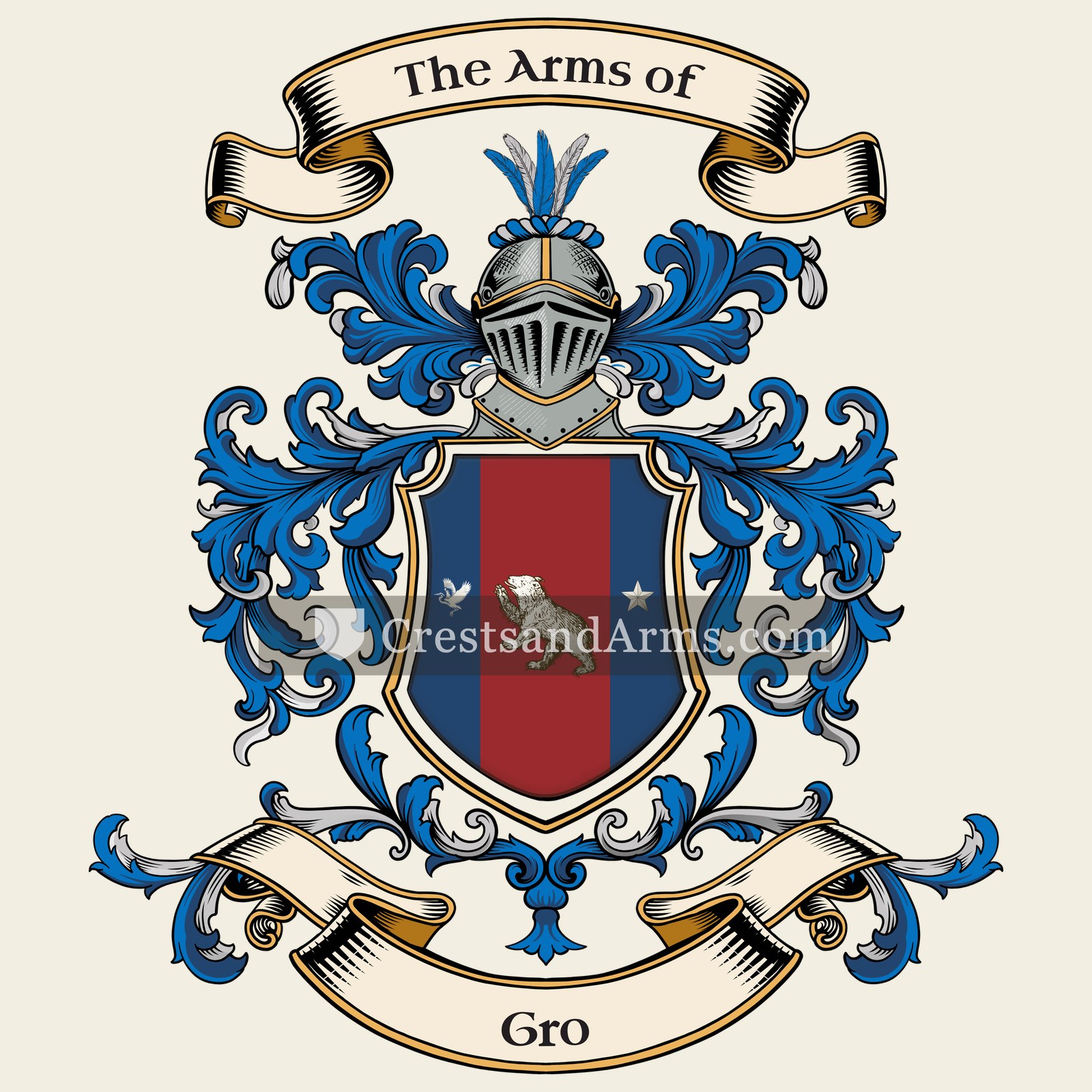
Symbols on this shield
heronPatience and quiet watchfulness
bearStrength, cunning and protection of kin
mulletThe third son, and a divine quality from above
Colours
Blue (Azure)Means: Loyalty and truth
Red (Gules)Means: Military strength
Silver (Argent)Means: Peace and sincerity
Historical info
Source
J. B. Rietstap, Armorial Général, Gouda: G. B. van Goor Zonen, 1884–87
Blazon (the actual original written record)
“Tiercé en pal: au 1 d'azur à une grue au nat.; au 2 de gu. à un ours ramp. au nat.; au 3 d'azur à une étoile d'arg.”
Spainc. 1722
Digital archive packCoat of arms PNG, gold border print PDF, vector SVG and the certificate of authenticity. Sent to your email in minutes.
Map of Spain showing where the Gro arms are recorded
The Gro arms were recorded in Spain, c. 1722.
Arms such as these were typically recorded in Castile.
Castile was the heart of Spain and the source of most of its noble families. Land won in the long wars against the Moors was granted out to fighting men, and a man granted land was granted arms along with it.
This is where the arms were entered in the register. Families often moved to other parts of the country, so the same name can turn up in more than one region.
The body that granted and recorded arms in Spain in this period.
Philip V of Spain
Sovereign of the period
Philip V of Spain
1714–1724
Reigning in France when the Gro arms are first recorded.
How Arms Worked in Spain
In Spain, a coat of arms was considered a form of property that belonged to the entire family line. These arms were passed down from a father to all his children equally. Younger branches of the family usually kept the original design without needing to add any special marks to distinguish their specific line.
Granting authority
The Cronista Rey de Armas was the official body that regulated and granted coats of arms throughout Spain.
How they got arms
Families often obtained their arms through royal grants or by proving their noble status to the official heraldic authority.
Where arms were recorded
Coats of arms were officially recorded in the registers of the Cronista Rey de Armas starting in 1496.
The family's standing
Recorded among the armigerous families of Spain.
Origin & History of the Gro Family in Spain
The surname Gro is a rare and distinct name that first appears in the historical records of Castile during the early eighteenth century. By 1722, members of the family were already established within the social fabric of this central Spanish region, a time when Castile served as the political and cultural heart of the kingdom. Because the name does not follow the traditional linguistic patterns of common Spanish surnames, historians often suggest that the family may have originated from migratory movements or cross-border exchanges between Spain and neighboring European regions. These early ancestors likely navigated the complex administrative systems of the Spanish Crown, which required families to document their residency and lineage for tax and legal purposes. As the family settled into Castilian life, they integrated into the local economy and community, leaving behind a legacy that reflects the broader patterns of internal migration and social development in eighteenth-century Spain.
Gro Meaning & Related Branches
Root word
Crassus
A Latin term meaning thick, fat, or dense.
This name
GroA descriptive nickname for a person of large or stout physical stature.
also spelled
Groos
Gro
Gross
Documented Sources
J. B. Rietstap, Armorial Général, Gouda: G. B. van Goor Zonen, 1884–87
Archives départementales du Morbihan, Série E (Registres paroissiaux et d'état civil)
Dauzat, Albert, Dictionnaire étymologique des noms et prénoms de France, 1951
Morlet, Marie-Thérèse, Dictionnaire étymologique des noms de famille, 1991
Digital archive packCoat of arms PNG, gold border print PDF, vector SVG and the certificate of authenticity. Sent to your email in minutes.


 ringFidelity, and a promise kept
 fleur de lisPurity, light, and the sixth son
 ringFidelity, and a promise kept
 fleur de lisPurity, light, and the sixth son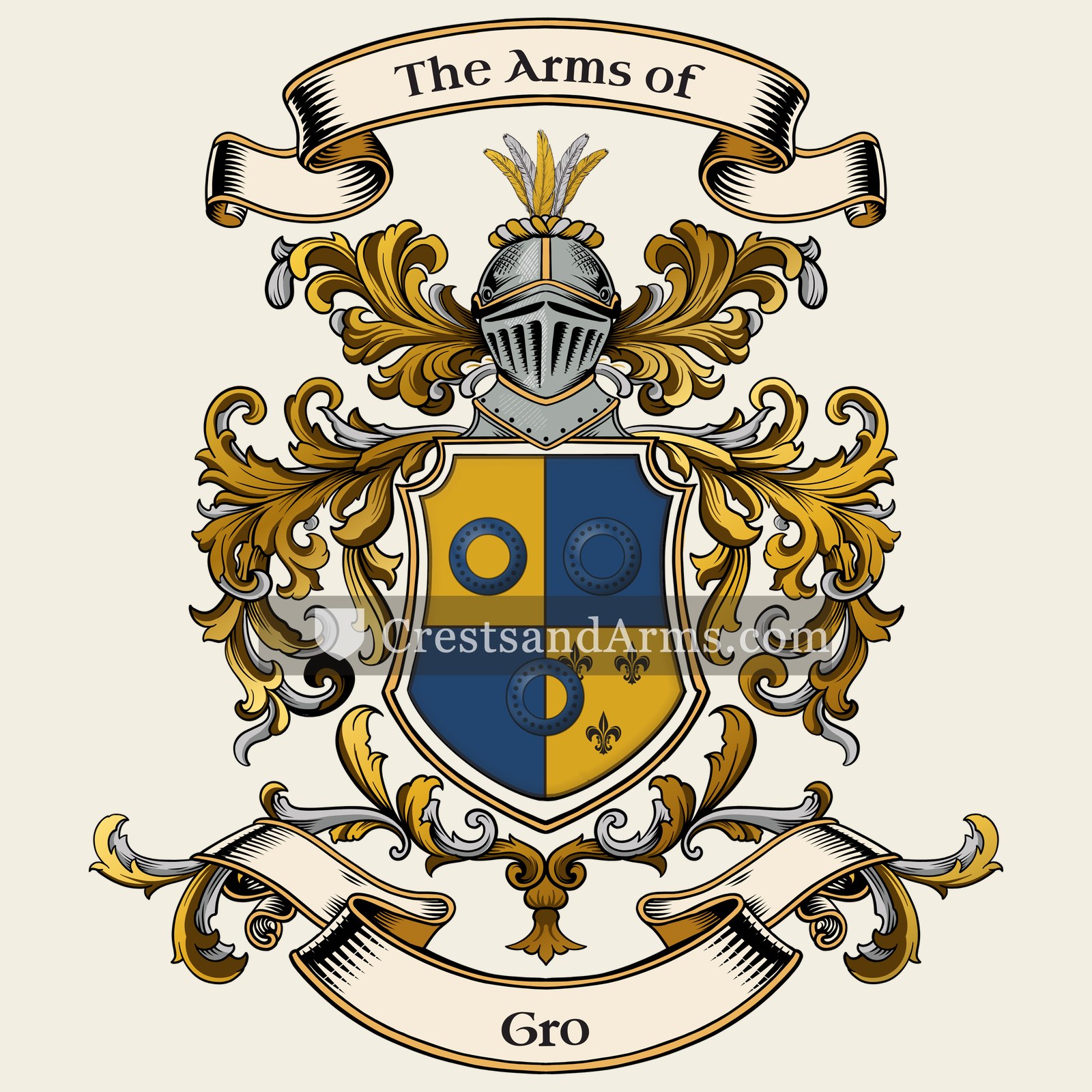


 chevronProtection, and faithful service completed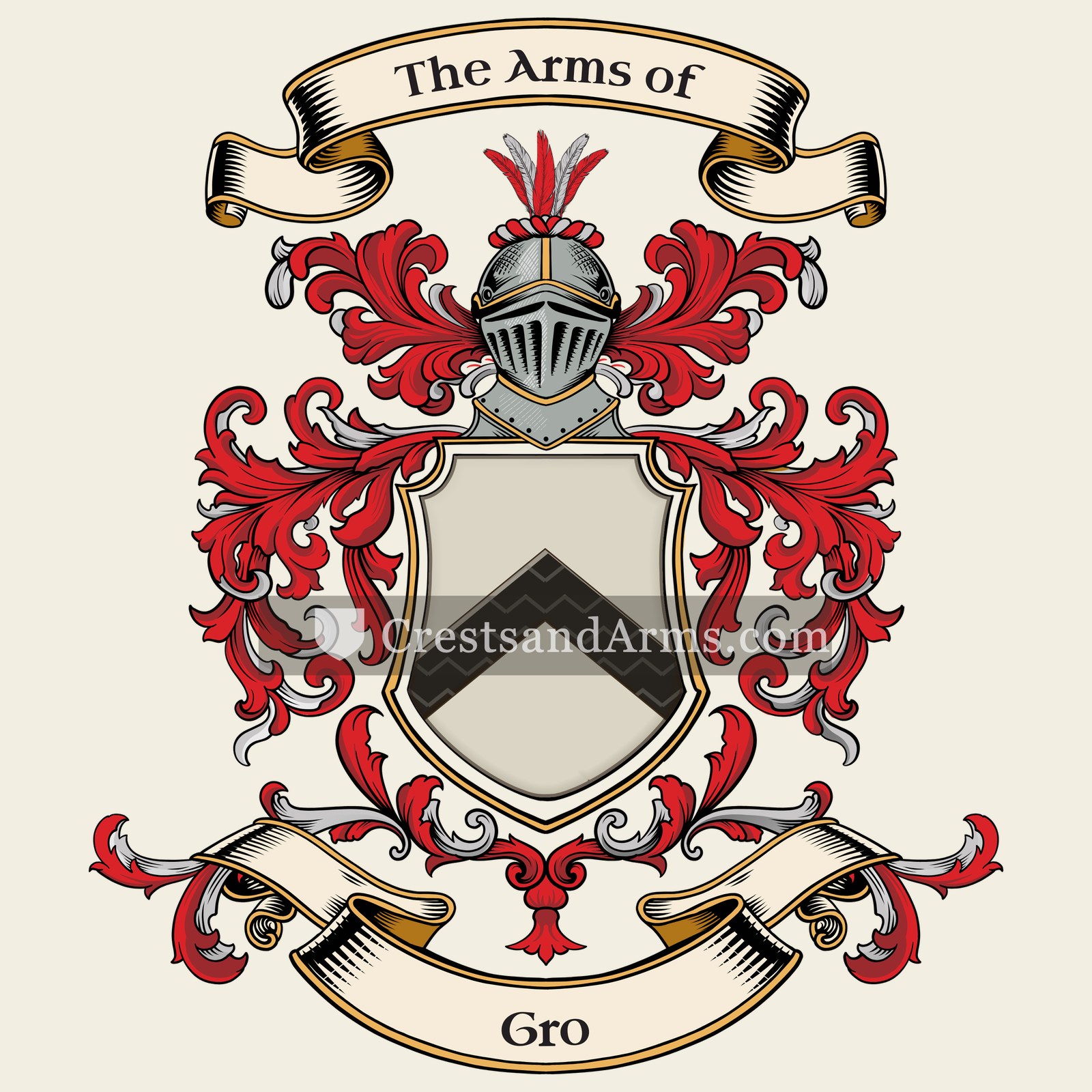


 heronPatience and quiet watchfulness
 bearStrength, cunning and protection of kin
 mulletThe third son, and a divine quality from above