A record of documented arms, meaning and origin, researched for the Grogan family lines. Documented in 2 countries.
Reg. 8996 · French, G–I
Coat of Arms & Family Crest Details
Symbols on this shield
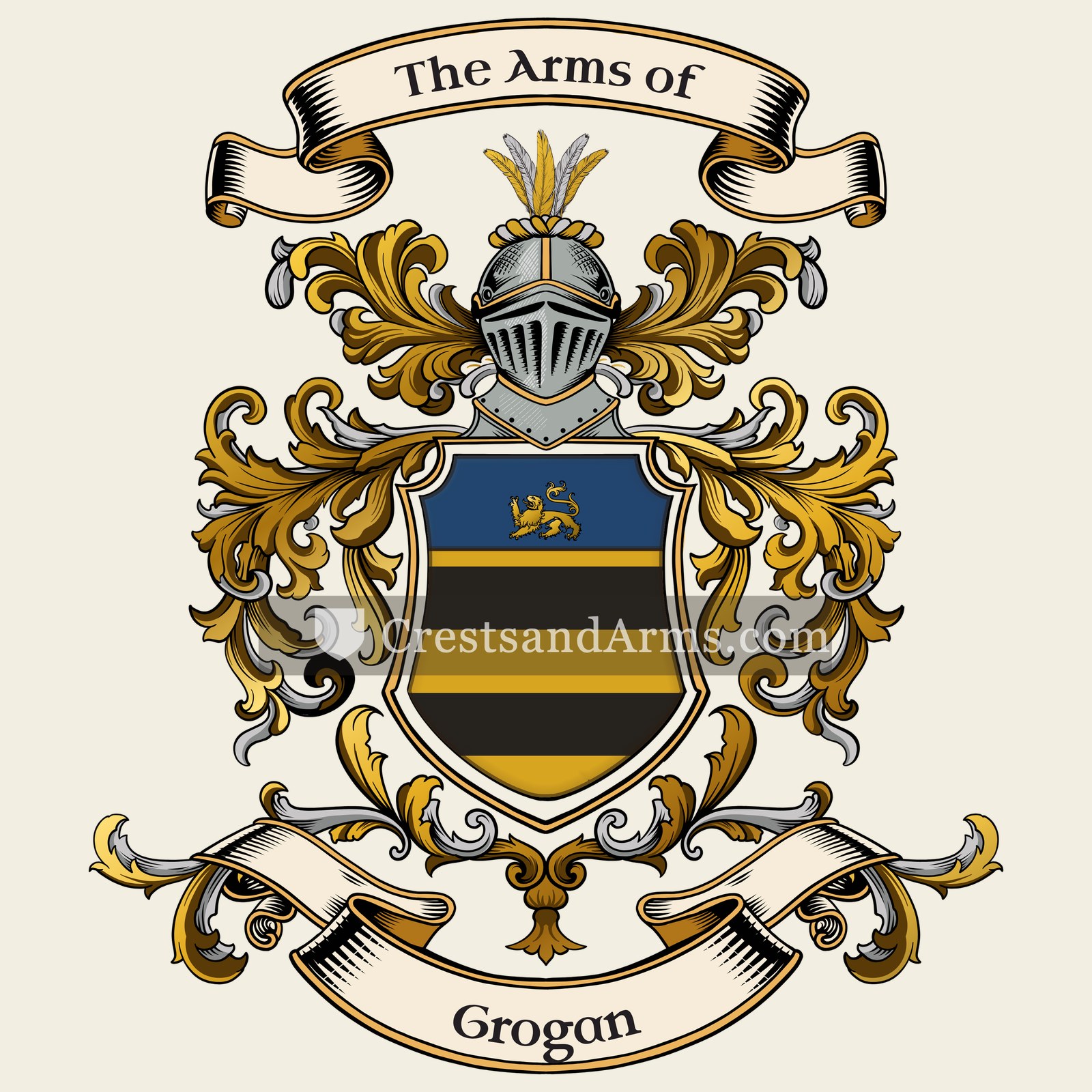
fessThe military belt, and readiness to serve
chiefAuthority, wisdom and dominion
lionCourage, strength and royalty
Colours
Gold (Or)Means: Generosity
Blue (Azure)Means: Loyalty and truth
Black (Sable)Means: Constancy
Historical info
Source
J. B. Rietstap, Armorial Général, Gouda: G. B. van Goor Zonen, 1884–87
Blazon (the actual original written record)
“Fascé d'or et de sa., au chef cannelé d'azur, ch. d'un lion léopardé du premier. C.: une tête et col de lion de sa. ch. d'une étoile d'or. D.: HONOR ET VIRTUS.”
DublinDublin, c. 1859
Digital archive packCoat of arms PNG, gold border print PDF, vector SVG and the certificate of authenticity. Sent to your email in minutes.
Map of France showing where the Grogan arms are recorded
The Grogan arms were recorded in Dublin, c. 1859.
Dublin was the seat of government in Ireland and the place where grants were sought and recorded. Families with business at the castle or the courts settled nearby, and settling there put their arms on record.
This is where the arms were entered in the register. Families often moved to other parts of the country, so the same name can turn up in more than one region.
The body that granted and recorded arms in France in this period.
Napoleon III
Sovereign of the period
Napoleon III
1852–1870
Reigning in France when the Grogan arms are first recorded.
How Arms Worked in France
In France, a coat of arms was a mark of honor that passed down through the male line to all legitimate descendants. Families often used the same shield without changes to show their shared heritage. If a branch wanted to stand out, they could add a small mark to their shield to show their specific place in the family tree.
Granting authority
The Juge d'armes de France acted as the official authority that regulated and verified coats of arms across the country.
How they got arms
Families typically inherited their arms from ancestors, though they could also receive them through royal grants or by proving their noble status.
Where arms were recorded
Coats of arms were officially recorded in the Armorial Général de France, which began its main collection in the year 1696.
The family's standing
Recorded among the armigerous families of Dublin.
Origin & History of the Grogan Family in France
The name Grogan is primarily associated with Irish heritage, but its roots are deeply connected to the movement of people across Europe, including early influences from France. The name is an Anglicized version of the Gaelic surname Ó Gruagáin, which translates to descendant of the hairy or long-haired one. Long before family members were documented living in Dublin in 1859, the name likely evolved during a period when French influence was strong in the British Isles following the Norman Conquest. Many families with similar Gaelic origins adopted administrative structures and naming conventions that were influenced by the French-speaking nobility who held power in Ireland during the medieval era. While the family became firmly established in the social and professional life of Dublin by the mid-nineteenth century, their ancestors were part of a long history of migration and cultural blending that defined the Irish population for centuries.
Coat of Arms & Family Crest Details
Symbols on this shield
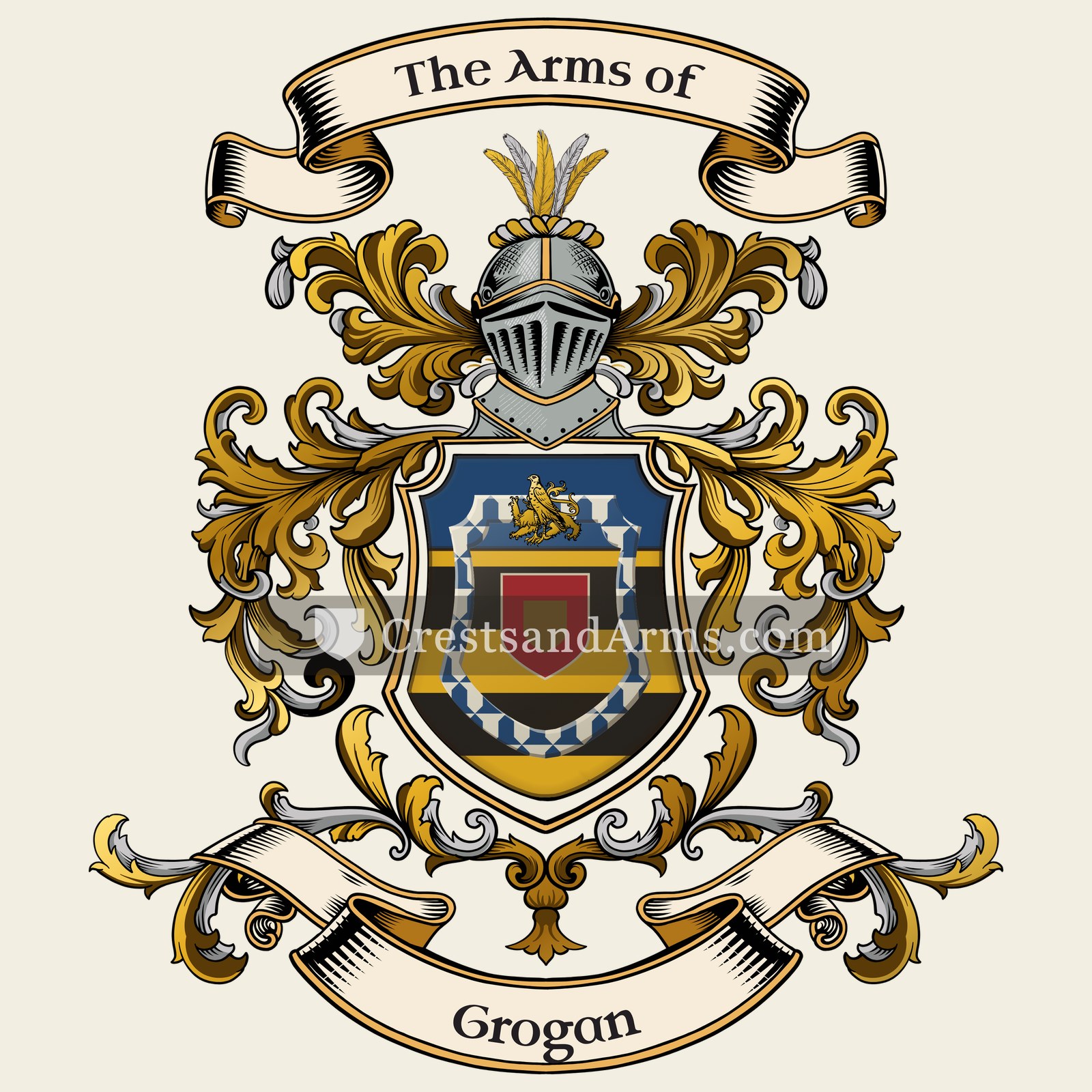
chiefAuthority, wisdom and dominion
orlePreservation, and protection in battle
lionCourage, strength and royalty
escutcheonA shield within a shield, and a claim inherited
falconOne eager and quick in pursuit
Colours
Gold (Or)Means: Generosity
Blue (Azure)Means: Loyalty and truth
Silver (Argent)Means: Peace and sincerity
Red (Gules)Means: Military strength
Black (Sable)Means: Constancy
Historical info
Source
Sir Bernard Burke, The General Armory of England, Scotland, Ireland and Wales, London: Harrison & Sons, 1884
Blazon (the actual original written record)
“Barry of six or and sa. on a chief az. a lion pass. of the first, an escutcheon of pretence gu. a falcon rising or, within an orle ar. the inner rim engr. the outer wavy”
WexfordJohnstown · Wexford, c. 1757
Digital archive packCoat of arms PNG, gold border print PDF, vector SVG and the certificate of authenticity. Sent to your email in minutes.
Map of Ireland showing where the Grogan arms are recorded
The Grogan arms were recorded in Wexford, c. 1757.
Wexford was the corner of Ireland closest to Wales, settled early by Norman families. They held their land under arms and kept it for generations, which is why so many Wexford names carry recorded shields.
This is where the arms were entered in the register. Families often moved to other parts of the country, so the same name can turn up in more than one region.
The body that granted and recorded arms in Ireland in this period.
George II of Great Britain
Sovereign of the period
George II of Great Britain
1727–1760
Reigning in France when the Grogan arms are first recorded.
How Arms Worked in Ireland
The Ulster King of Arms granted coats of arms to individuals who proved their social standing and good character. These symbols were typically inherited by all legitimate descendants of the original holder. If a family branch wanted a unique look, they could apply for a specific change to their design through the office to ensure their identity remained distinct.
Granting authority
The Ulster King of Arms acted as the official body that regulated and issued all coats of arms throughout Ireland.
How they got arms
Families obtained their arms through formal grants issued by the office after proving their eligibility and paying the required fees.
Where arms were recorded
All official grants were recorded in the registers held by the Ulster King of Arms starting from the year 1552.
The family's standing
Recorded among the armigerous families of Wexford.
Origin & History of the Grogan Family in Ireland
The surname Grogan is deeply rooted in the history of Ireland, particularly within the southeastern county of Wexford. The name is an anglicized version of the Gaelic Irish name Ó Gruagáin, which is derived from the word gruagach, meaning a hairy or long-haired person. This suggests that the name may have originally been a descriptive nickname for an ancestor who was known for a distinctive appearance. By the mid-18th century, the Grogan family had established a firm presence in Wexford, where they became notable figures in local society and land ownership. Their history in this region reflects the broader transition of Irish families during this era, as they moved from traditional Gaelic roots into the changing social and economic landscape of 18th-century Ireland. The family’s longevity in Wexford highlights how surnames often became tied to specific geographic areas as they were passed down through generations.
Grogan Meaning & Related Branches
Root word
Grogán
Derived from the Gaelic word for a person with a large nose.
This name
GroganAn Irish surname originating from the Gaelic term for a hook-nosed or fierce individual.
also spelled
Groggen
Related arms
Esmonderecorded with Grogan, same area
Reynoldsrecorded with Grogan, same area
Documented Sources
J. B. Rietstap, Armorial Général, Gouda: G. B. van Goor Zonen, 1884–87
MacLysaght, Edward. The Surnames of Ireland. 1985
Woulfe, Patrick. Sloinnte Gaedheal is Gall. 1923
National Archives of Ireland, 1859 Dublin City Valuation Records
Digital archive packCoat of arms PNG, gold border print PDF, vector SVG and the certificate of authenticity. Sent to your email in minutes.


 fessThe military belt, and readiness to serve
 chiefAuthority, wisdom and dominion
 lionCourage, strength and royalty
 fessThe military belt, and readiness to serve
 chiefAuthority, wisdom and dominion
 lionCourage, strength and royalty


 orlePreservation, and protection in battle
 escutcheonA shield within a shield, and a claim inherited
 falconOne eager and quick in pursuit