A record of documented arms, meaning and origin, researched for the Groll family lines. Documented in 3 countries.
Reg. 2936 · Dutch, G–I
Coat of Arms & Family Crest Details
Symbols on this shield
bearStrength, cunning and protection of kin
roundelA coin, and one who has been to the crusades
Colours
Gold (Or)Means: Generosity
Black (Sable)Means: Constancy
Historical info
Source
J. B. Rietstap, Armorial Général, Gouda: G. B. van Goor Zonen, 1884–87
Blazon (the actual original written record)
“D'or à un ours ramp. de sa., coll. et bouclé d'or, portant de sa patte sen. à sa bouche une boule d'or. C.: un ours pass. de sa., coll. et bouclé d'or (Arm. v. G.)”
Netherlandsc. 1815
Digital archive packCoat of arms PNG, gold border print PDF, vector SVG and the certificate of authenticity. Sent to your email in minutes.
Map of Netherlands showing where the Groll arms are recorded
The Groll arms were recorded in Netherlands, c. 1815.
Arms such as these were typically recorded in Friesland.
Friesland was low, wet country on the northern coast of the Netherlands, farmed by families who had held the same land for centuries. Free landholders were unusually common there, and a free landholder could carry arms.
This is where the arms were entered in the register. Families often moved to other parts of the country, so the same name can turn up in more than one region.
Region
Friesland
First recorded
1815
Granting Authority for the Groll Arms
Hoge Raad van Adel
Photograph made by me · CC BY-SA 3.0
The body that granted and recorded arms in Netherlands in this period.
William I of the Netherlands
Sovereign of the period
William I of the Netherlands
1815–1840
Reigning in Netherlands when the Groll arms are first recorded.
How Arms Worked in Netherlands
In the Netherlands, coats of arms were often used by noble families and those who held specific public offices. These arms were passed down through the generations to legitimate descendants. Younger branches of a family usually kept the original design without needing to add special marks. This system ensured that the family identity remained clear and consistent over many years.
Granting authority
The Hoge Raad van Adel is the official body that regulates and manages noble titles and coats of arms in the Netherlands.
How they got arms
Families typically obtained their coats of arms through official royal grants or by proving their long-standing historical use of the symbols.
Where arms were recorded
Coats of arms are officially recorded in the registers held by the Hoge Raad van Adel, which began its work in 1814.
The family's standing
Recorded among the armigerous families of Netherlands.
Origin & History of the Groll Family in Netherlands
The history of the Groll family in the Netherlands is deeply connected to the northern province of Friesland, where records confirm their presence by the early nineteenth century. The name itself likely originated as a topographic descriptor, referring to individuals who lived near a specific location or settlement known as Groll. During the Napoleonic era and the subsequent formation of the Kingdom of the Netherlands, the government required citizens to adopt fixed surnames for official registration. This period of administrative reform helped solidify the family name as it transitioned from a local identifier into a formal hereditary surname. By 1815, families bearing this name were well-integrated into the local Frisian community, participating in the agricultural and social life of the region. Their presence in these early civil registries serves as a vital link to understanding how the family established its roots during a time of significant national change.
Coat of Arms & Family Crest Details
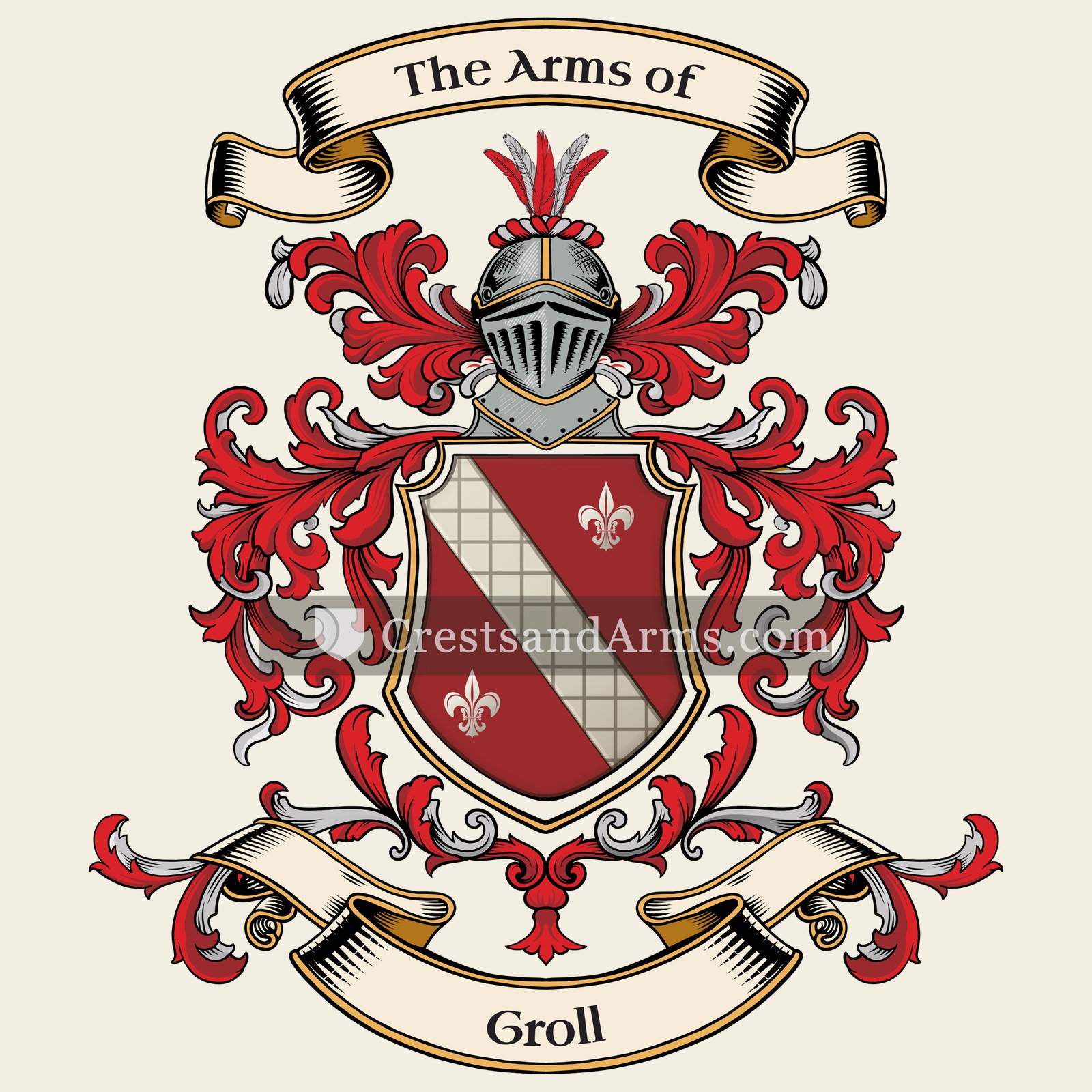
Symbols on this shield
bendDefence, and the scarf of a commander
fleur de lisPurity, light, and the sixth son
Colours
Red (Gules)Means: Military strength
Silver (Argent)Means: Peace and sincerity
Historical info
Source
J. B. Rietstap, Armorial Général, Gouda: G. B. van Goor Zonen, 1884–87
Blazon (the actual original written record)
“De gu. à la bande d'arg., acc. de deux fleurs-de-lis du même. Cq. cour. C.: un bouquetin iss. d'arg., langué de gu.”
WurttembergWurttemberg, c. 1880
Digital archive packCoat of arms PNG, gold border print PDF, vector SVG and the certificate of authenticity. Sent to your email in minutes.
Map of Germany showing where the Groll arms are recorded
The Groll arms were recorded in Wurttemberg, c. 1880.
Wurttemberg was southern German country of small estates and well-off market towns. Both landowners and leading townsmen kept arms there, so the region carries far more names than its size suggests.
This is where the arms were entered in the register. Families often moved to other parts of the country, so the same name can turn up in more than one region.
The body that granted and recorded arms in Germany in this period.
Wilhelm I
Sovereign of the period
Wilhelm I
1861–1888
Reigning in Netherlands when the Groll arms are first recorded.
How Arms Worked in Germany
Prussian heraldry was strictly tied to social rank and noble status rather than being a free choice for every citizen. These symbols were treated as permanent family property that moved through the generations to all legitimate heirs. If a family branch wanted to change their design to stand out, they had to apply for official permission to alter their specific version of the shield.
Granting authority
The Prussian Heroldsamt acted as the central state office that managed and strictly controlled all noble titles and coats of arms.
How they got arms
Families usually obtained their arms through formal royal grants or by proving their long-standing noble status to the state authorities.
Where arms were recorded
All official coats of arms were kept in the rolls of the Prussian Heroldsamt, which functioned from 1706 until 1918.
The family's standing
Recorded among the armigerous families of Wurttemberg.
Origin & History of the Groll Family in Germany
The surname Groll has deep roots in the German-speaking regions of Europe, where it emerged as a descriptive nickname during the Middle Ages. In the German language, the word "groll" refers to feelings of resentment, anger, or a grudge, and it was likely used to identify an individual known for a stern or serious temperament. By the late 19th century, records confirm that families bearing this name were well-established in the region of Württemberg. During this period, the area was undergoing significant social and economic shifts as part of the German Empire. Families in Württemberg often worked in agriculture or skilled trades, contributing to the local economy of the southwestern German landscape. Because the name was tied to a personality trait rather than a specific location, it appeared independently in various towns, allowing the Groll family line to grow across different districts of the region.
Coat of Arms & Family Crest Details
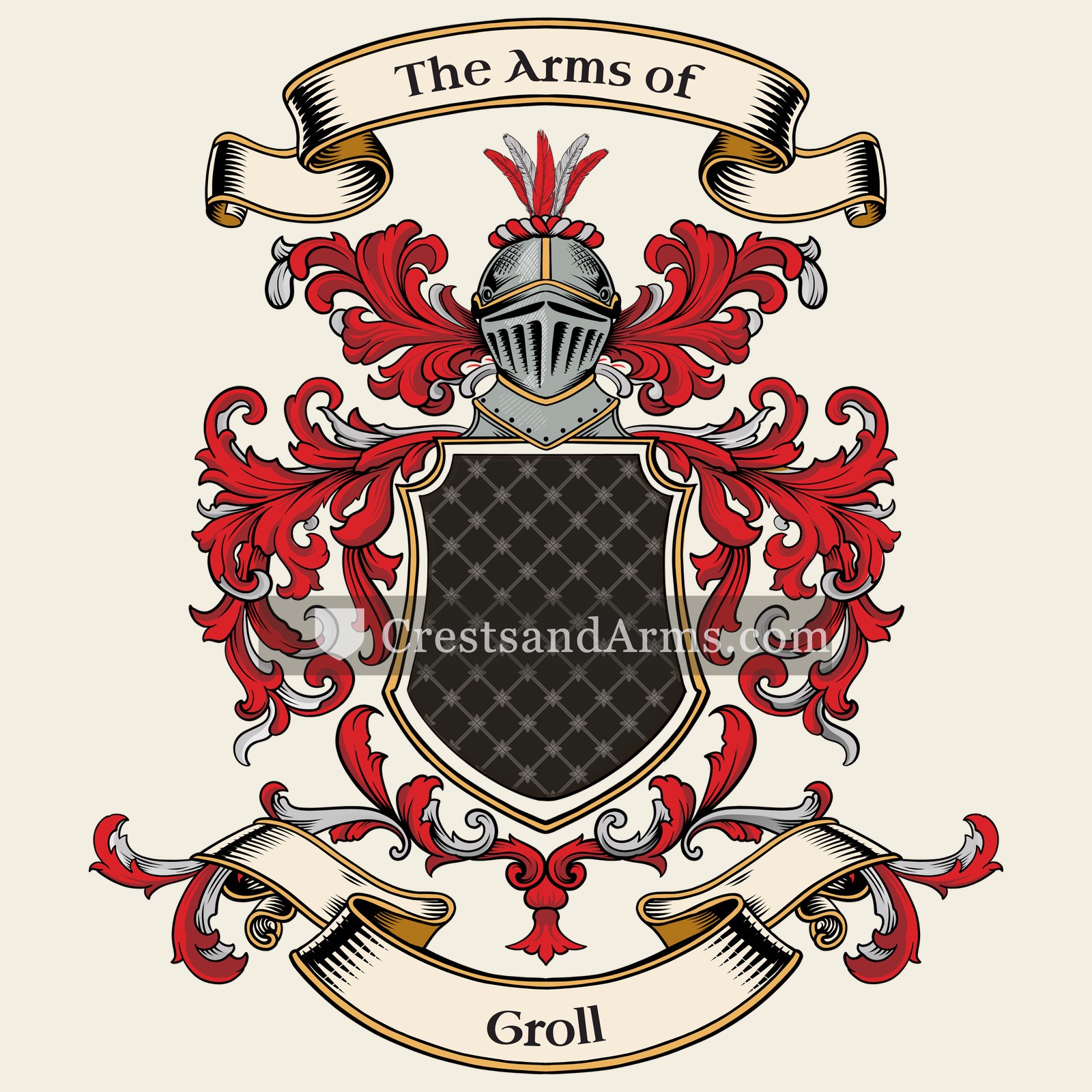
Colours
Black (Sable)Means: Constancy
Historical info
Source
J. B. Rietstap, Armorial Général, Gouda: G. B. van Goor Zonen, 1884–87
Blazon (the actual original written record)
“de sa. équipollés à quatre d'arg.”
Switzerlandc. 1745
Digital archive packCoat of arms PNG, gold border print PDF, vector SVG and the certificate of authenticity. Sent to your email in minutes.
Map of Switzerland showing where the Groll arms are recorded
The Groll arms were recorded in Switzerland, c. 1745.
Arms such as these were typically recorded in Bern.
Bern was the largest of the Swiss cantons and ran itself, with its own council and its own courts. Its governing families held office for generations, and office of that kind carried a shield with it.
This is where the arms were entered in the register. Families often moved to other parts of the country, so the same name can turn up in more than one region.
The body that granted and recorded arms in Switzerland in this period.
How Arms Worked in Switzerland
In Switzerland, coats of arms were not restricted to the nobility and were often adopted by common citizens and families. These symbols were passed down through generations to show family identity. When branches of a family grew, they often changed small details of the design to distinguish their own line from the original group.
Granting authority
Cantonal and civic authorities managed the use of coats of arms within their specific regions and local jurisdictions.
How they got arms
Families typically assumed their own coats of arms based on local custom rather than receiving them from a central monarch.
Where arms were recorded
Arms were recorded in various cantonal and civic registers starting from the fourteenth century throughout the Swiss region.
The family's standing
Recorded among the armigerous families of Switzerland.
Origin & History of the Groll Family in Switzerland
The surname Groll has deep roots in the Swiss canton of Bern, where records confirm the family was well-established by the year 1745. In the German language, the name is often associated with the word for someone who is grumpy or stubborn, though it likely originated as a nickname for a person with a distinct personality or a specific physical trait. During the eighteenth century, families with this name were typically integrated into the local agricultural and artisanal communities of the Swiss plateau. Life in Bern at this time was governed by strict social hierarchies and local guilds, which meant that the Groll family would have been deeply connected to the civic and religious life of their parish. As members of the community, they participated in the daily rhythms of a region known for its transition from traditional farming to early industrial trade. By maintaining their presence in the city and surrounding areas, the Groll family helped shape the local culture and contributed to the long-standing history of the Bernese region.
Groll Meaning & Related Branches
Root word
Grol
A geographical location or settlement near a ditch or water channel.
This name
GrollRefers to a person who originated from the town of Groenlo in the Netherlands.
also spelled
Grol
Related arms
Corbarasimilar arms
Haubensimilar arms
Monte-Martesimilar arms
Documented Sources
J. B. Rietstap, Armorial Général, Gouda: G. B. van Goor Zonen, 1884–87
Tresoar (Fries Historisch en Letterkundig Centrum), Burgerlijke Stand van Friesland (1811-1950)
Nederlandse Genealogische Vereniging, Nederlandse Familienamen Databank
Digital archive packCoat of arms PNG, gold border print PDF, vector SVG and the certificate of authenticity. Sent to your email in minutes.


 bearStrength, cunning and protection of kin
 roundelA coin, and one who has been to the crusades
 bearStrength, cunning and protection of kin
 roundelA coin, and one who has been to the crusades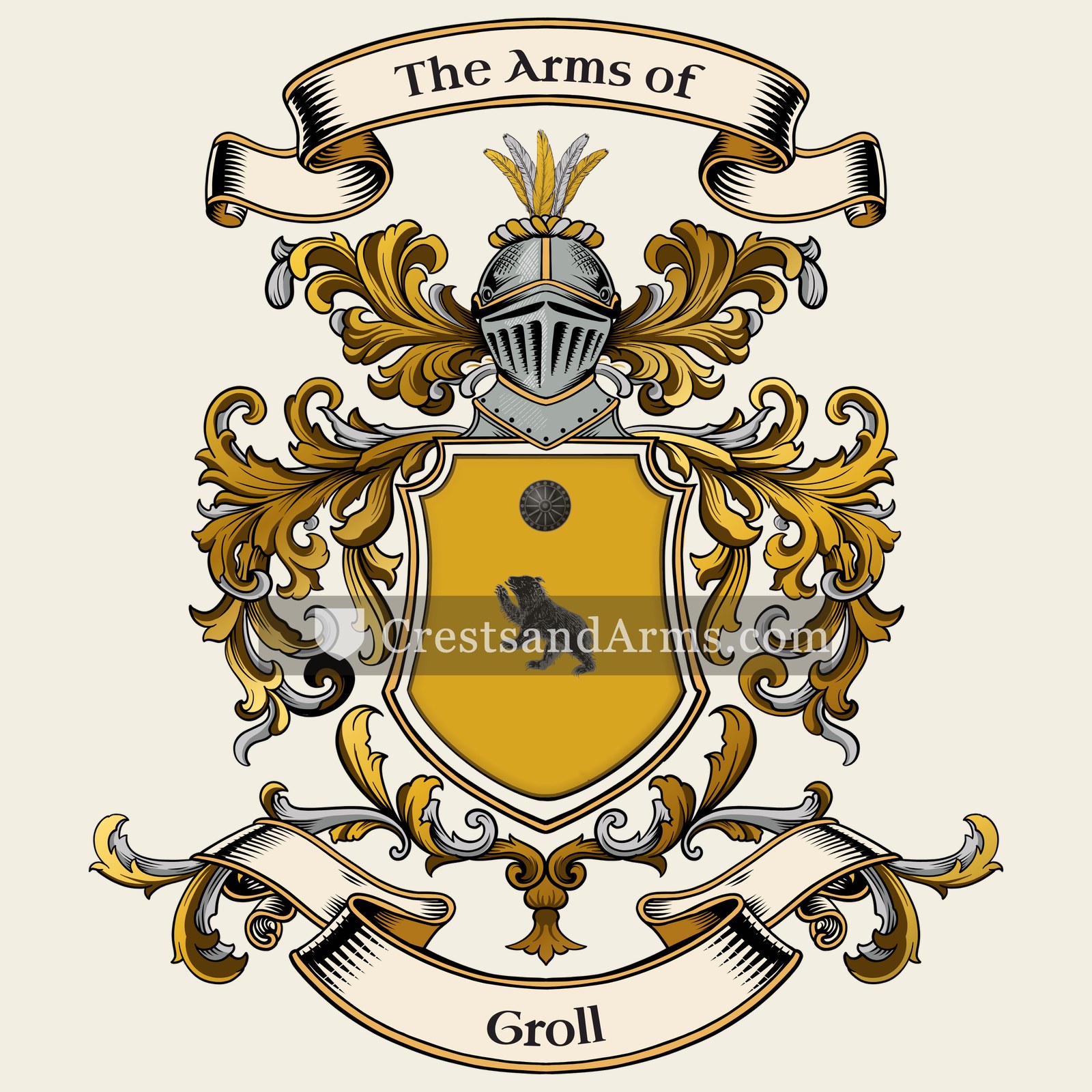


 bendDefence, and the scarf of a commander
 fleur de lisPurity, light, and the sixth son