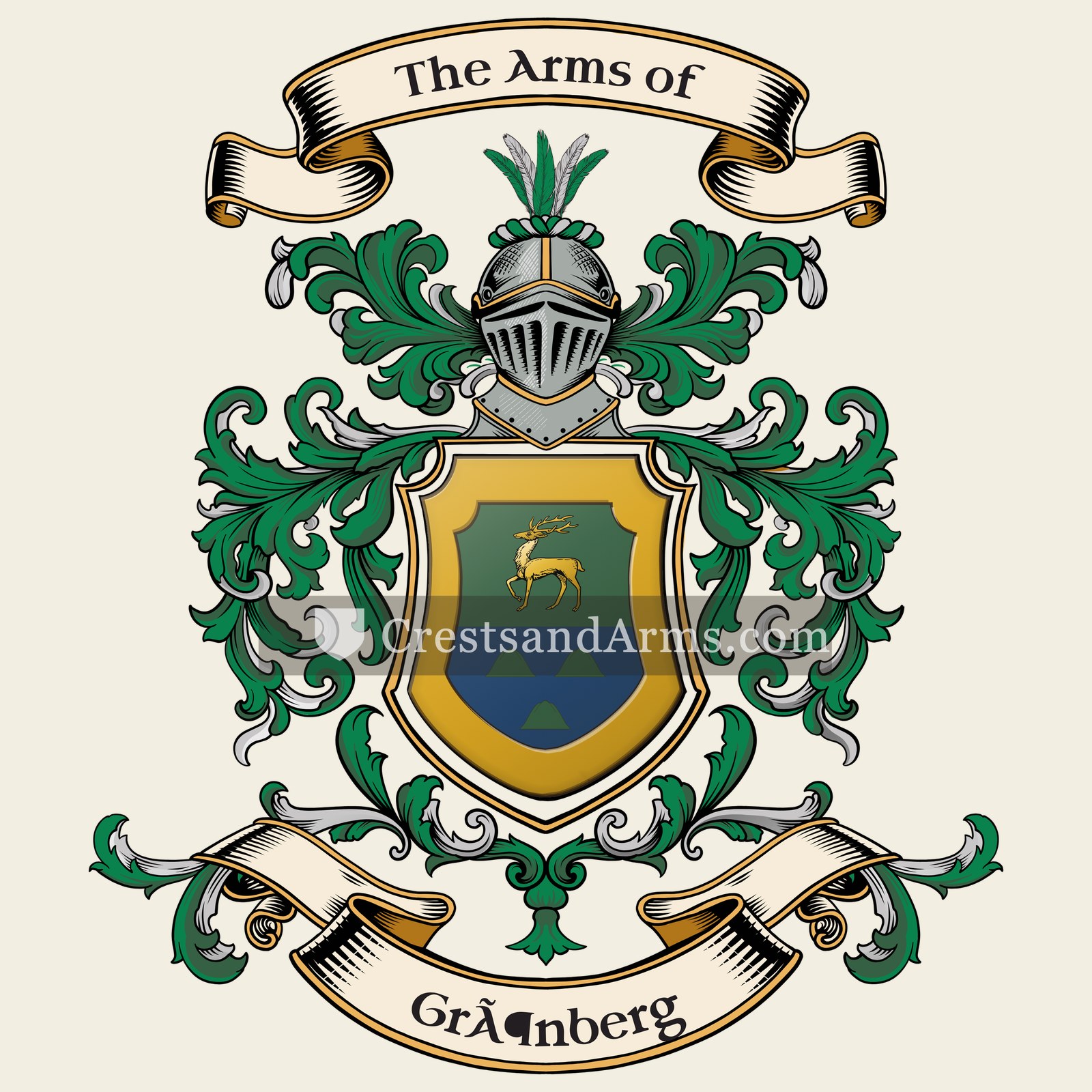
A record of documented arms, meaning and origin, researched for the Grönberg family of Sweden.
Reg. 7309 · Swedish, G–I
Coat of Arms & Family Crest Details
Symbols on this shield
mountThe ground held, and steadfastness upon it
stagPeace and harmony, and one who will not fight unprovoked
Colours
Green (Vert)Means: Hope
Blue (Azure)Means: Loyalty and truth
Gold (Or)Means: Generosity
Historical info
Source
J. B. Rietstap, Armorial Général, Gouda: G. B. van Goor Zonen, 1884–87
Blazon (the actual original written record)
“Coupé: au 1 de sin. à un cerf naiss. d'or, mouv. du coupé; au 2 d'azur à trois collines de sin., accostées, mouv. de la p. L'écu bordé d'or. C.: un cerf iss. d'or, le corps passé dans une couronne de laurier de sin.”
Swedenc. 1631
Digital archive packCoat of arms PNG, gold border print PDF, vector SVG and the certificate of authenticity. Sent to your email in minutes.
Map of Sweden showing where the Grönberg arms are recorded
The Grönberg arms were recorded in Sweden, c. 1631.
Arms such as these were typically recorded in Stockholm.
Stockholm held the Swedish court and the House of Nobility, where every noble family's arms were entered and kept. Families ennobled for service registered there, which is why so many are recorded around the city.
This is where the arms were entered in the register. Families often moved to other parts of the country, so the same name can turn up in more than one region.
The body that granted and recorded arms in Sweden in this period.
Gustavus Adolphus of Sweden
Sovereign of the period
Gustavus Adolphus of Sweden
1611–1632
Reigning in Sweden when the Grönberg arms are first recorded.
How Arms Worked in Sweden
In Sweden, a coat of arms belonged to a noble family as a whole rather than just one individual. These arms were passed down through the generations to all legitimate descendants. Younger branches of the family used the same shield without needing to change it. This system ensured that the entire lineage shared the same identity and status under the law.
Granting authority
The Riddarhuset, or House of Nobility, regulated all noble coats of arms in Sweden under royal authority.
How they got arms
Families received their coats of arms through royal grants of nobility which were then officially registered with the House.
Where arms were recorded
Coats of arms were officially recorded in the Swedish House of Nobility register starting in the year 1626.
The family's standing
Recorded among the armigerous families of Sweden.
Origin & History of the Grönberg Family in Sweden
The surname Grönberg is a classic example of the Swedish tradition of creating ornamental names during the seventeenth century. The name combines the words grön, meaning green, and berg, meaning mountain or hill, to form a descriptive and pleasant-sounding identity. While many families adopted such names to distinguish themselves in urban settings, the Grönberg family was already firmly established in Stockholm by 1631. During this era, Stockholm was a rapidly growing center of trade and administration, and families like the Grönbergs often played active roles in the city's developing merchant and artisan classes. By settling in the capital during the early modern period, the family became part of the vibrant social fabric of a city that was quickly rising to prominence as the heart of the Swedish Empire.
Grönberg Meaning & Related Branches
Root word
Grön and Berg
Green and mountain or hill.
This name
GrönbergA topographic name referring to a green mountain or a verdant hill.
also spelled
Groenberg
Gronbergh
Gronberk
Documented Sources
J. B. Rietstap, Armorial Général, Gouda: G. B. van Goor Zonen, 1884–87
Otterbjörk, Roland, Svenska förnamn: Kortfattat namnlexikon, 1964
Hasselberg, Göte, Svenska släktnamn: Deras uppkomst och historia, 1945
Riksarkivet (National Archives of Sweden), Stockholms stadsarkiv: Mantalslängder 1631
Digital archive packCoat of arms PNG, gold border print PDF, vector SVG and the certificate of authenticity. Sent to your email in minutes.


 mountThe ground held, and steadfastness upon it
 stagPeace and harmony, and one who will not fight unprovoked
 mountThe ground held, and steadfastness upon it
 stagPeace and harmony, and one who will not fight unprovoked