A record of documented arms, meaning and origin, researched for the Grondin family lines. Documented in 3 countries.
Reg. 0167 · Austrian, G–I
Coat of Arms & Family Crest Details
Symbols on this shield
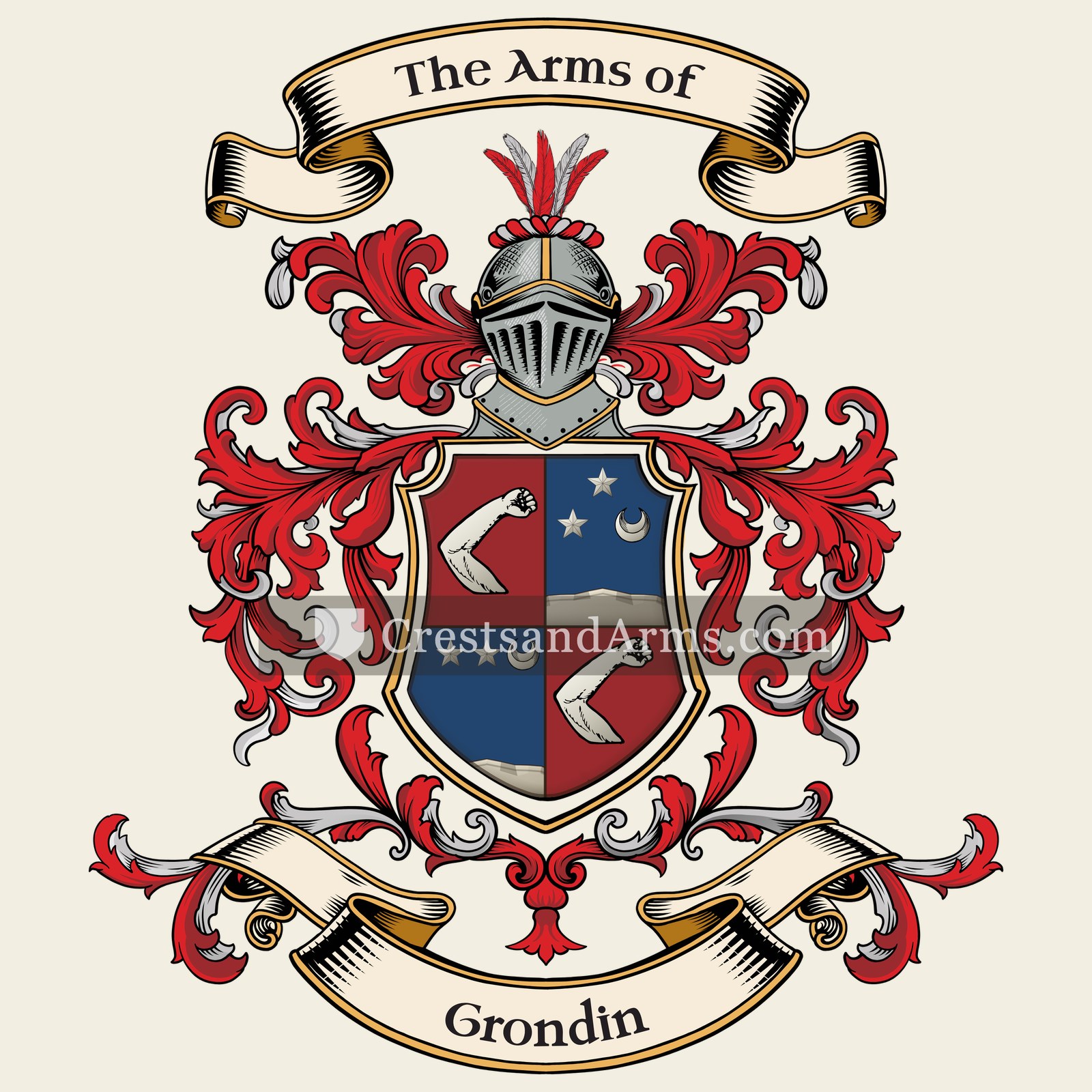
mountThe ground held, and steadfastness upon it
armA person of action, industrious and laborious
mulletThe third son, and a divine quality from above
crescentHonour by the sovereign, and the second son
Colours
Red (Gules)Means: Military strength
Blue (Azure)Means: Loyalty and truth
Silver (Argent)Means: Peace and sincerity
Historical info
Source
J. B. Rietstap, Armorial Général, Gouda: G. B. van Goor Zonen, 1884–87
Blazon (the actual original written record)
“Ec.: au 1 de gu. à un senestrochère de carn., sortant d'une nuée et tenant un caducée d'arg. en pal; aux 2 et 3 d'azur à un mont de cinq coupeaux d'arg., acc. en chef de deux étoiles du même, surmontées d'un croiss. figuré aussi d'arg.; au 4 de gu. à un dextrochère de carn., sortant d'une nuée et tenant un caducée d'arg., en bande. Deux cq. cour. C.: 1º un vol, coupé alt. d'arg. et d'azur; 1. d'arg. et de gu.; 2º un mont de cinq coupeaux d'arg., celui du milieu supp. un croiss. figuré du même; 1. d'arg. et d'azur [Les armes de 1792 ne sont timbrées que d'un seul cq. cour., portant en cimier le mont avec le croiss., entre le vol.]”
Austriac. 1772
Digital archive packCoat of arms PNG, gold border print PDF, vector SVG and the certificate of authenticity. Sent to your email in minutes.
Map of Austria showing where the Grondin arms are recorded
The Grondin arms were recorded in Austria, c. 1772.
Arms such as these were typically recorded in Tyrol.
Tyrol was mountain country in western Austria, where the valleys were held by families who had been there a very long time. Old tenure counted for more than money, and old families carried arms.
This is where the arms were entered in the register. Families often moved to other parts of the country, so the same name can turn up in more than one region.
Region
Tyrol
First recorded
1772
Granting Authority for the Grondin Arms
Imperial and Royal chancery
Sodacan · CC BY-SA 3.0
The body that granted and recorded arms in Austria in this period.
Joseph II, Holy Roman Emperor
Sovereign of the period
Joseph II, Holy Roman Emperor
1765–1790
Reigning in Austria when the Grondin arms are first recorded.
How Arms Worked in Austria
Austrian coats of arms were often linked directly to noble titles granted by the Emperor. These symbols belonged to the entire family line rather than just one individual. When a family grew, new branches kept the original design without needing to change it. This system allowed all members of a noble house to share the same identity across many generations.
Granting authority
The Imperial and Royal chancery managed all heraldic matters and controlled the official granting of arms throughout the Austrian lands.
How they got arms
Families typically received their arms through a formal imperial decree that often accompanied the elevation of a person to noble status.
Where arms were recorded
Official records of these grants were kept in the Imperial Register of Nobility which began its formal documentation process in 1453.
The family's standing
Recorded among the armigerous families of Austria.
Origin & History of the Grondin Family in Austria
The history of the Grondin family in the Austrian region of Tyrol is deeply connected to the rugged landscape and the shifting social structures of the late eighteenth century. By 1772, records confirm that members of the family were established within this mountainous territory, likely working as skilled laborers or farmers who adapted to the challenging alpine environment. During this period, Tyrol was a vital crossroads for trade and migration between the German-speaking lands and Northern Italy. The name itself suggests a connection to the linguistic diversity of the region, as it likely evolved from local dialects that blended Latin and Germanic influences. Families like the Grondins often lived in tight-knit village communities where they relied on agriculture and local craftsmanship to sustain their households. Their presence in the historical record during the 1770s highlights a time of transition in the Habsburg Empire, as families began to settle more permanently in specific valleys while contributing to the local economy and regional culture.
Coat of Arms & Family Crest Details
Symbols on this shield
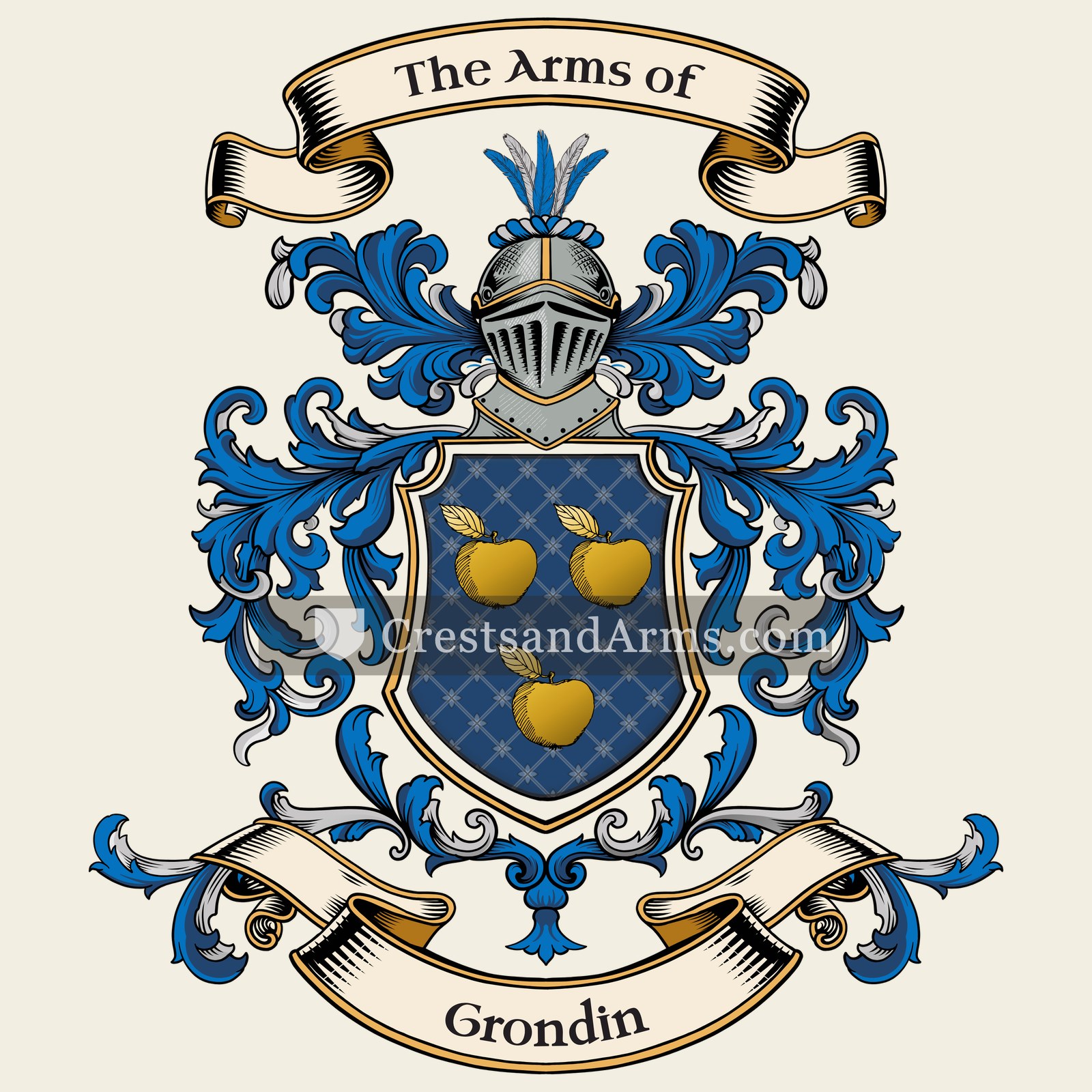
applePeace, plenty and long-standing settlement
Colours
Blue (Azure)Means: Loyalty and truth
Gold (Or)Means: Generosity
Historical info
Source
J. B. Rietstap, Armorial Général, Gouda: G. B. van Goor Zonen, 1884–87
Blazon (the actual original written record)
“D'azur à trois grenades d'or.”
ProvenceProvence, c. 1663
Digital archive packCoat of arms PNG, gold border print PDF, vector SVG and the certificate of authenticity. Sent to your email in minutes.
Map of France showing where the Grondin arms are recorded
The Grondin arms were recorded in Provence, c. 1663.
Provence was old country, with towns dating to the Romans and families who traced their land back nearly as far. Its gentry were many and long-settled, and long settlement is what fills a register.
This is where the arms were entered in the register. Families often moved to other parts of the country, so the same name can turn up in more than one region.
The body that granted and recorded arms in France in this period.
Louis XIV of France
Sovereign of the period
Louis XIV of France
1643–1715
Reigning in Austria when the Grondin arms are first recorded.
How Arms Worked in France
In France, a coat of arms was a mark of honor that passed down through the male line to all legitimate descendants. Families often used the same shield without changes to show their shared heritage. If a branch wanted to stand out, they could add a small mark to their shield to show their specific place in the family tree.
Granting authority
The Juge d'armes de France acted as the official authority that regulated and verified coats of arms across the country.
How they got arms
Families typically inherited their arms from ancestors, though they could also receive them through royal grants or by proving their noble status.
Where arms were recorded
Coats of arms were officially recorded in the Armorial Général de France, which began its main collection in the year 1696.
The family's standing
Recorded among the armigerous families of Provence.
Origin & History of the Grondin Family in France
The surname Grondin finds its roots in the southern regions of France, particularly within the historic province of Provence. Linguists believe the name originated as a descriptive nickname, likely derived from the Old French word "grondir," which means to grumble or to growl. In medieval society, such names were often given to individuals who possessed a stern temperament or a particularly deep, resonant voice. By the mid-seventeenth century, families bearing this name were well-established in the social fabric of the region. Records confirming their presence in Provence by 1663 highlight a lineage deeply connected to the rural and provincial life of the era. These early Grondins lived through a period of significant transition in France, as the centralized power of the monarchy began to reshape local communities and influence the movement of families across the countryside.
Coat of Arms & Family Crest Details
Symbols on this shield
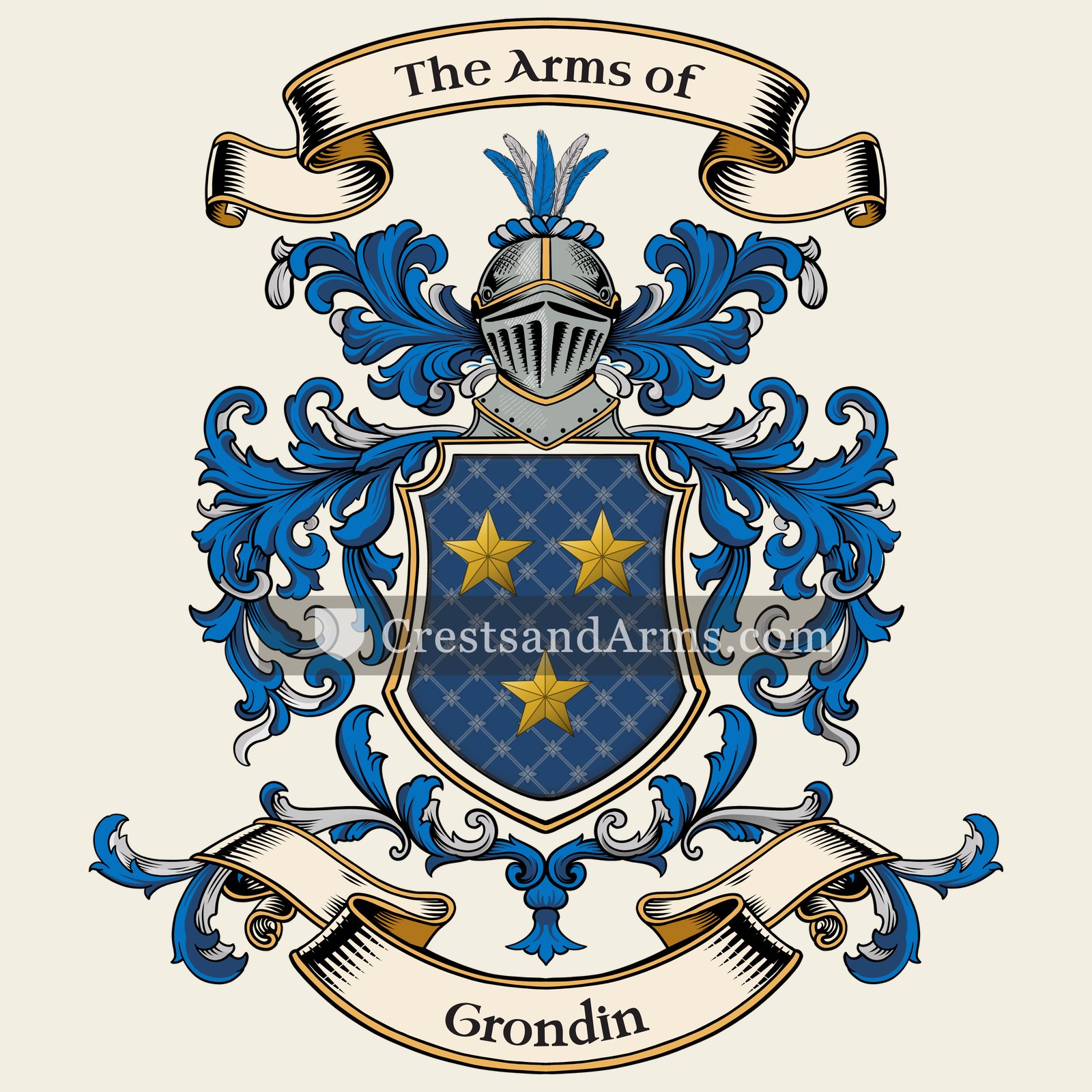
mulletThe third son, and a divine quality from above
Colours
Blue (Azure)Means: Loyalty and truth
Gold (Or)Means: Generosity
Historical info
Source
Sir Bernard Burke, The General Armory of England, Scotland, Ireland and Wales, London: Harrison & Sons, 1884
Blazon (the actual original written record)
“Az. three mullets or”
Englandc. 1620
Digital archive packCoat of arms PNG, gold border print PDF, vector SVG and the certificate of authenticity. Sent to your email in minutes.
Map of England showing where the Grondin arms are recorded
The Grondin arms were recorded in England, c. 1620.
Arms such as these were typically recorded in York.
Yorkshire is the largest of the English counties, and it held more gentry families than any other. Land there was split among a great many households rather than a few, so a great many of them carried arms.
This is where the arms were entered in the register. Families often moved to other parts of the country, so the same name can turn up in more than one region.
The body that granted and recorded arms in England in this period.
James VI and I
Sovereign of the period
James VI and I
1603–1625
Reigning in Austria when the Grondin arms are first recorded.
How Arms Worked in England
English heraldry allowed arms to be shared by all legitimate descendants of the original owner. These symbols were treated as personal property that moved through the generations to all children. While the eldest son kept the original design, other family members could use the same shield without needing to change it or register their own unique versions.
Granting authority
The College of Arms in London has regulated the use of coats of arms throughout England and Wales since 1484.
How they got arms
Families typically obtained their coats of arms through a formal grant from the Crown or by proving their ancient right to them.
Where arms were recorded
All official coats of arms are recorded in the registers kept at the College of Arms, which date back to the fifteenth century.
The family's standing
Recorded among the armigerous families of England.
Origin & History of the Grondin Family in England
The Grondin family name carries a history that stretches back to the early seventeenth century in the city of York. While the name is often associated with French origins, its presence in England by 1620 suggests that members of the family were integrated into the local community during a period of significant social change. Records from this time indicate that the family lived in a city defined by its medieval walls and its importance as a northern hub for trade and religion. Settling in York meant that these early ancestors likely navigated the complexities of English life during the reign of King James I. Their presence in the city archives provides a rare glimpse into the lives of families who helped shape the local landscape long before the modern era. By studying these early mentions, we can see how the Grondin name became a part of the historical fabric of northern England.
Grondin Meaning & Related Branches
Root word
Grund
A German term referring to ground, soil, or a valley floor.
This name
GrondinDerived from a topographic descriptor for someone who lived near a valley or specific plot of land.
also spelled
Grandinn
Grandyn
Grandine
Documented Sources
J. B. Rietstap, Armorial Général, Gouda: G. B. van Goor Zonen, 1884–87


 mountThe ground held, and steadfastness upon it
 armA person of action, industrious and laborious
 mulletThe third son, and a divine quality from above
 crescentHonour by the sovereign, and the second son
 mountThe ground held, and steadfastness upon it
 armA person of action, industrious and laborious
 mulletThe third son, and a divine quality from above
 crescentHonour by the sovereign, and the second son


 applePeace, plenty and long-standing settlement