A record of documented arms, meaning and origin, researched for the Gross family lines. Documented in 3 countries.
Reg. 4077 · Swiss, G–I
Meaning of the Gross family crest colors & symbols
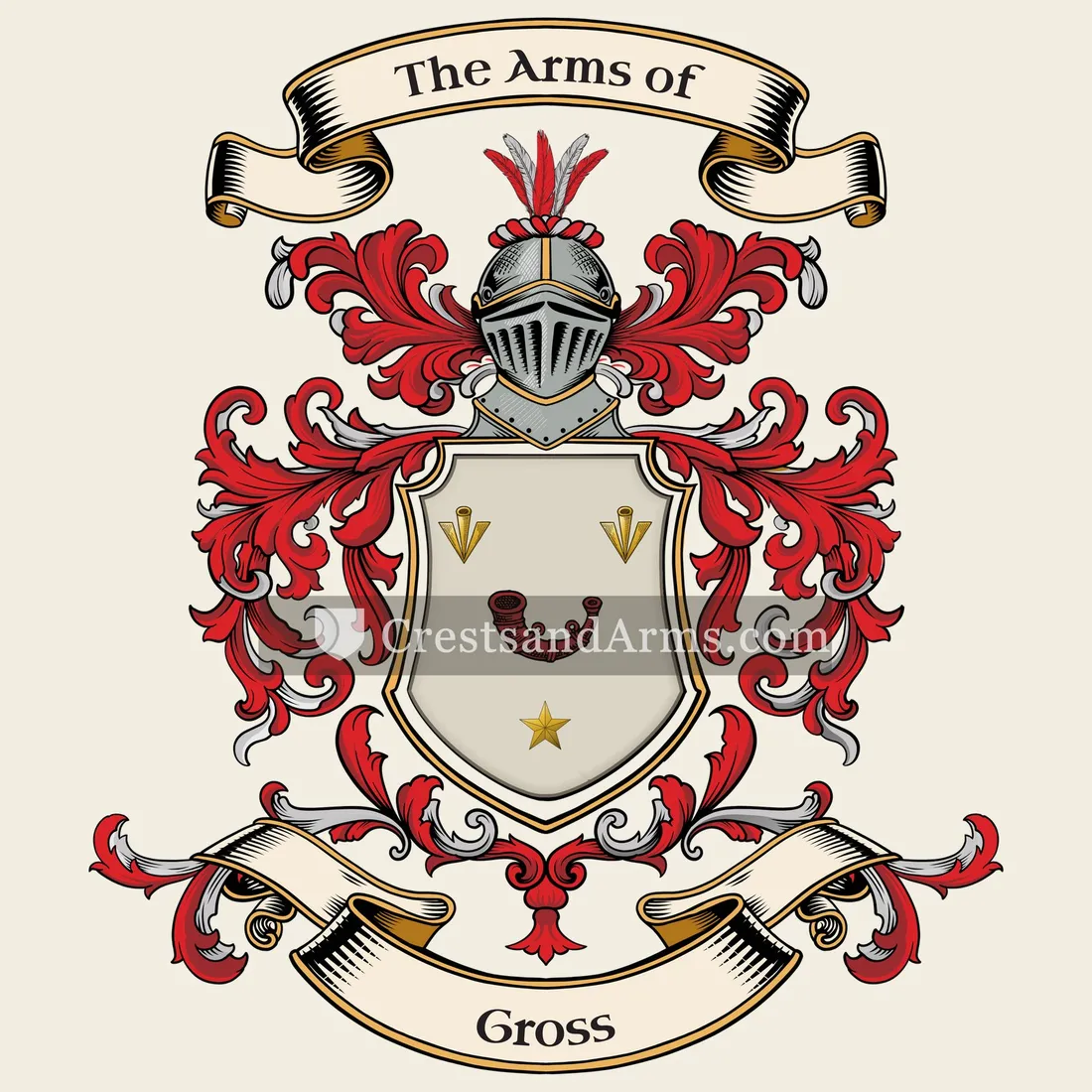
Symbols on this shield
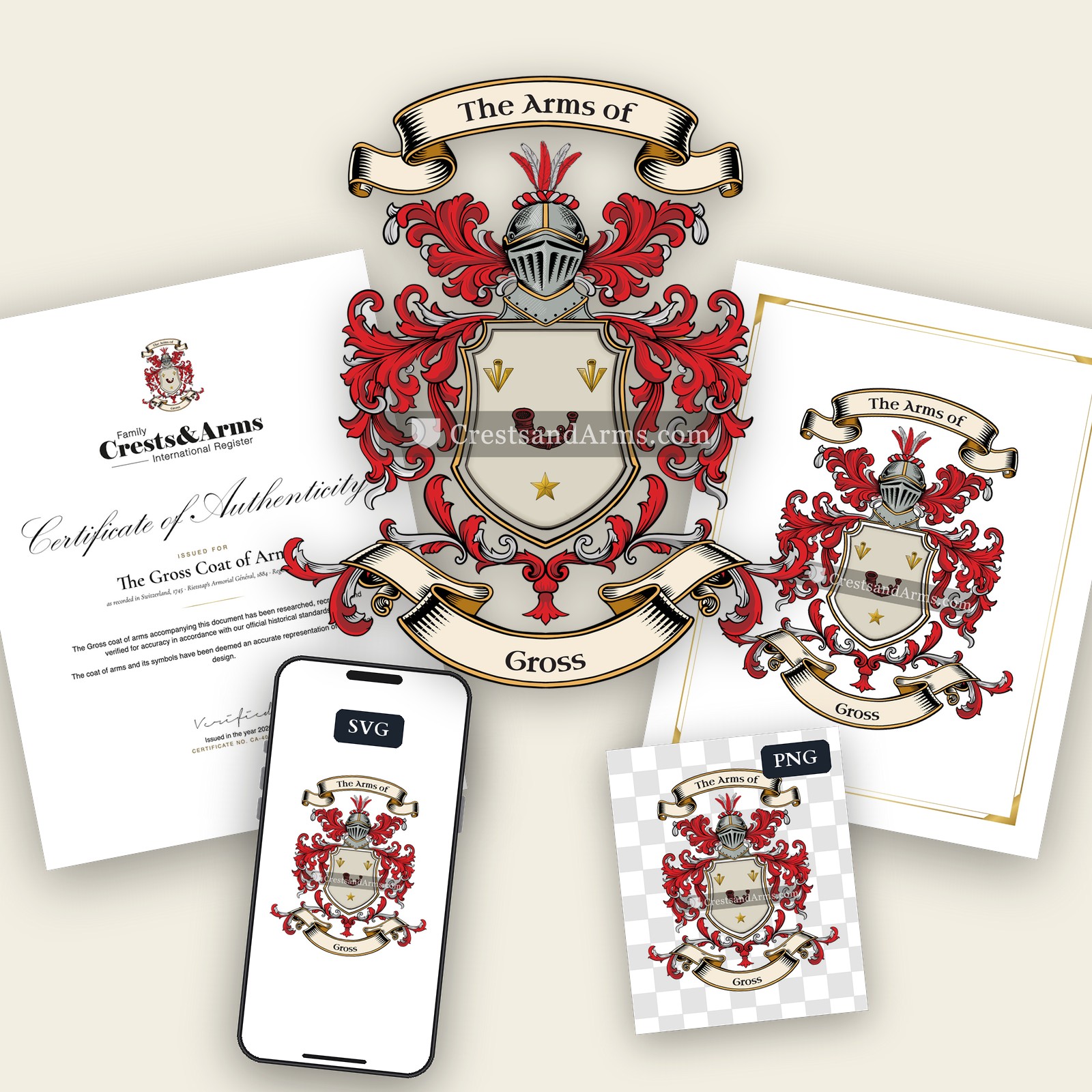
hunting horn stringedOne who delights in the chase
arrowReadiness for battle, and affliction endured
mulletThe third son, and a divine quality from above
Colours
Silver (Argent)Means: Peace and sincerity
Red (Gules)Means: Military strength
Gold (Or)Means: Generosity
Historical info
Source
J. B. Rietstap, Armorial Général, Gouda: G. B. van Goor Zonen, 1884–87
Blazon (the actual original written record)
“D'arg. à deux flèches d'or et empennées d'arg., passées en saut., et un cor de gu., br. sur le point d'intersection, surm. d'une étoile d'or entre les flèches. C.: une étoile d'or; entre deux prob., coupées alt. d'arg. et de gu. L.: d'arg. et de gu.”
SwitzerlandBâle, c. 1745
Digital archive packCoat of arms PNG, gold border print PDF, vector SVG and the certificate of authenticity. Sent to your email in minutes.
Map of Switzerland showing where the Gross arms are recorded
The Gross arms were recorded in Bâle, c. 1745.
This is where the arms were entered in the register. Families often moved to other parts of the country, so the same name can turn up in more than one region.
The body that granted and recorded arms in Switzerland in this period.
How Arms Worked in Switzerland
In Switzerland, coats of arms were not restricted to the nobility and were often adopted by common citizens and families. These symbols were passed down through generations to show family identity. When branches of a family grew, they often changed small details of the design to distinguish their own line from the original group.
Granting authority
Cantonal and civic authorities managed the use of coats of arms within their specific regions and local jurisdictions.
How they got arms
Families typically assumed their own coats of arms based on local custom rather than receiving them from a central monarch.
Where arms were recorded
Arms were recorded in various cantonal and civic registers starting from the fourteenth century throughout the Swiss region.
The family's standing
Recorded among the armigerous families of Switzerland.
Origin & History of the Gross Family in Switzerland
The surname Gross traces its roots to the Germanic term for "large" or "great," a descriptor frequently used in the Middle Ages to distinguish between two people of the same name or to highlight a person of significant physical stature. In the context of Switzerland, the family established a notable presence in the city of Basel by 1745, where they integrated into the local urban structure. During this period, Basel served as a major center for trade and intellectual exchange, and families like the Gross line often participated in the city’s guild system or local governance. Because Basel was a crossroads for travelers and merchants, the name likely moved through the region as part of the broader migration patterns of the Swiss cantons. Over time, the family became deeply rooted in the social fabric of the city, contributing to the professional and civic life that defined the Swiss Confederation during the eighteenth century.
Meaning of the Gross family crest colors & symbols
Symbols on this shield
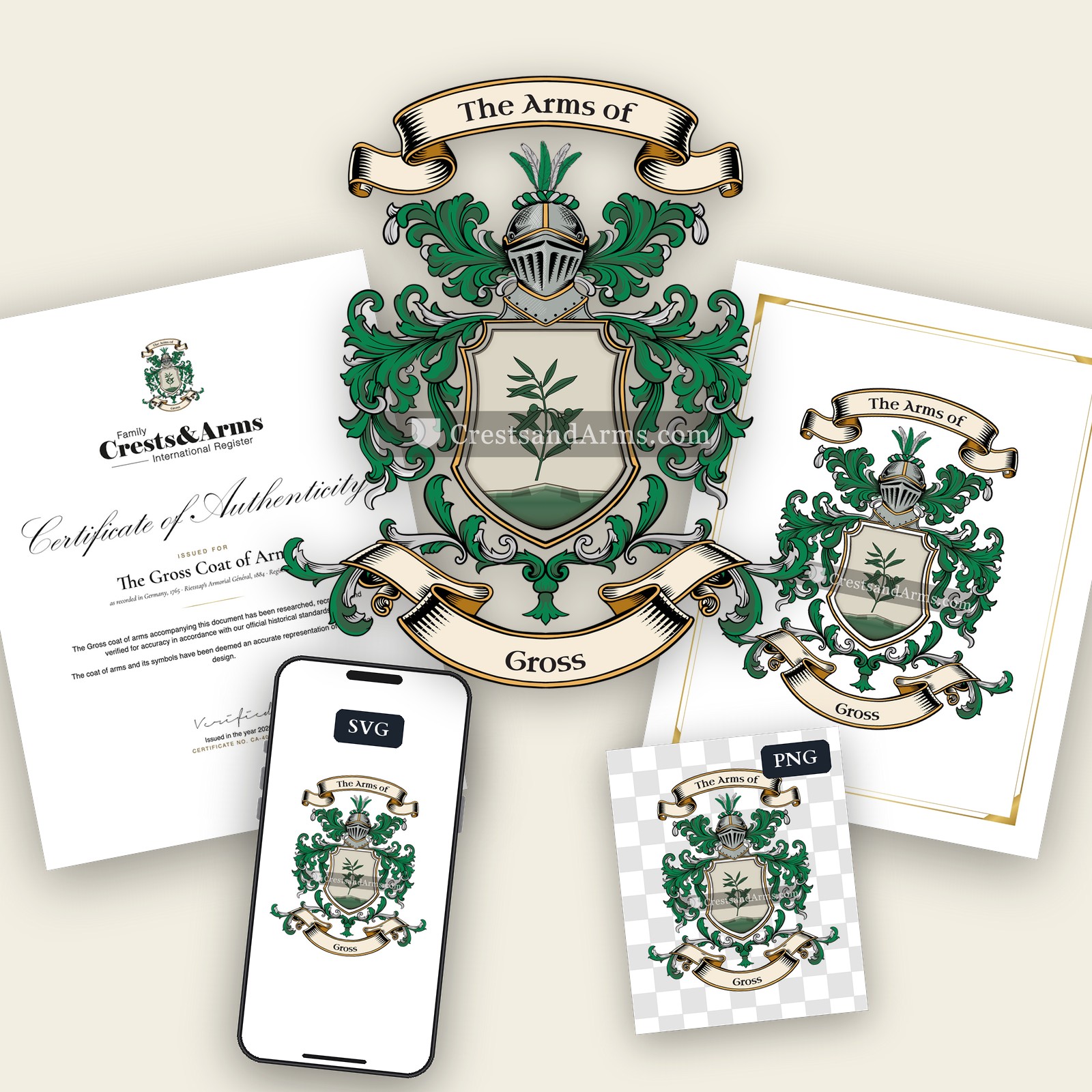
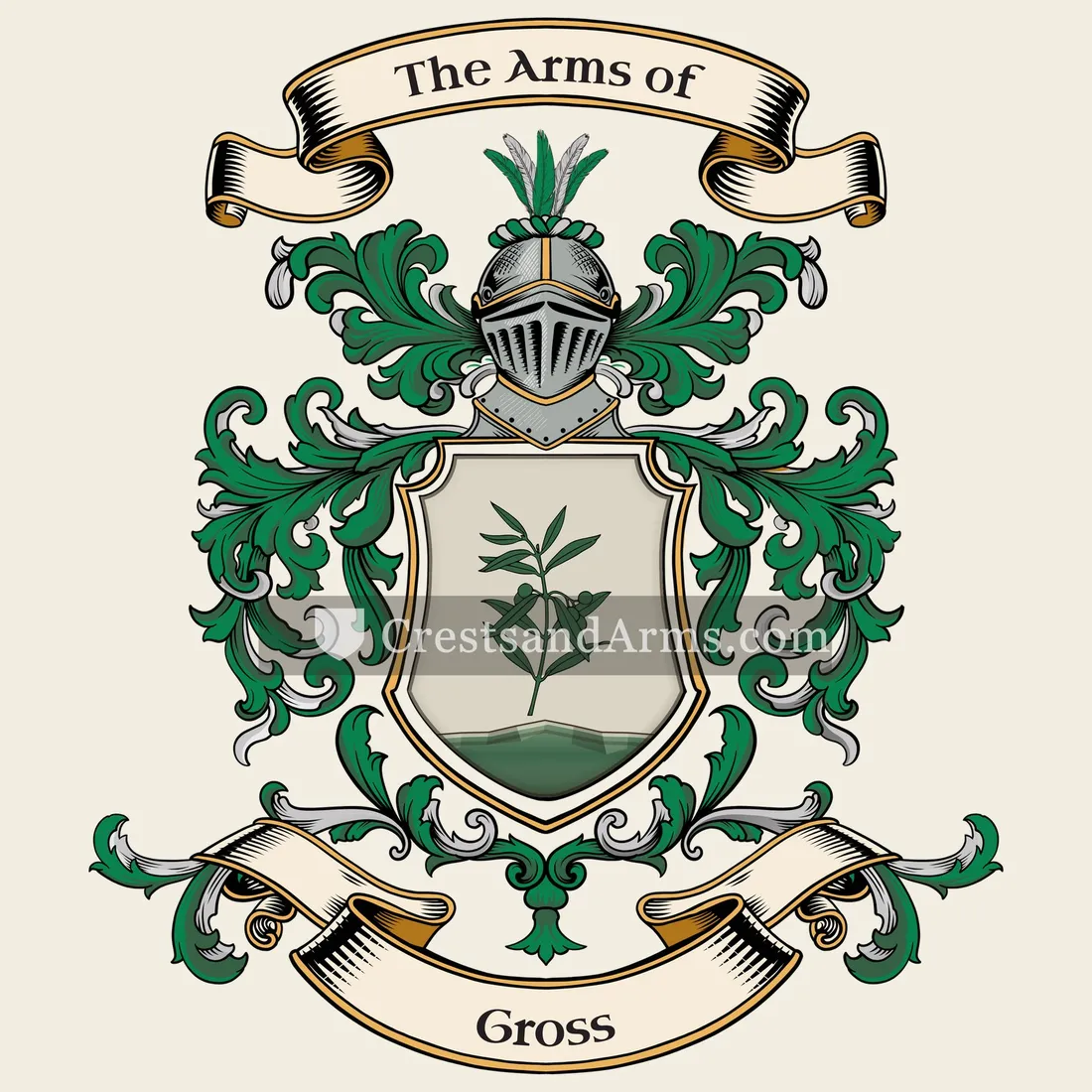
mountThe ground held, and steadfastness upon it
branchPeace, and new growth
Colours
Silver (Argent)Means: Peace and sincerity
Green (Vert)Means: Hope
Historical info
Source
J. B. Rietstap, Armorial Général, Gouda: G. B. van Goor Zonen, 1884–87
Blazon (the actual original written record)
“D'arg. à une branche de tilleul de sin., posée sur un tertre du même. C.: entre deux prob. d'arg., ornées à l'ext. et dans les embrasures de feuilles de tilleul de sin. L.: d'arg. et de sin.”
GermanyNuremberg, c. 1765
Digital archive packCoat of arms PNG, gold border print PDF, vector SVG and the certificate of authenticity. Sent to your email in minutes.
Map of Germany showing where the Gross arms are recorded
The Gross arms were recorded in Nuremberg, c. 1765.
This is where the arms were entered in the register. Families often moved to other parts of the country, so the same name can turn up in more than one region.
The body that granted and recorded arms in Germany in this period.
Francis I, Holy Roman Emperor
Sovereign of the period
Francis I, Holy Roman Emperor
1745–1765
Reigning in Switzerland when the Gross arms are first recorded.
How Arms Worked in Germany
In the Holy Roman Empire, coats of arms were often granted to individuals by the Emperor or his representatives. These arms were then passed down through the generations to all legitimate descendants of the original holder. Younger branches of a family usually kept the same shield design without needing to change it, as the arms belonged to the entire lineage.
Granting authority
The Holy Roman Emperor held the sole power to grant new coats of arms throughout his vast imperial territories.
How they got arms
Families typically obtained their coats of arms through a formal imperial grant or by proving their noble status to the authorities.
Where arms were recorded
These grants were officially recorded in the Imperial Chancery registers, which began keeping formal records of such honors during the Middle Ages.
The family's standing
Recorded among the armigerous families of Germany.
Origin & History of the Gross Family in Germany
The surname Gross originated as a descriptive nickname in medieval Germany, where it was used to distinguish individuals based on their physical stature or social importance. The word itself translates to "large" or "great," and it likely served as a way to identify a person who was tall or held a position of authority within their local community. By the mid-eighteenth century, families bearing this name had established themselves in significant urban centers like Nuremberg. During this period, Nuremberg was a bustling hub of trade and craftsmanship, and residents named Gross were often integrated into the city’s professional guilds. These early family members were part of the growing middle class that helped define the cultural and economic life of the region during the Enlightenment. Their presence in city records from 1765 reflects a time when surnames were becoming permanent fixtures of identity as families settled into specific trades and neighborhoods.
Meaning of the Gross family crest colors & symbols
Symbols on this shield
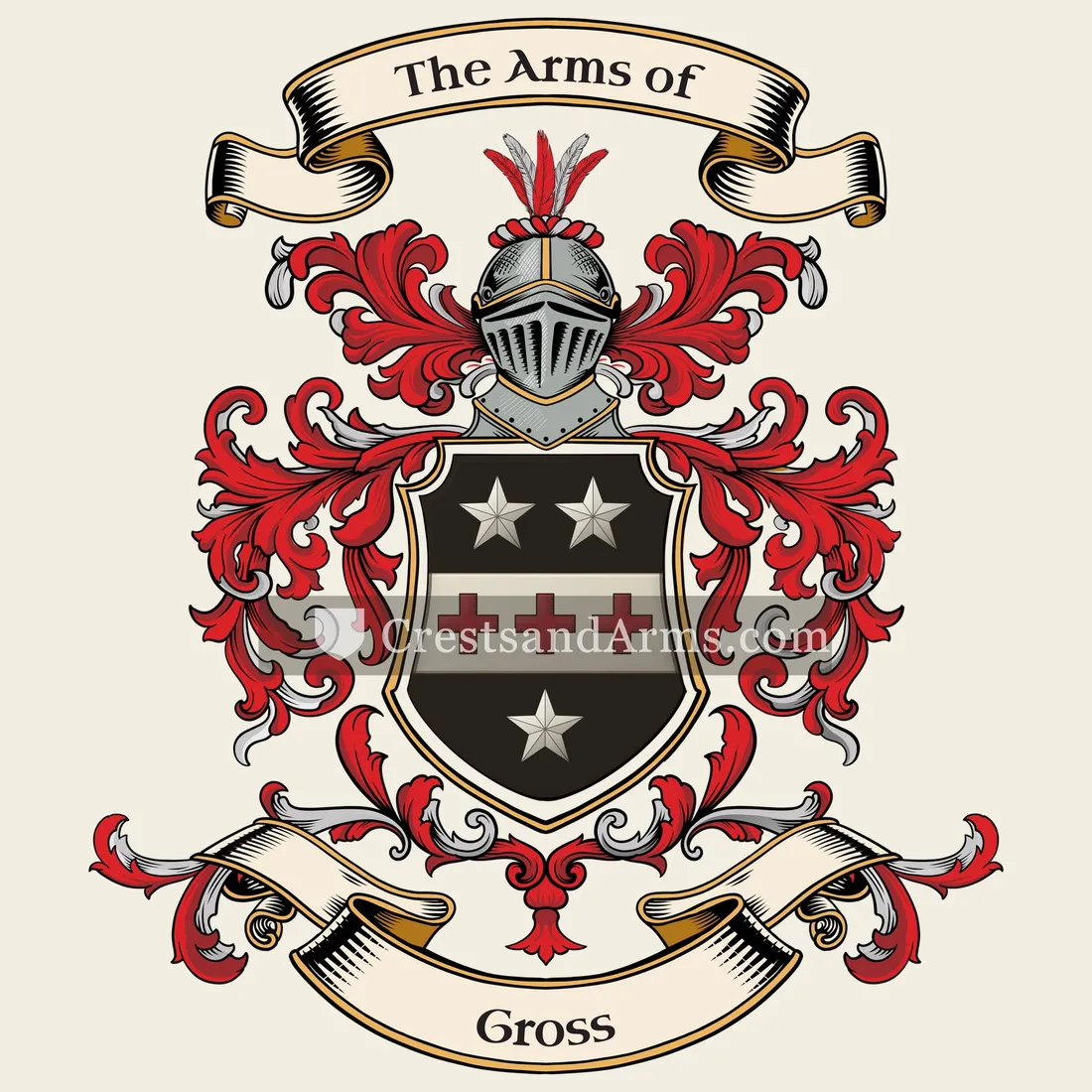
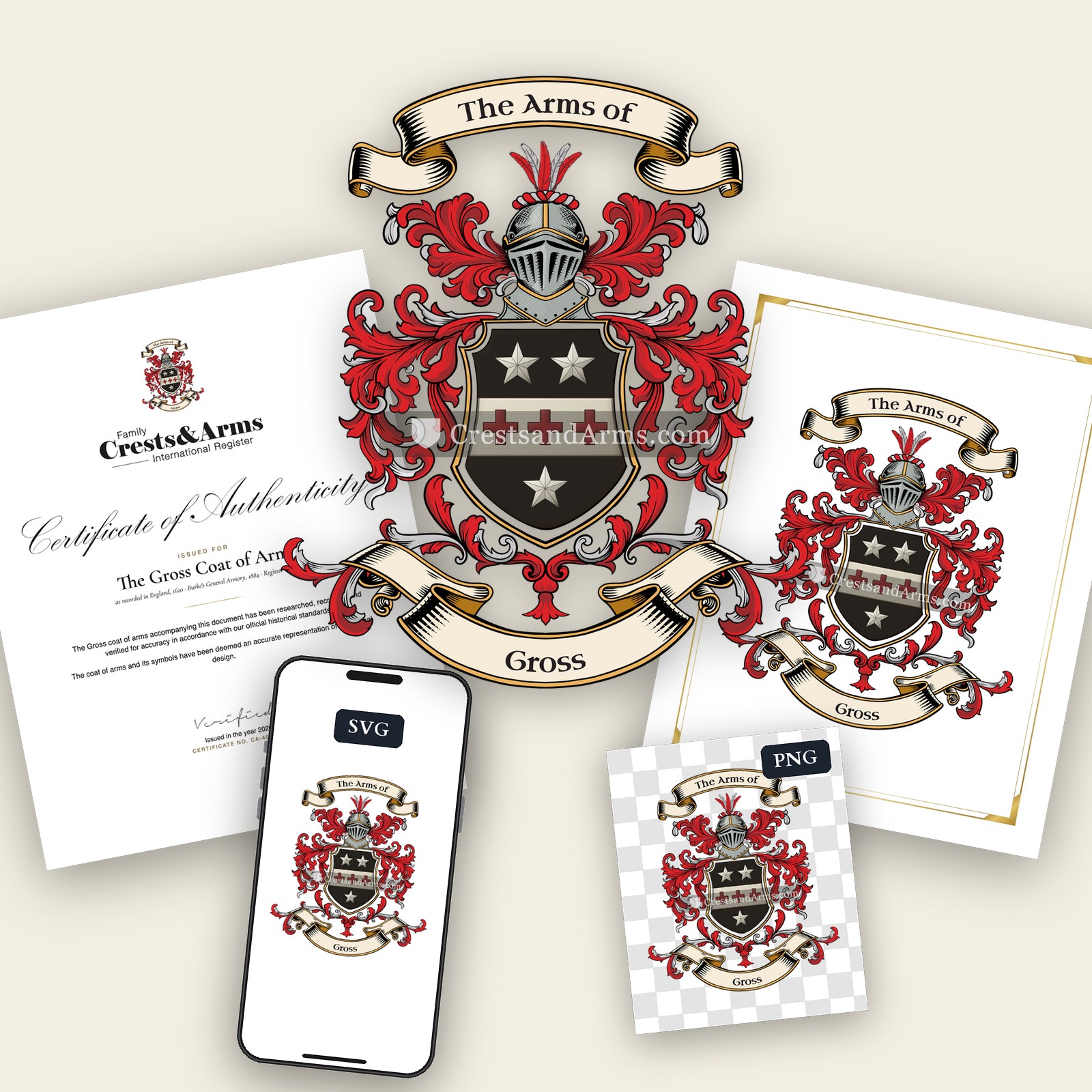
fessThe military belt, and readiness to serve
cross symbolChristian faith and service
mulletThe third son, and a divine quality from above
Colours
Black (Sable)Means: Constancy
Silver (Argent)Means: Peace and sincerity
Red (Gules)Means: Military strength
Historical info
Source
Sir Bernard Burke, The General Armory of England, Scotland, Ireland and Wales, London: Harrison & Sons, 1884
Blazon (the actual original written record)
“Sa. on a fesse betw. three mullets pierced ar. as many crosses crosslet gu”
Englandc. 1620
Digital archive packCoat of arms PNG, gold border print PDF, vector SVG and the certificate of authenticity. Sent to your email in minutes.
Map of England showing where the Gross arms are recorded
The Gross arms were recorded in England, c. 1620.
Arms such as these were typically recorded in York.
Yorkshire is the largest of the English counties, and it held more gentry families than any other. Land there was split among a great many households rather than a few, so a great many of them carried arms.
This is where the arms were entered in the register. Families often moved to other parts of the country, so the same name can turn up in more than one region.
The body that granted and recorded arms in England in this period.
James VI and I
Sovereign of the period
James VI and I
1603–1625
Reigning in Switzerland when the Gross arms are first recorded.
How Arms Worked in England
English heraldry allowed arms to be shared by all legitimate descendants of the original owner. These symbols were treated as personal property that moved through the generations to all children. While the eldest son kept the original design, other family members could use the same shield without needing to change it or register their own unique versions.
Granting authority
The College of Arms in London has regulated the use of coats of arms throughout England and Wales since 1484.
How they got arms
Families typically obtained their coats of arms through a formal grant from the Crown or by proving their ancient right to them.
Where arms were recorded
All official coats of arms are recorded in the registers kept at the College of Arms, which date back to the fifteenth century.
The family's standing
Recorded among the armigerous families of England.
Origin & History of the Gross Family in England
The surname Gross has deep roots in the English language, typically originating as a descriptive nickname for a person of large physical stature or a bold personality. By the early 17th century, the name was firmly established in northern England, with records confirming that members of the family were living in the historic city of York by 1620. During this period, York served as a vital regional hub for trade and administration, placing the family at the center of a bustling urban environment. As the family settled into the area, they likely integrated into the local economy as merchants, tradesmen, or skilled craftsmen. Their presence in such a prominent city suggests that they were active participants in the social and economic life of the region during the transition into the Stuart era.
Gross Meaning & Related Branches
Root word
crassus
Latin term meaning thick, fat, or dense.
This name
GrossA descriptive nickname for a large, stout, or physically imposing person.
also spelled
Gros
Grosse
Grose
Related arms
Crogesimilar arms
Grosvariant spelling
Grosevariant spelling
Documented Sources
J. B. Rietstap, Armorial Général, Gouda: G. B. van Goor Zonen, 1884–87
Historisches Lexikon der Schweiz, Gross (Familie), 2006
Staatsarchiv Basel-Stadt, Bürgerverzeichnisse und Einwohnerregister, 1745
Familiennamenbuch der Schweiz, Gross, 1989
Digital archive packCoat of arms PNG, gold border print PDF, vector SVG and the certificate of authenticity. Sent to your email in minutes.


 hunting horn stringedOne who delights in the chase
 arrowReadiness for battle, and affliction endured
 mulletThe third son, and a divine quality from above
 hunting horn stringedOne who delights in the chase
 arrowReadiness for battle, and affliction endured
 mulletThe third son, and a divine quality from above

 mountThe ground held, and steadfastness upon it
 branchPeace, and new growth


 fessThe military belt, and readiness to serve
 cross symbolChristian faith and service