A record of documented arms, meaning and origin, researched for the Grosvenor family lines. Documented in 2 countries.
Reg. 2387 · French, G–I
Coat of Arms & Family Crest Details
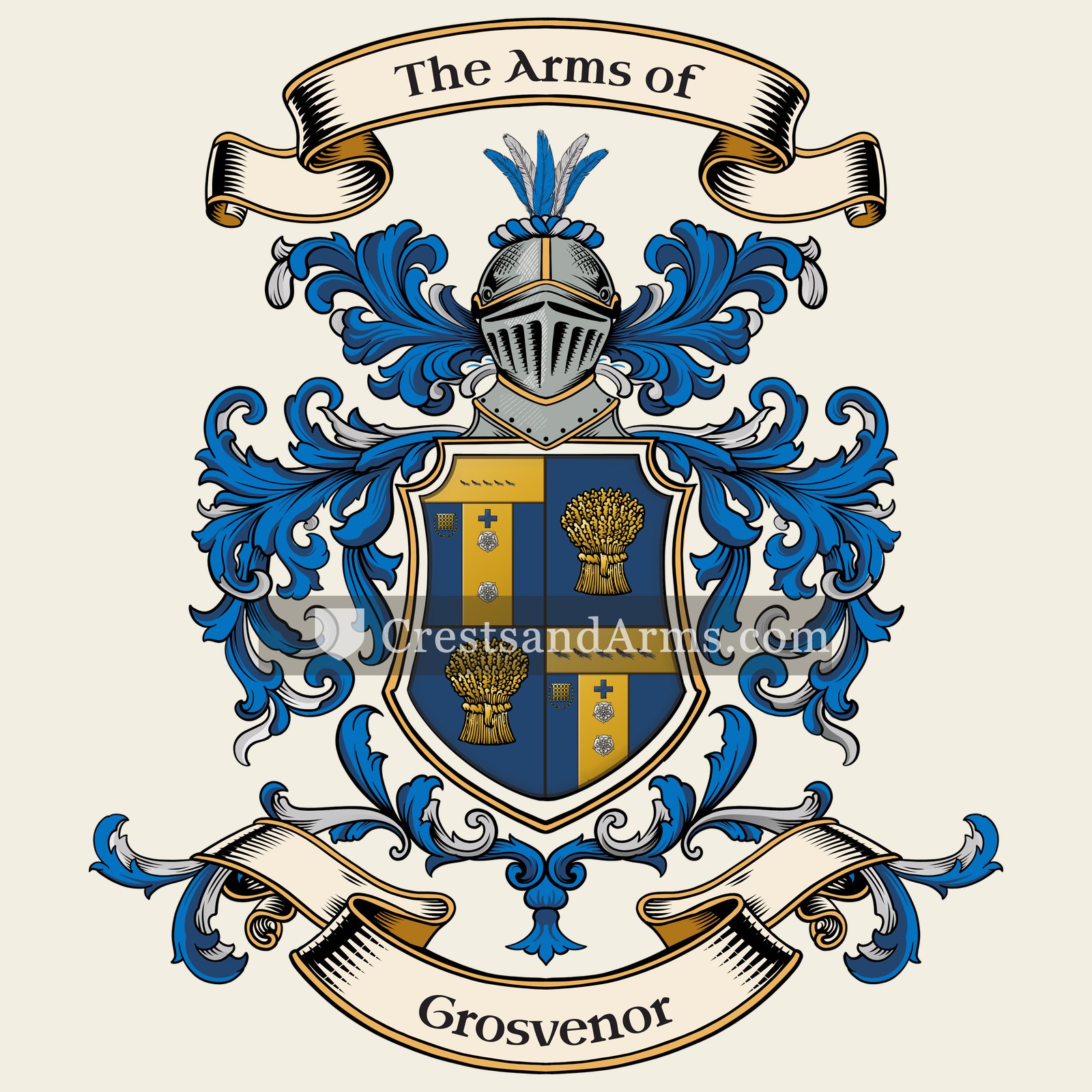
Symbols on this shield
chiefAuthority, wisdom and dominion
paleMilitary strength, and a fortified defence
cross symbolChristian faith and service
portcullisProtection of the household, and the guarded gate
martletA younger son, who must win his own land
roseThe seventh son, and beauty with grace
wheatsheafPlenty, and the harvest of one's own labour
Colours
Blue (Azure)Means: Loyalty and truth
Gold (Or)Means: Generosity
Silver (Argent)Means: Peace and sincerity
Historical info
Source
J. B. Rietstap, Armorial Général, Gouda: G. B. van Goor Zonen, 1884–87
Blazon (the actual original written record)
“Ec.: aux 1 et 4 les armes de la ville de Westminster qui sont d'azur à une herse sarasine d'or, enchainée du même; au chef d'or, ch. d'un pal d'azur surch. des armes attribuées à Edouard le Confesseur: une croix florencée cantonnée de quatre martinets et acc. en p. d'un cinquième martinet, le tout d'or; ledit pal accosté de deux roses écartelées d'arg. et de gu.; aux 2 et 3 d'azur à une gerbe d'or (Grosvenor). C.: un dogue arrêté d'or. S.: deux dogues reg. d'or, coll. d'azur. D.: VIRTUS NON STEMMA.”
Francec. 1621
Where the Grosvenor Arms Were Recorded
Bretagne
Map of France showing where the Grosvenor arms are recorded
The Grosvenor arms were recorded in France, c. 1621.
Arms such as these were typically recorded in Bretagne.
More families held coats of arms in Bretagne than anywhere else in France. The land was divided into many small estates rather than a few large ones, so far more households counted as gentry, and each needed a shield of its own to be told apart.
This is where the arms were entered in the register. Families often moved to other parts of the country, so the same name can turn up in more than one region.
The body that granted and recorded arms in France in this period.
Louis XIII of France
Sovereign of the period
Louis XIII of France
1617–1643
Reigning in France when the Grosvenor arms are first recorded.
How Arms Worked in France
In France, a coat of arms was a mark of honor that passed down through the male line to all legitimate descendants. Families often used the same shield without changes to show their shared heritage. If a branch wanted to stand out, they could add a small mark to their shield to show their specific place in the family tree.
Granting authority
The Juge d'armes de France acted as the official authority that regulated and verified coats of arms across the country.
How they got arms
Families typically inherited their arms from ancestors, though they could also receive them through royal grants or by proving their noble status.
Where arms were recorded
Coats of arms were officially recorded in the Armorial Général de France, which began its main collection in the year 1696.
The family's standing
Recorded among the armigerous families of France.
Origin & History of the Grosvenor Family in France
The surname Grosvenor traces its roots to the historical region of Normandy and the broader territories of northern France. The name itself is derived from the Old French term "le gros veneur," which translates to the great hunter or the chief huntsman. This title was often bestowed upon individuals who held significant roles within the administrative or sporting households of the French nobility. By the early 17th century, members of the family were well-established in the province of Brittany. Records from 1621 confirm their presence in this region, where they lived as part of the local landed society. During this era, the family navigated the complex social structures of Brittany, often serving in local government or managing agricultural estates. Their history in France reflects a transition from holding functional titles in royal courts to becoming settled members of the provincial gentry.
Coat of Arms & Family Crest Details
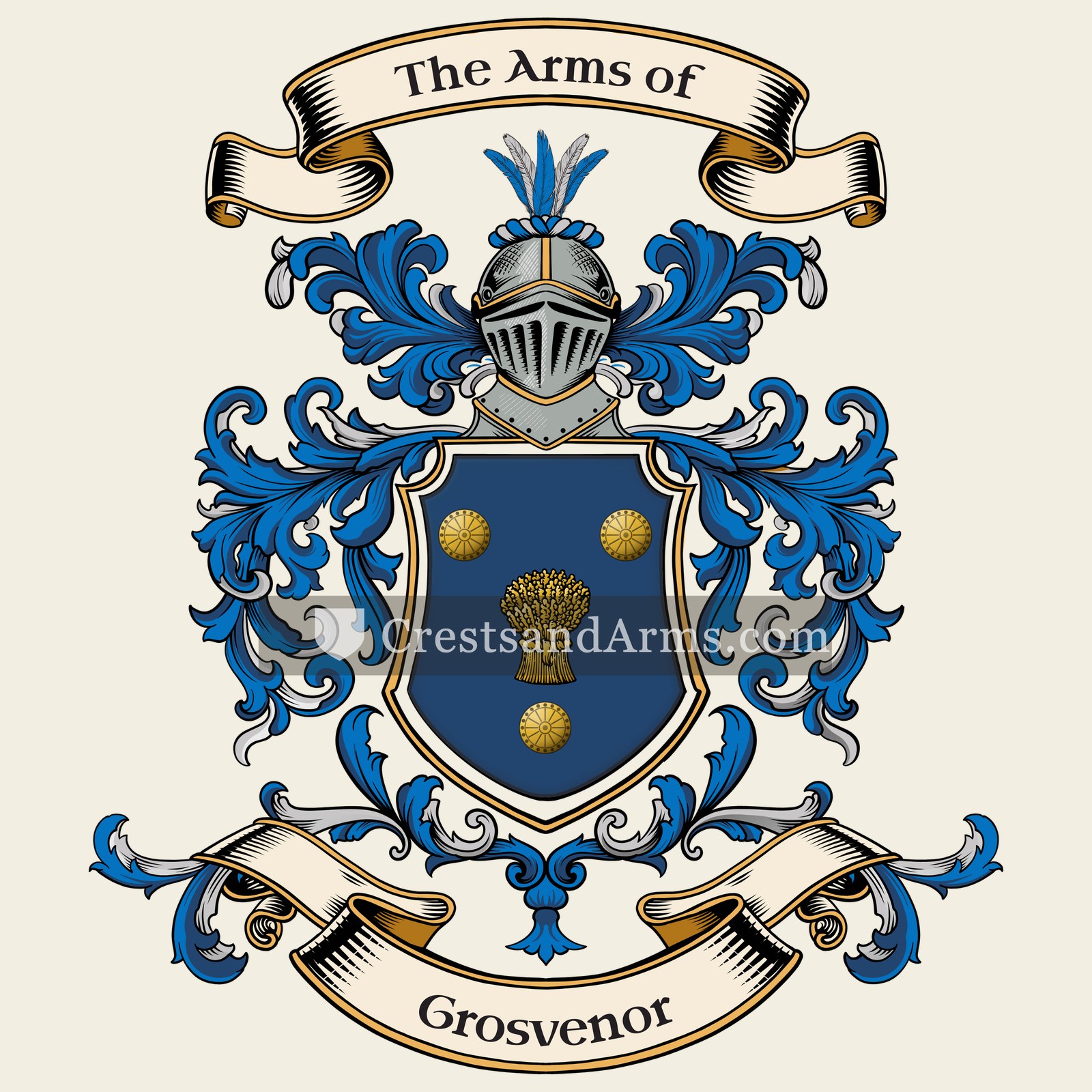
Symbols on this shield
wheatsheafPlenty, and the harvest of one's own labour
roundelA coin, and one who has been to the crusades
Colours
Blue (Azure)Means: Loyalty and truth
Gold (Or)Means: Generosity
Historical info
Source
Sir Bernard Burke, The General Armory of England, Scotland, Ireland and Wales, London: Harrison & Sons, 1884
Blazon (the actual original written record)
“Az. a garb or, betw. three bezants”
StaffordBushbury · Stafford, c. 1583
Where the Grosvenor Arms Were Recorded
Stafford
Map of England showing where the Grosvenor arms are recorded
The Grosvenor arms were recorded in Stafford, c. 1583.
Staffordshire was mixed country of moorland, farmland and early ironworking. Its landed families were spread widely rather than concentrated, and each holding brought its own claim to arms.
This is where the arms were entered in the register. Families often moved to other parts of the country, so the same name can turn up in more than one region.
The body that granted and recorded arms in England in this period.
Elizabeth I of England
Sovereign of the period
Elizabeth I of England
1558–1603
Reigning in France when the Grosvenor arms are first recorded.
How Arms Worked in England
English heraldry allowed arms to be shared by all legitimate descendants of the original owner. These symbols were treated as personal property that moved through the generations to all children. While the eldest son kept the original design, other family members could use the same shield without needing to change it or register their own unique versions.
Granting authority
The College of Arms in London has regulated the use of coats of arms throughout England and Wales since 1484.
How they got arms
Families typically obtained their coats of arms through a formal grant from the Crown or by proving their ancient right to them.
Where arms were recorded
All official coats of arms are recorded in the registers kept at the College of Arms, which date back to the fifteenth century.
The family's standing
Recorded among the armigerous families of Stafford.
Origin & History of the Grosvenor Family in England
The Grosvenor family name has deep roots in the history of England, with the name itself originating from the Old French term *le gros veneur*, which translates to the great hunter. This title was originally a professional designation for the chief huntsman of a royal household, reflecting a position of high status and trust within the medieval social structure. By the late sixteenth century, members of the family were well-established in the county of Stafford, where they played active roles in local life. The family’s presence in this region by 1583 highlights their transition from their early origins into the landed gentry of the English countryside. Over the centuries, the family became deeply connected to the development of English estates and local governance, moving from their initial roles in service toward becoming prominent figures in their respective communities.
Related Branches & Arms
Root word
Grand Veneur
A high-ranking official responsible for the king's hunting dogs.
This name
GrosvenorRefers to the hereditary title of the chief huntsman to the Duke of Normandy.
also spelled
Grosvenour
Grosveneur
Grovnor
Related arms
Morgansame arms
Bedfordrecorded with Grosvenor, same area
Jollyerecorded with Grosvenor, same area
Paytonrecorded with Grosvenor, same area
Documented Sources
J. B. Rietstap, Armorial Général, Gouda: G. B. van Goor Zonen, 1884–87
Lower, Mark Antony, Patronymica Britannica: A Dictionary of the Family Names of the United Kingdom, 1860
Archives départementales d'Ille-et-Vilaine, Série E: Familles, seigneuries et terres, 1621
Morice, Pierre-Hyacinthe, Mémoires pour servir de preuves à l'histoire ecclésiastique et civile de Bretagne, 1742
Digital archive packCoat of arms PNG, gold border print PDF, vector SVG and the certificate of authenticity. Sent to your email in minutes.