A record of documented arms, meaning and origin, researched for the Grote family lines. Documented in 3 countries.
Reg. 0587 · German, G–I
Coat of Arms & Family Crest Details
Symbols on this shield
horseReadiness to serve king and country
eagleNobility, strength and a keen mind
Colours
Silver (Argent)Means: Peace and sincerity
Gold (Or)Means: Generosity
Black (Sable)Means: Constancy
Red (Gules)Means: Military strength
Historical info
Source
J. B. Rietstap, Armorial Général, Gouda: G. B. van Goor Zonen, 1884–87
Blazon (the actual original written record)
“Ec.: aux 1 et 4 d'arg. à un cheval pass. de sa., bridé de gu.; aux 2 et 3 d'or à l'aigle de gu., cour., bq. et m. du champ. Cq. cour. C.: une queue de paon au nat.; ou, un panache de plumes de coq de bruyère de sa. L.: à dextre d'arg. et de sa., à sen. d'or et de gu. S.: deux licornes reg. d'arg. (ou de sa.)”
GermanyHan, c. 1689
Digital archive packCoat of arms PNG, gold border print PDF, vector SVG and the certificate of authenticity. Sent to your email in minutes.
Map of Germany showing where the Grote arms are recorded
The Grote arms were recorded in Han, c. 1689.
This is where the arms were entered in the register. Families often moved to other parts of the country, so the same name can turn up in more than one region.
The body that granted and recorded arms in Germany in this period.
Leopold I, Holy Roman Emperor
Sovereign of the period
Leopold I, Holy Roman Emperor
1658–1705
Reigning in Germany when the Grote arms are first recorded.
How Arms Worked in Germany
In the Holy Roman Empire, coats of arms were often granted to individuals by the Emperor or his representatives. These arms were then passed down through the generations to all legitimate descendants of the original holder. Younger branches of a family usually kept the same shield design without needing to change it, as the arms belonged to the entire lineage.
Granting authority
The Holy Roman Emperor held the sole power to grant new coats of arms throughout his vast imperial territories.
How they got arms
Families typically obtained their coats of arms through a formal imperial grant or by proving their noble status to the authorities.
Where arms were recorded
These grants were officially recorded in the Imperial Chancery registers, which began keeping formal records of such honors during the Middle Ages.
The family's standing
Recorded among the armigerous families of Germany.
Origin & History of the Grote Family in Germany
The surname Grote originates from the Low German word for large or great, and it was historically used as a descriptive nickname to distinguish individuals based on their physical stature or social prominence. By the late seventeenth century, the family established a notable presence in the region of Han, which was part of the complex landscape of the Holy Roman Empire. During this period, families often lived in small, tight-knit agricultural or trade communities where surnames became fixed as a way to track tax obligations and church records. The presence of the Grote family in Han by 1689 suggests they were part of the local social fabric during a time of significant reconstruction following the devastation of the Thirty Years' War. As the family grew, they integrated into the local economy, likely participating in the regional traditions of farming or craftsmanship that defined life in northern Germany at the time.
Coat of Arms & Family Crest Details
Symbols on this shield
mountThe ground held, and steadfastness upon it
foxWit and wisdom in defence
treeLife, endurance and deep roots
Colours
Silver (Argent)Means: Peace and sincerity
Green (Vert)Means: Hope
Historical info
Source
J. B. Rietstap, Armorial Général, Gouda: G. B. van Goor Zonen, 1884–87
Blazon (the actual original written record)
“D'arg. à un renard au nat., courant entre trois arbres de sin. sur une terrasse du même. Cq. cour. C.: un arbre de sin. L. d'arg. et de sin.”
LivoniaLivonia, c. 1775
Digital archive packCoat of arms PNG, gold border print PDF, vector SVG and the certificate of authenticity. Sent to your email in minutes.
Map of Poland showing where the Grote arms are recorded
The Grote arms were recorded in Livonia, c. 1775.
Livonia was Baltic country held by a small number of landed families who kept their estates for centuries. Land there passed down whole rather than being divided, and long unbroken tenure is what fills a register.
This is where the arms were entered in the register. Families often moved to other parts of the country, so the same name can turn up in more than one region.
Region
Livonia
First recorded
1775
Granting Authority for the Grote Arms
Ennoblement by the Sejm
Author: Olek Remesz · CC BY-SA 3.0
The body that granted and recorded arms in Poland in this period.
Stanisław August Poniatowski
Sovereign of the period
Stanisław August Poniatowski
1764–1795
Reigning in Germany when the Grote arms are first recorded.
How Arms Worked in Poland
Polish noble families shared a single coat of arms across many different surnames, creating large clans rather than individual designs. These symbols were held collectively by all members of the clan regardless of their specific family name. When a new family joined the nobility, they were adopted into an existing clan and began using that group's established shield.
Granting authority
The Sejm, which was the Polish parliament, held the power to grant noble status and the right to bear arms.
How they got arms
Families typically received their coat of arms through a formal act of ennoblement granted by the Sejm for distinguished service.
Where arms were recorded
These grants were officially recorded in the Crown Metrica, which served as the central archive for state documents starting in the sixteenth century.
The family's standing
Recorded among the armigerous families of Livonia.
Origin & History of the Grote Family in Poland
The Grote family name has deep roots in the Baltic region, particularly within the historical territory of Livonia. By 1775, members of the family were well-established in this area, which served as a cultural bridge between Northern Europe and the Polish-Lithuanian Commonwealth. The name Grote is derived from the Middle Low German word for large or great, and it likely served as a descriptive nickname for a person of significant physical stature or social importance. As the family moved and integrated into the administrative and social structures of the Polish-influenced Baltic lands, they often served in professional or landowning capacities. This migration pattern reflects the broader movement of families across the Baltic Sea region during the eighteenth century, where individuals moved between German-speaking centers and the diverse territories of the Polish crown to pursue trade, military service, or agricultural management.
Coat of Arms & Family Crest Details
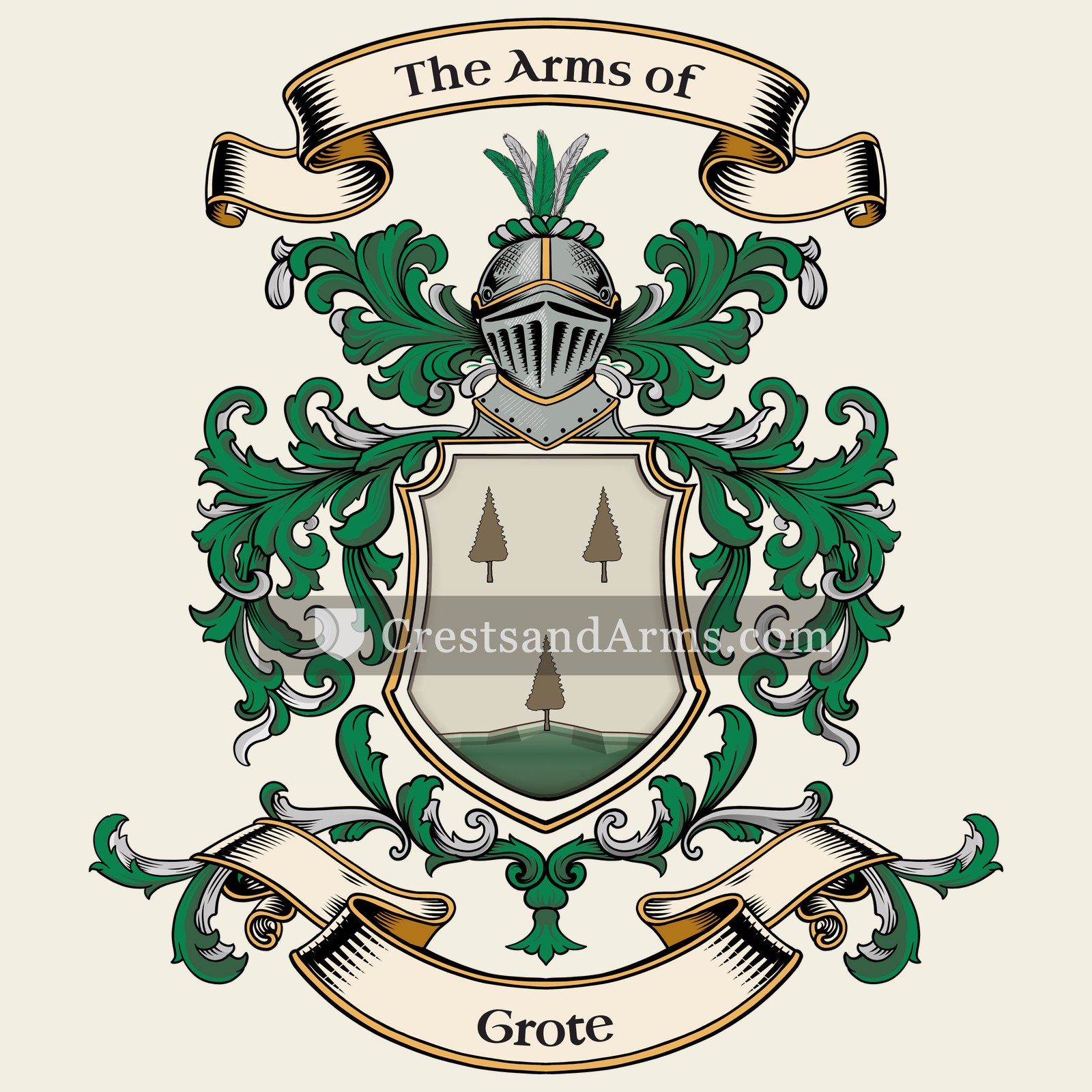
Symbols on this shield
mountThe ground held, and steadfastness upon it
pine treeSteadfastness through every season
Colours
Silver (Argent)Means: Peace and sincerity
Green (Vert)Means: Hope
Historical info
Source
Sir Bernard Burke, The General Armory of England, Scotland, Ireland and Wales, London: Harrison & Sons, 1884
Blazon (the actual original written record)
“Ar. on a mount vert three pine trees ppr. a dexter side or”
EnglandLondon, c. 1809
Digital archive packCoat of arms PNG, gold border print PDF, vector SVG and the certificate of authenticity. Sent to your email in minutes.
Map of England showing where the Grote arms are recorded
The Grote arms were recorded in London, c. 1809.
This is where the arms were entered in the register. Families often moved to other parts of the country, so the same name can turn up in more than one region.
The body that granted and recorded arms in England in this period.
George III of Great Britain
Sovereign of the period
George III of Great Britain
1801–1820
Reigning in Germany when the Grote arms are first recorded.
How Arms Worked in England
English heraldry allowed arms to be shared by all legitimate descendants of the original owner. These symbols were treated as personal property that moved through the generations to all children. While the eldest son kept the original design, other family members could use the same shield without needing to change it or register their own unique versions.
Granting authority
The College of Arms in London has regulated the use of coats of arms throughout England and Wales since 1484.
How they got arms
Families typically obtained their coats of arms through a formal grant from the Crown or by proving their ancient right to them.
Where arms were recorded
All official coats of arms are recorded in the registers kept at the College of Arms, which date back to the fifteenth century.
The family's standing
Recorded among the armigerous families of England.
Origin & History of the Grote Family in England
The surname Grote has deep roots that trace back to the Low Countries and Northern Germany, where the name originally served as a descriptive term for someone of large stature or great importance. By the time the family became firmly established in London in 1809, they had already transitioned from their continental origins into the professional and intellectual life of England. The family is perhaps most famously associated with George Grote, a prominent banker and historian who played a vital role in the founding of the University of London. As the family integrated into English society, they moved away from their merchant beginnings to become influential figures in politics, classical studies, and finance. Their presence in the capital during the early nineteenth century marked a period of significant growth, as they helped shape the educational and social landscape of a rapidly changing city.
Grote Meaning & Related Branches
Root word
grot
Middle Low German word meaning large or tall.
This name
GroteA descriptive nickname for a person of significant physical stature or height.
also spelled
Groote
Grot
Groat
Groot
Documented Sources
J. B. Rietstap, Armorial Général, Gouda: G. B. van Goor Zonen, 1884–87
Bahlow, Hans, Deutsches Namenlexikon: Familien- und Vornamen nach Ursprung und Sinn erklärt, 1967
Heintze, Albert, Die deutschen Familien-Namen: geschichtlich, geographisch, sprachlich, 1903
Lower Saxony State Archives (Niedersächsisches Landesarchiv), Kirchenbücher und Zivilstandsregister der Region Hannover
Digital archive packCoat of arms PNG, gold border print PDF, vector SVG and the certificate of authenticity. Sent to your email in minutes.


 horseReadiness to serve king and country
 eagleNobility, strength and a keen mind
 horseReadiness to serve king and country
 eagleNobility, strength and a keen mind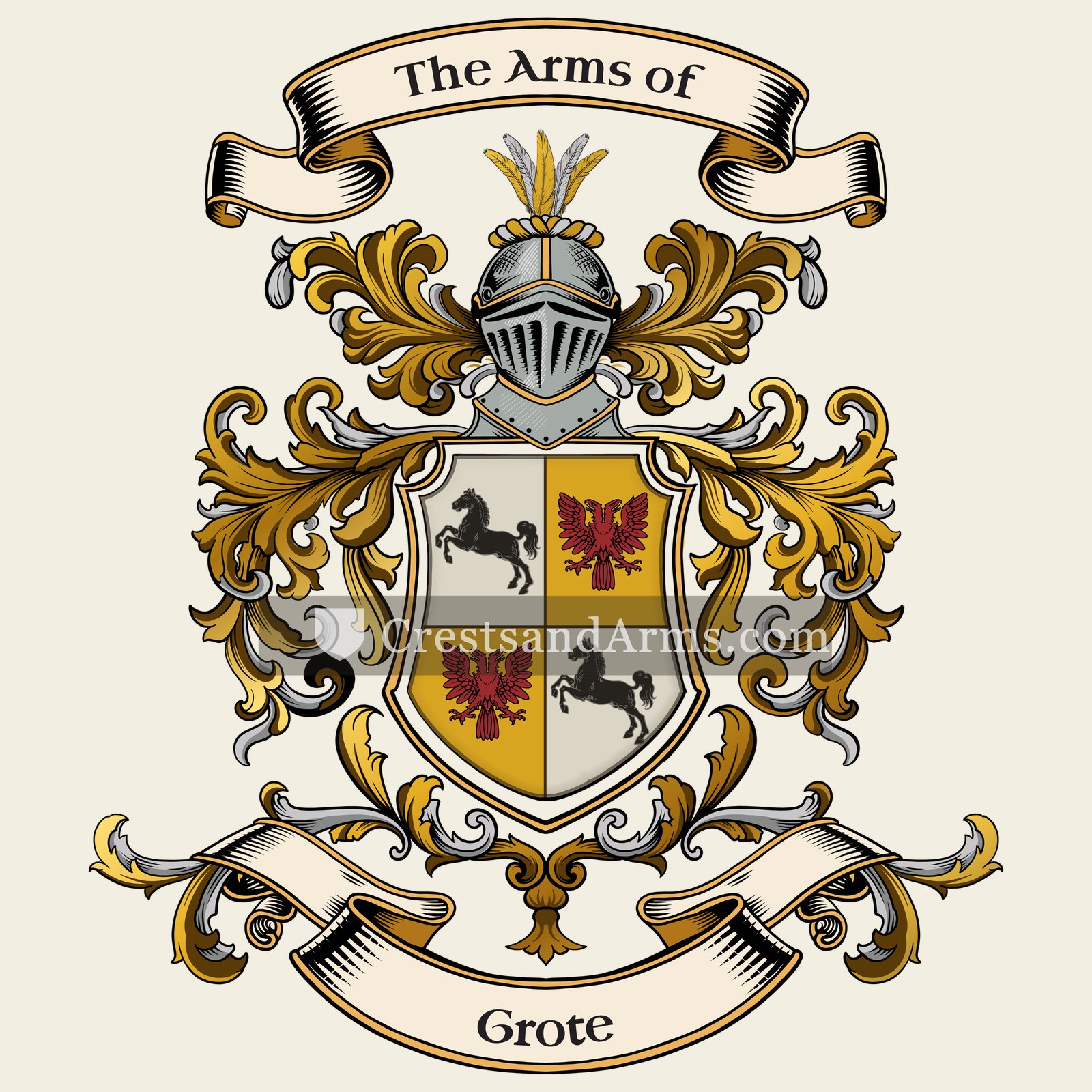


 mountThe ground held, and steadfastness upon it
 foxWit and wisdom in defence
 treeLife, endurance and deep roots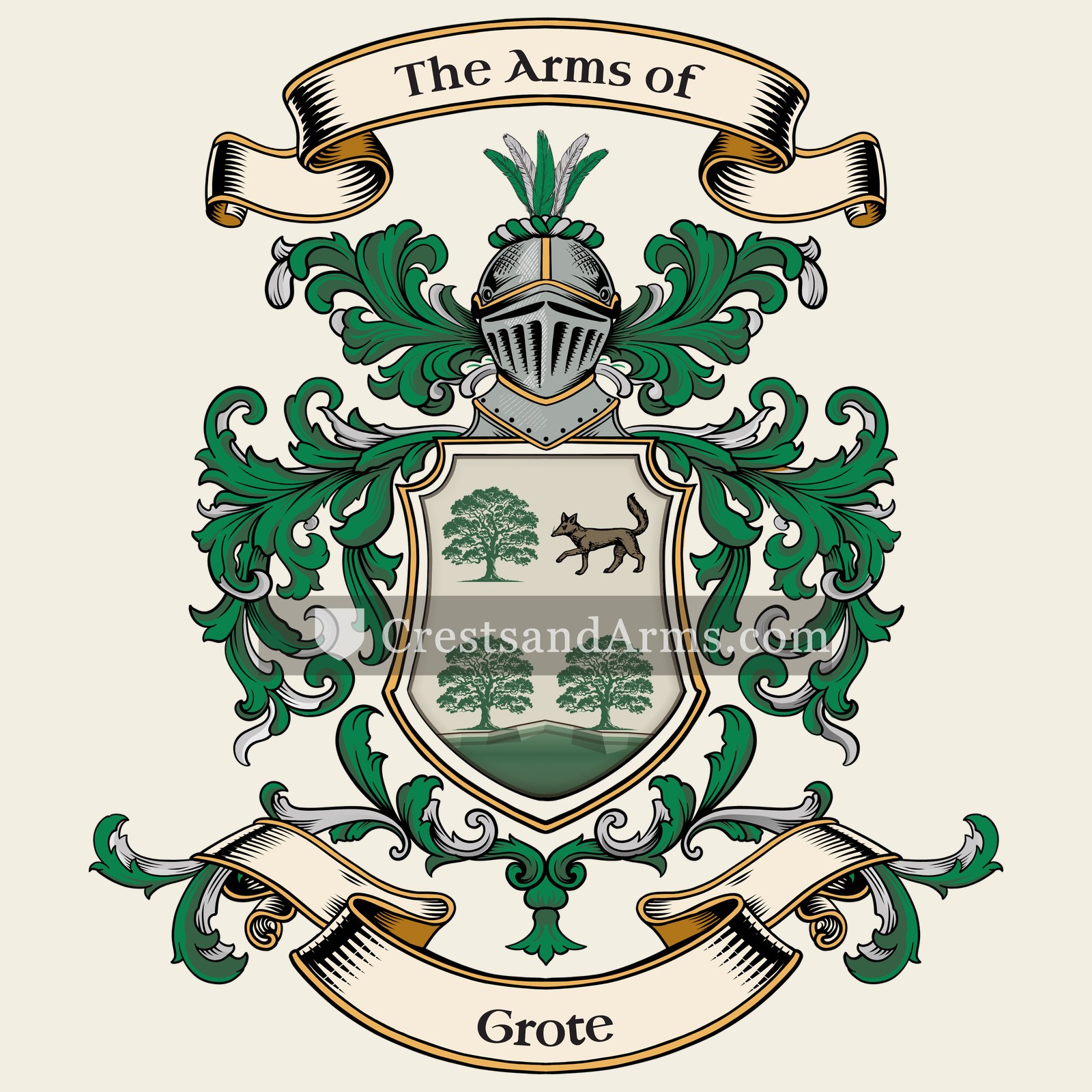


 pine treeSteadfastness through every season