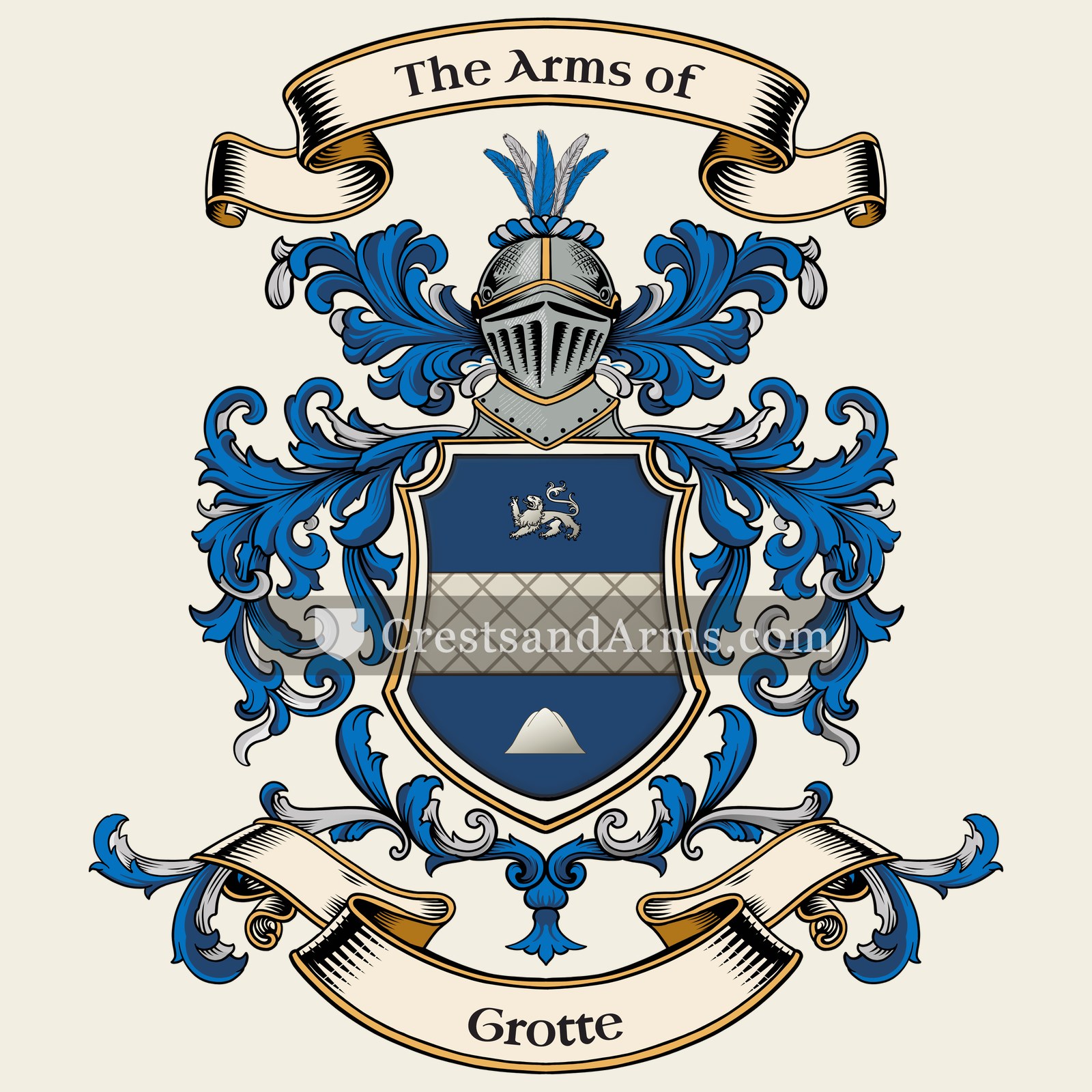
A record of documented arms, meaning and origin, researched for the Grotte family of France.
Reg. 5950 · French, G–I
Coat of Arms & Family Crest Details
Symbols on this shield
fessThe military belt, and readiness to serve
mountThe ground held, and steadfastness upon it
lionCourage, strength and royalty
Colours
Blue (Azure)Means: Loyalty and truth
Silver (Argent)Means: Peace and sincerity
Historical info
Source
J. B. Rietstap, Armorial Général, Gouda: G. B. van Goor Zonen, 1884–87
Blazon (the actual original written record)
“D'azur à la fasce, acc. en chef d'un lion naiss. et en p. d'une roche caverneuse, le tout d'arg.”
LorraineLorraine, c. 1611
Where the Grotte Arms Were Recorded
Lorraine
Map of France showing where the Grotte arms are recorded
The Grotte arms were recorded in Lorraine, c. 1611.
Lorraine sat on the border between France and the German lands, and border country bred soldiers. Families here held small estates and served in arms, and a fighting man was exactly the sort who carried a shield of his own.
This is where the arms were entered in the register. Families often moved to other parts of the country, so the same name can turn up in more than one region.
The body that granted and recorded arms in France in this period.
Louis XIII of France
Sovereign of the period
Louis XIII of France
1610–1617
Reigning in France when the Grotte arms are first recorded.
How Arms Worked in France
In France, a coat of arms was a mark of honor that passed down through the male line to all legitimate descendants. Families often used the same shield without changes to show their shared heritage. If a branch wanted to stand out, they could add a small mark to their shield to show their specific place in the family tree.
Granting authority
The Juge d'armes de France acted as the official authority that regulated and verified coats of arms across the country.
How they got arms
Families typically inherited their arms from ancestors, though they could also receive them through royal grants or by proving their noble status.
Where arms were recorded
Coats of arms were officially recorded in the Armorial Général de France, which began its main collection in the year 1696.
The family's standing
Recorded among the armigerous families of Lorraine.
Origin & History of the Grotte Family in France
The family name Grotte has deep roots in the historical region of Lorraine, where records confirm members of the family were living as early as 1611. During this period, Lorraine was a crossroads of European culture and politics, situated between the French Kingdom and the Holy Roman Empire. The name itself is likely topographic in origin, derived from the Old French word "grotte," which refers to a cave or a rocky hollow. This suggests that the earliest ancestors to bear the name may have lived near a distinctive geological feature or a stone dwelling. As the family established themselves in this borderland, they lived through a time of significant transition and regional conflict that defined the social landscape of the seventeenth century. By settling in this area, the Grotte family became part of the resilient population that navigated the complex cultural shifts of the Lorraine duchy during the early modern era.
Related Branches & Arms
Root word
Crypta
A hidden or vaulted underground chamber or cave.
This name
GrotteA topographic name for someone who lived near a cave or a rocky hollow.
also spelled
Grotta
Grotten
Grotteh
Grot
Related arms
Grottavariant spelling
Documented Sources
J. B. Rietstap, Armorial Général, Gouda: G. B. van Goor Zonen, 1884–87
Archives départementales de Meurthe-et-Moselle, Registres paroissiaux de Lorraine
Cabourdin, Guy, La vie quotidienne en Lorraine aux XVIe et XVIIe siècles, 1984
Lepage, Henri, Les communes de la Meurthe: journal historique des villes, bourgs, villages, hameaux et censes de ce département, 1853
Digital archive packCoat of arms PNG, gold border print PDF, vector SVG and the certificate of authenticity. Sent to your email in minutes.


 fessThe military belt, and readiness to serve
 mountThe ground held, and steadfastness upon it
 lionCourage, strength and royalty
 fessThe military belt, and readiness to serve
 mountThe ground held, and steadfastness upon it
 lionCourage, strength and royalty