Map of Germany showing where the Grün arms are recorded
The Grün arms were recorded in Franconia, c. 1765.
Franconia was a patchwork of small territories in central Germany, full of minor landowners and prosperous market towns. So many separate households held land there that the region produced a great many coats of arms.
This is where the arms were entered in the register. Families often moved to other parts of the country, so the same name can turn up in more than one region.
The body that granted and recorded arms in Germany in this period.
Francis I, Holy Roman Emperor
Sovereign of the period
Francis I, Holy Roman Emperor
1745–1765
Reigning in Germany when the Grün arms are first recorded.
How Arms Worked in Germany
In the Holy Roman Empire, coats of arms were often granted to individuals by the Emperor or his representatives. These arms were then passed down through the generations to all legitimate descendants of the original holder. Younger branches of a family usually kept the same shield design without needing to change it, as the arms belonged to the entire lineage.
Granting authority
The Holy Roman Emperor held the sole power to grant new coats of arms throughout his vast imperial territories.
How they got arms
Families typically obtained their coats of arms through a formal imperial grant or by proving their noble status to the authorities.
Where arms were recorded
These grants were officially recorded in the Imperial Chancery registers, which began keeping formal records of such honors during the Middle Ages.
The family's standing
Recorded among the armigerous families of Franconia.
Origin & History of the Grün Family in Germany
The surname Grün, which translates to the color green, originated as a descriptive nickname in medieval Germany. During this era, people often received names based on their physical appearance, their personality, or the clothing they frequently wore. A person might have been called Grün because they lived near a lush meadow or because they had a fondness for wearing green garments. By the time members of the family were documented in the Franconia region in 1765, the name had long transitioned from a simple nickname into a formal hereditary surname. In the social structure of eighteenth-century Franconia, families with this name were often integrated into the local agricultural or artisan communities. These early ancestors lived through a period of significant regional change as the Holy Roman Empire began to shift toward the modern political landscape of Germany. Their presence in the historical records of Franconia highlights the transition of the family from local inhabitants to established members of the regional population.
Coat of Arms & Family Crest Details
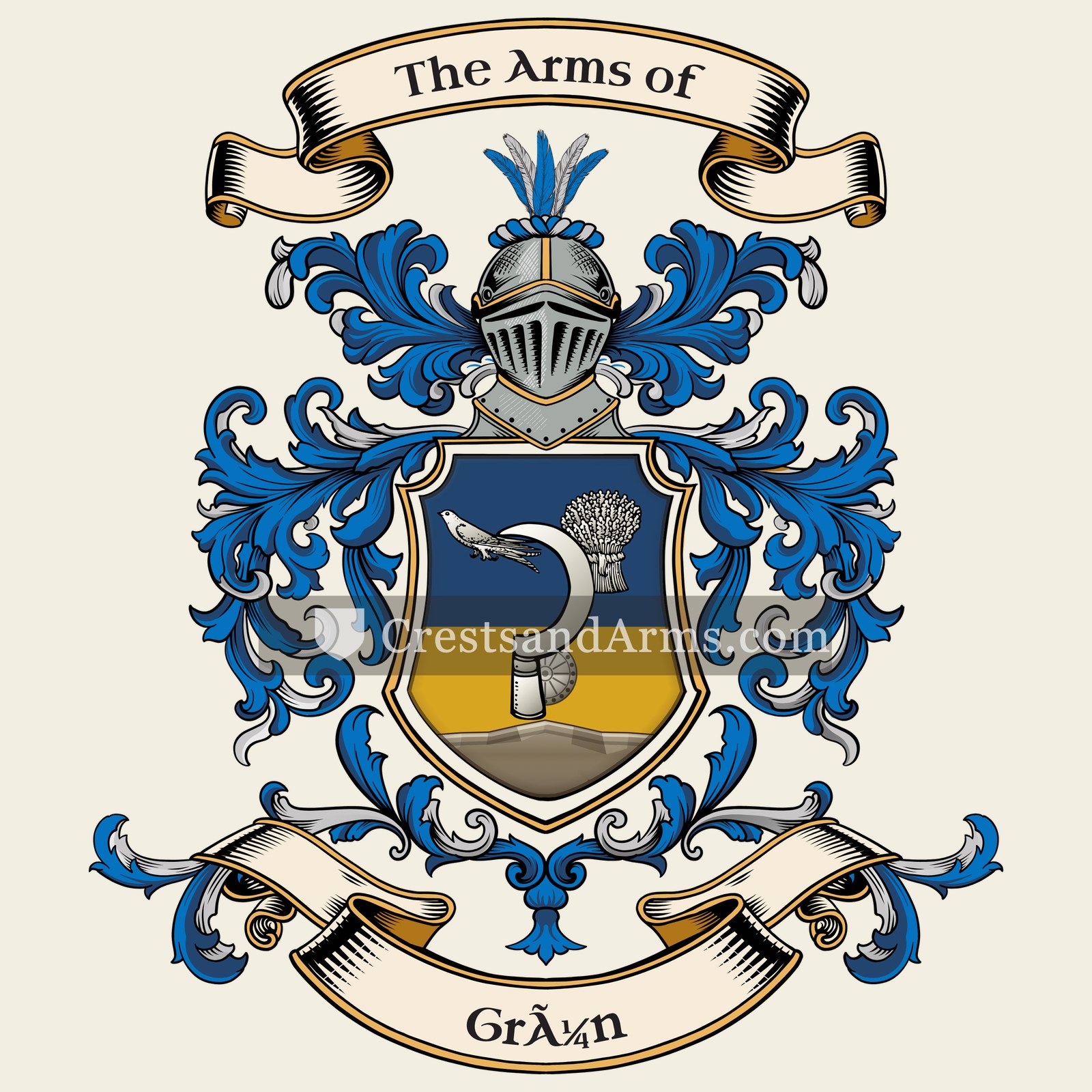
Symbols on this shield
mountThe ground held, and steadfastness upon it
sickleThe harvest, and the reaping of what was sown
martletA younger son, who must win his own land
wheatsheafPlenty, and the harvest of one's own labour
roundelA coin, and one who has been to the crusades
Colours
Blue (Azure)Means: Loyalty and truth
Gold (Or)Means: Generosity
Silver (Argent)Means: Peace and sincerity
Historical info
Source
J. B. Rietstap, Armorial Général, Gouda: G. B. van Goor Zonen, 1884–87
Blazon (the actual original written record)
“Coupé: au 1 parti: a. d'azur à un oiseau volant, posé en barre, la tête en bas, au-dessus d'un champ de blé sur une terrasse, le tout au nat.; b. d'or à un globe terrestre de couleur blanche, avec ses méridiens; au 2 de gu. à une charrue dans un champ de labour, le tout au nat. Deux cq. cour. C.: 1° un Pégase iss. d'arg., ailé d'or; 1. d'or et d'azur; 2° une chouette au nat., la tête sommée d'une étoile d'or; 1. d'or et de gu.”
Austriac. 1875
Digital archive packCoat of arms PNG, gold border print PDF, vector SVG and the certificate of authenticity. Sent to your email in minutes.
Map of Austria showing where the Grün arms are recorded
The Grün arms were recorded in Austria, c. 1875.
Arms such as these were typically recorded in Tyrol.
Tyrol was mountain country in western Austria, where the valleys were held by families who had been there a very long time. Old tenure counted for more than money, and old families carried arms.
This is where the arms were entered in the register. Families often moved to other parts of the country, so the same name can turn up in more than one region.
Region
Tyrol
First recorded
1875
Granting Authority for the Grün Arms
Imperial and Royal chancery
Sodacan · CC BY-SA 3.0
The body that granted and recorded arms in Austria in this period.
Franz Joseph I of Austria
Sovereign of the period
Franz Joseph I of Austria
1848–1916
Reigning in Germany when the Grün arms are first recorded.
How Arms Worked in Austria
Austrian coats of arms were often linked directly to noble titles granted by the Emperor. These symbols belonged to the entire family line rather than just one individual. When a family grew, new branches kept the original design without needing to change it. This system allowed all members of a noble house to share the same identity across many generations.
Granting authority
The Imperial and Royal chancery managed all heraldic matters and controlled the official granting of arms throughout the Austrian lands.
How they got arms
Families typically received their arms through a formal imperial decree that often accompanied the elevation of a person to noble status.
Where arms were recorded
Official records of these grants were kept in the Imperial Register of Nobility which began its formal documentation process in 1453.
The family's standing
Recorded among the armigerous families of Austria.
Origin & History of the Grün Family in Austria
The surname Grün, which translates to green in English, belongs to a category of names derived from descriptive characteristics or geographic features. In the context of the Austrian Alps, the name likely originated as a way to identify families living near lush mountain meadows or verdant pastures. By the time records confirm the presence of the family in Tyrol during 1875, the name was already well-established within the local agrarian culture. These early ancestors were often tied to the rugged landscape of the region, where the name served as a practical label for those who tended the vibrant green slopes of the valleys. As the family moved through the late nineteenth century, they became part of the social fabric of the Austro-Hungarian Empire, reflecting the deep connection between rural inhabitants and the natural environment of their home province.
Grün Meaning & Related Branches
Root word
grōni
Proto-Germanic term referring to the color green or growing vegetation.
This name
GrünA topographic name for someone living near a green area or a nickname for someone associated with the color.
also spelled
Gruen
Groon
Related arms
Wundersame arms
Documented Sources
J. B. Rietstap, Armorial Général, Gouda: G. B. van Goor Zonen, 1884–87
Bahlow, Hans, Deutsches Namenlexikon: Familien- und Vornamen nach Ursprung und Sinn erklärt, 1967
Gottschald, Max, Deutsche Namenkunde: Unsere Familiennamen nach ihrer Entstehung und Bedeutung, 1971
Staatsarchiv Bamberg, Standesamtliche Unterlagen und Kirchenbücher der Region Franken, 1765
Digital archive packCoat of arms PNG, gold border print PDF, vector SVG and the certificate of authenticity. Sent to your email in minutes.


 bendDefence, and the scarf of a commander
 bendDefence, and the scarf of a commander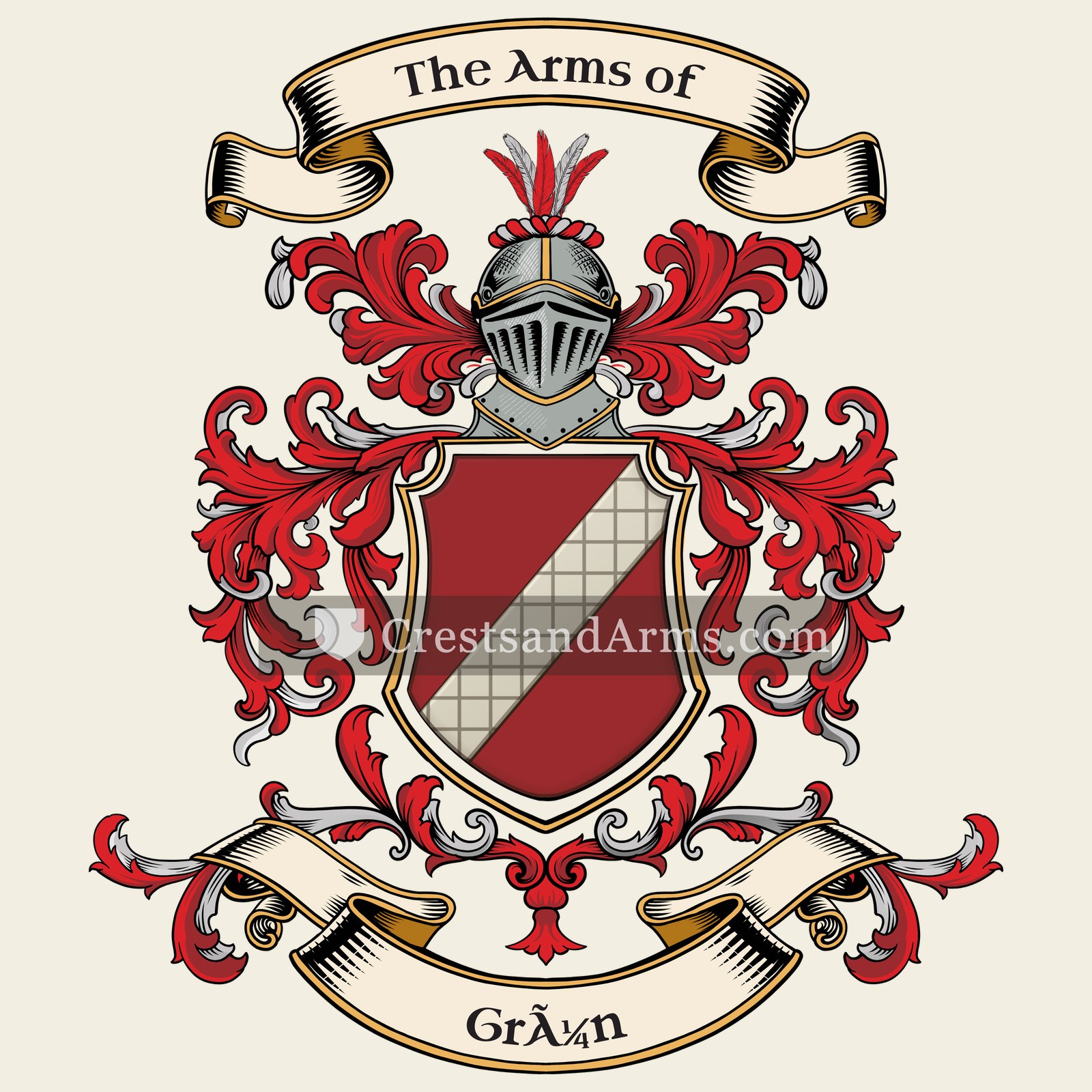


 mountThe ground held, and steadfastness upon it
 sickleThe harvest, and the reaping of what was sown
 martletA younger son, who must win his own land
 wheatsheafPlenty, and the harvest of one's own labour
 roundelA coin, and one who has been to the crusades