Map of Germany showing where the Grünau arms are recorded
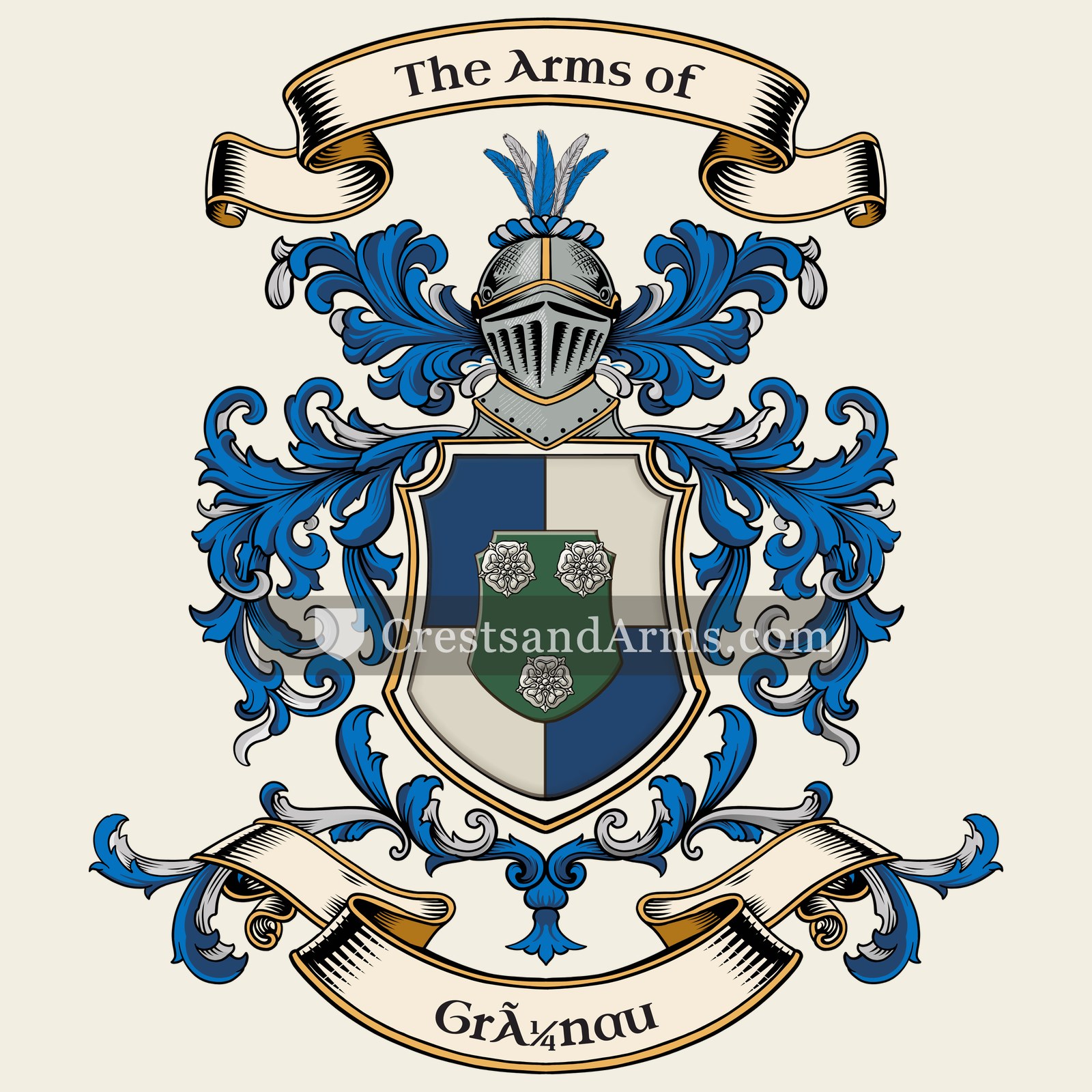
The Grünau arms were recorded in Bade, c. 1870.
This is where the arms were entered in the register. Families often moved to other parts of the country, so the same name can turn up in more than one region.
The body that granted and recorded arms in Germany in this period.
Wilhelm I
Sovereign of the period
Wilhelm I
1861–1888
Reigning in Germany when the Grünau arms are first recorded.
How Arms Worked in Germany
Prussian heraldry was strictly tied to social rank and noble status rather than being a free choice for every citizen. These symbols were treated as permanent family property that moved through the generations to all legitimate heirs. If a family branch wanted to change their design to stand out, they had to apply for official permission to alter their specific version of the shield.
Granting authority
The Prussian Heroldsamt acted as the central state office that managed and strictly controlled all noble titles and coats of arms.
How they got arms
Families usually obtained their arms through formal royal grants or by proving their long-standing noble status to the state authorities.
Where arms were recorded
All official coats of arms were kept in the rolls of the Prussian Heroldsamt, which functioned from 1706 until 1918.
The family's standing
Recorded among the armigerous families of Germany.
Origin & History of the Grünau Family in Germany
The name Grünau is a topographical surname, which means it was originally derived from the physical landscape where a family lived. In German, the name combines the words *grün*, meaning green, and *au*, which refers to a meadow or a riverbank. This suggests that the earliest ancestors of the family likely settled near a lush, green valley or a fertile river basin. By the year 1870, records confirm that members of the Grünau family were well-established in the region of Baden. During this period, families in Baden were often deeply connected to the local agricultural economy and the changing political landscape of the German states. As the family moved through the late 19th century, they carried this name as a reflection of their ancestral ties to the natural beauty of the German countryside.
Grünau Meaning & Related Branches
Root word
Grün + Au
Green meadow or pasture land near a body of water.
This name
GrünauRefers to a person who lived near a lush, green meadow or riverbank.
also spelled
Gruenau
Grunauw
Gruna
Groonow
Documented Sources
J. B. Rietstap, Armorial Général, Gouda: G. B. van Goor Zonen, 1884–87
Bahlow, Hans, Deutsches Namenlexikon: Familien- und Vornamen nach Ursprung und Sinn erklärt, 1967
Badisches Generallandesarchiv, Zivilstandsregister des Großherzogtums Baden, 1870
Heintze, Albert, Die deutschen Familiennamen: geschichtlich, geographisch, sprachlich, 1903
Digital archive packCoat of arms PNG, gold border print PDF, vector SVG and the certificate of authenticity. Sent to your email in minutes.


 roseThe seventh son, and beauty with grace
 roseThe seventh son, and beauty with grace