Map of Germany showing where the Gruner arms are recorded
The Gruner arms were recorded in Nuremberg, c. 1765.
This is where the arms were entered in the register. Families often moved to other parts of the country, so the same name can turn up in more than one region.
The body that granted and recorded arms in Germany in this period.
Francis I, Holy Roman Emperor
Sovereign of the period
Francis I, Holy Roman Emperor
1745–1765
Reigning in Germany when the Gruner arms are first recorded.
How Arms Worked in Germany
In the Holy Roman Empire, coats of arms were often granted to individuals by the Emperor or his representatives. These arms were then passed down through the generations to all legitimate descendants of the original holder. Younger branches of a family usually kept the same shield design without needing to change it, as the arms belonged to the entire lineage.
Granting authority
The Holy Roman Emperor held the sole power to grant new coats of arms throughout his vast imperial territories.
How they got arms
Families typically obtained their coats of arms through a formal imperial grant or by proving their noble status to the authorities.
Where arms were recorded
These grants were officially recorded in the Imperial Chancery registers, which began keeping formal records of such honors during the Middle Ages.
The family's standing
Recorded among the armigerous families of Germany.
Origin & History of the Gruner Family in Germany
The surname Gruner originated in the German-speaking regions of Europe as a descriptive nickname, likely referring to a person who was associated with the color green or perhaps someone who lived near a lush, grassy area. By the time members of the family were documented in Nuremberg in 1765, the name had already become well-established throughout various German states. During the eighteenth century, Nuremberg served as a major hub for trade and craftsmanship, and families like the Gruners often integrated into the city’s active guilds or professional circles. Because the name is rooted in common Middle High German vocabulary, it was used by families across different social classes rather than being tied to a single geographic origin. This widespread use suggests that the family name evolved naturally as a way to identify individuals within their local communities long before formal census records became standard.
Coat of Arms & Family Crest Details
Symbols on this shield
mountThe ground held, and steadfastness upon it
roseThe seventh son, and beauty with grace
mulletThe third son, and a divine quality from above
Colours
Red (Gules)Means: Military strength
Silver (Argent)Means: Peace and sincerity
Green (Vert)Means: Hope
Historical info
Source
J. B. Rietstap, Armorial Général, Gouda: G. B. van Goor Zonen, 1884–87
Blazon (the actual original written record)
“Taillé de gu. sur arg.; à une rose de l'un en l'autre, tigée et feuillée de sin., soutenue d'un tertre du même, et acc. au canton dextre du chef d'une étoile d'arg. et au flanc sen. d'une autre étoile de gu. C.: une femme iss., hab. d'un parti d'arg. et de gu., tenant de sa main dextre une rose de gu. et de sa sen. une rose d'arg., chaque rose tigée et feuillée de sin.”
SwitzerlandBerne, c. 1745
Digital archive packCoat of arms PNG, gold border print PDF, vector SVG and the certificate of authenticity. Sent to your email in minutes.
Map of Switzerland showing where the Gruner arms are recorded
The Gruner arms were recorded in Berne, c. 1745.
This is where the arms were entered in the register. Families often moved to other parts of the country, so the same name can turn up in more than one region.
The body that granted and recorded arms in Switzerland in this period.
How Arms Worked in Switzerland
In Switzerland, coats of arms were not restricted to the nobility and were often adopted by common citizens and families. These symbols were passed down through generations to show family identity. When branches of a family grew, they often changed small details of the design to distinguish their own line from the original group.
Granting authority
Cantonal and civic authorities managed the use of coats of arms within their specific regions and local jurisdictions.
How they got arms
Families typically assumed their own coats of arms based on local custom rather than receiving them from a central monarch.
Where arms were recorded
Arms were recorded in various cantonal and civic registers starting from the fourteenth century throughout the Swiss region.
The family's standing
Recorded among the armigerous families of Switzerland.
Origin & History of the Gruner Family in Switzerland
The surname Gruner finds its roots in the German language, where it originated as a descriptive nickname for a person who was associated with the color green or perhaps someone who lived near a lush, verdant area. In the context of Switzerland, the family established a notable presence in the canton of Berne by the middle of the eighteenth century. By 1745, members of the Gruner family were already integrated into the social and civic fabric of the region, often participating in the professional and administrative life of the city. As the family grew, they became part of the local tradition of Swiss citizenship, which was historically tied to specific municipalities. Their presence in Berne suggests that they were part of the steady movement of families who helped shape the urban development and cultural identity of the Swiss Confederation during the Enlightenment era.
Coat of Arms & Family Crest Details
Symbols on this shield
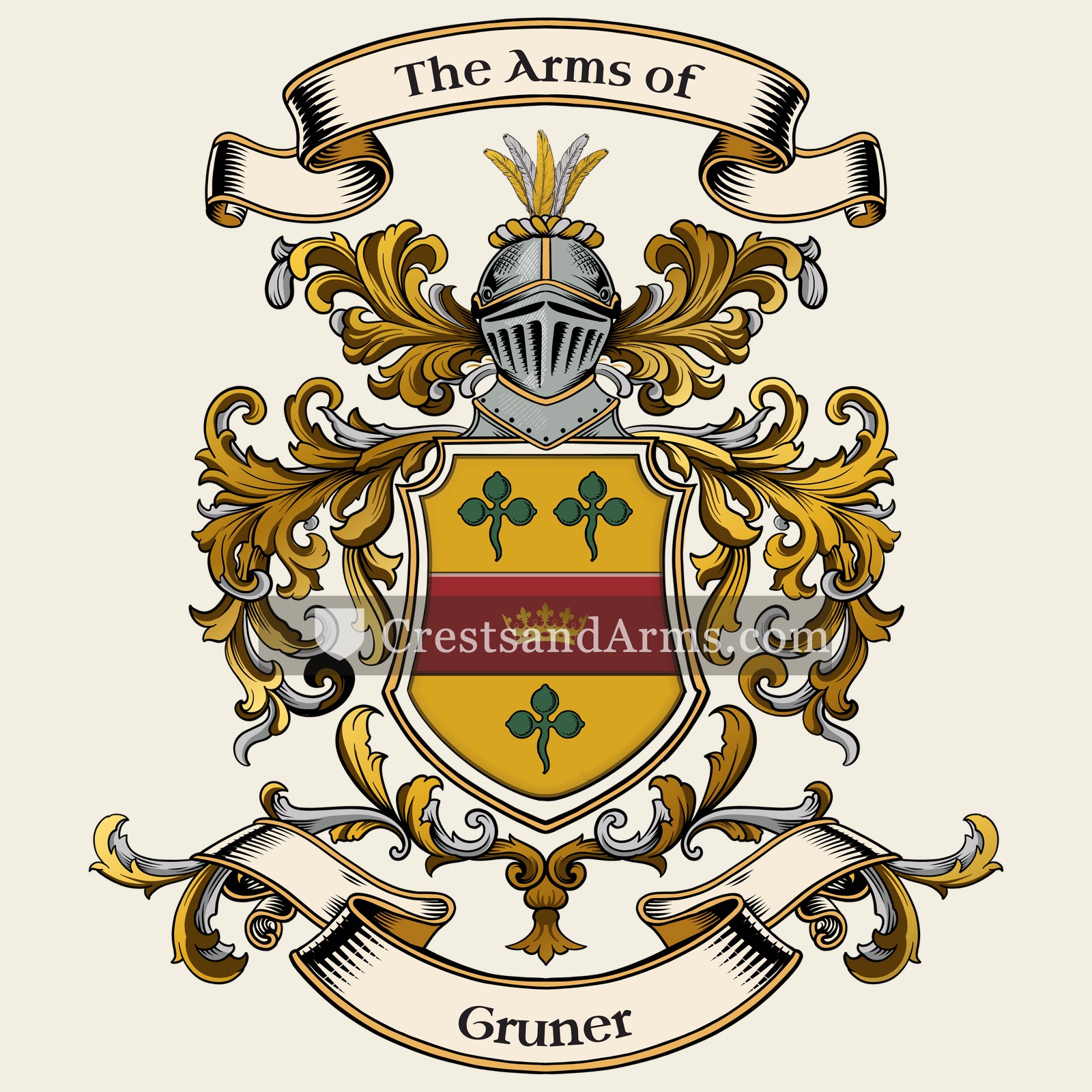
fessThe military belt, and readiness to serve
crownSovereignty, authority and just reward
trefoilPerpetuity, and the Trinity
Colours
Gold (Or)Means: Generosity
Red (Gules)Means: Military strength
Green (Vert)Means: Hope
Historical info
Source
J. B. Rietstap, Armorial Général, Gouda: G. B. van Goor Zonen, 1884–87
Blazon (the actual original written record)
“D'or à la fasce de gu., ch. d'une couronne du champ et acc. de trois trèfles de sin. C.: un lion iss. d'or.”
Denmarkc. 1693
Digital archive packCoat of arms PNG, gold border print PDF, vector SVG and the certificate of authenticity. Sent to your email in minutes.
Map of Denmark showing where the Gruner arms are recorded
The Gruner arms were recorded in Denmark, c. 1693.
Arms such as these were typically recorded in Sjaælland.
Zealand held the Danish court, the crown's offices and Copenhagen itself. Families who served the king kept estates within reach of it, and royal service was the ordinary route to a coat of arms.
This is where the arms were entered in the register. Families often moved to other parts of the country, so the same name can turn up in more than one region.
The body that granted and recorded arms in Denmark in this period.
Christian V of Denmark
Sovereign of the period
Christian V of Denmark
1670–1699
Reigning in Germany when the Gruner arms are first recorded.
How Arms Worked in Denmark
Danish heraldry during this period was closely tied to noble status and royal favor rather than being open to all citizens. Arms were typically granted by the monarch to individuals, and these symbols were then shared by all members of the noble house. If a family line died out, the right to use those specific arms ended with them.
Granting authority
The Danish royal chancery held the power to issue and regulate official coats of arms for the kingdom.
How they got arms
Families usually received their arms through a formal royal grant that confirmed their noble status and rights.
Where arms were recorded
These grants were officially recorded in the Danish Royal Chancery records starting in the sixteenth century.
The family's standing
Recorded among the armigerous families of Denmark.
Origin & History of the Gruner Family in Denmark
The name Gruner has deep roots in the history of Denmark, with documented evidence placing family members on the island of Sjælland as early as 1693. The name itself is derived from the German word for green, which often served as a descriptive nickname for a person who lived near a lush meadow or a dense forest. During the late 17th century, the family became part of the social and professional fabric of the region, often serving in administrative or military roles that were common for families of their standing at the time. As they settled into the Danish landscape, they adapted to the local culture while maintaining the distinct identity associated with their name. Their presence in Sjælland suggests they were part of the steady movement of families across Northern Europe during a period of significant social change. By integrating into local parishes and government records, the early Gruner family helped establish a lasting legacy that persisted through the generations in Denmark.
Gruner Meaning & Related Branches
Root word
grun
Old High German word meaning green or verdant.
This name
GrunerA descriptive surname for someone who lived near a green area or had a fresh complexion.
also spelled
Greener
Documented Sources
J. B. Rietstap, Armorial Général, Gouda: G. B. van Goor Zonen, 1884–87
Bahlow, Hans, Deutsches Namenlexikon: Familien- und Vornamen nach Ursprung und Sinn erklärt, 1967
Heintze, Albert, Die deutschen Familiennamen: geschichtlich, geographisch, sprachlich, 1903
Stadtarchiv Nürnberg, Bürgerbücher der Stadt Nürnberg, 1765
Digital archive packCoat of arms PNG, gold border print PDF, vector SVG and the certificate of authenticity. Sent to your email in minutes.


 crescentHonour by the sovereign, and the second son
 crescentHonour by the sovereign, and the second son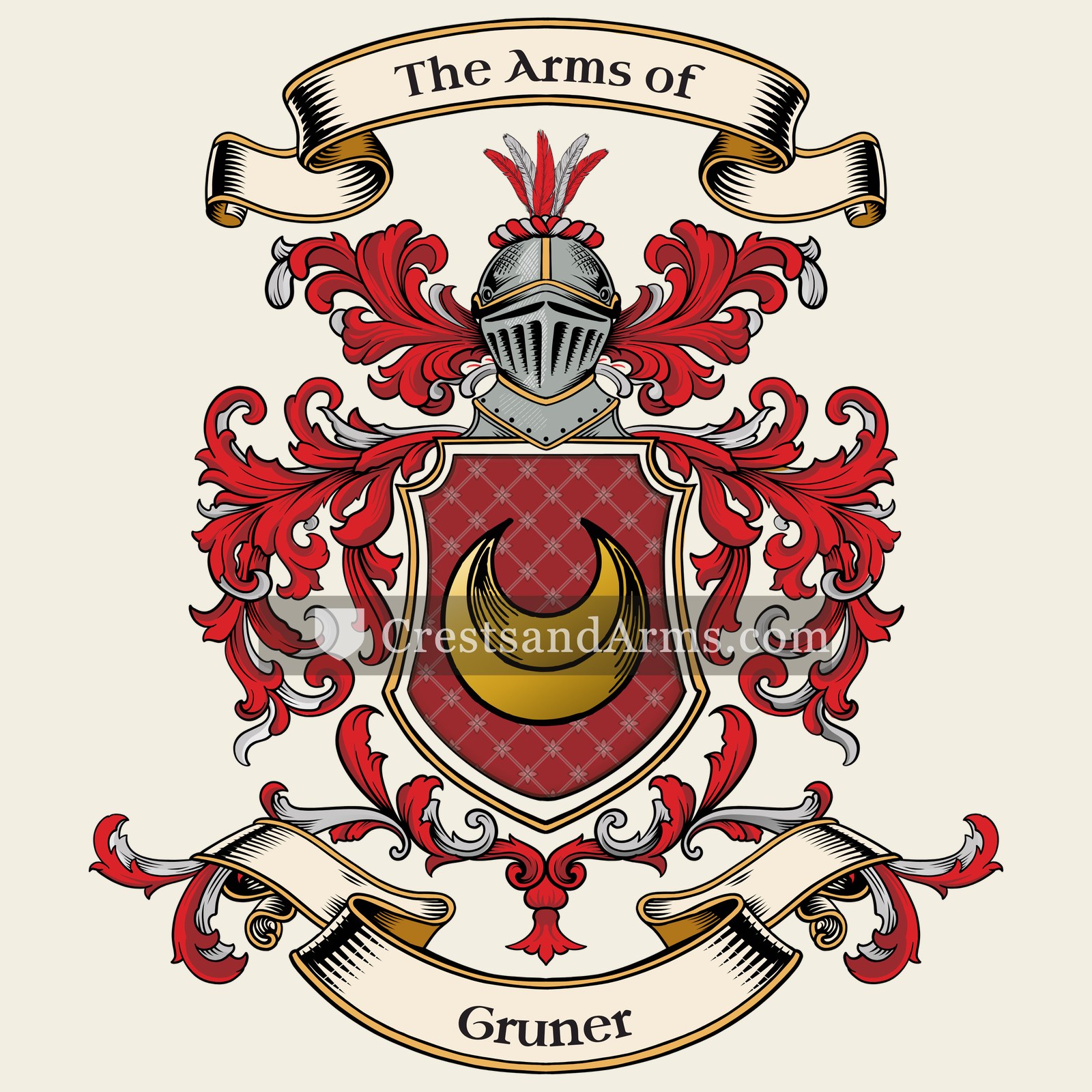


 mountThe ground held, and steadfastness upon it
 roseThe seventh son, and beauty with grace
 mulletThe third son, and a divine quality from above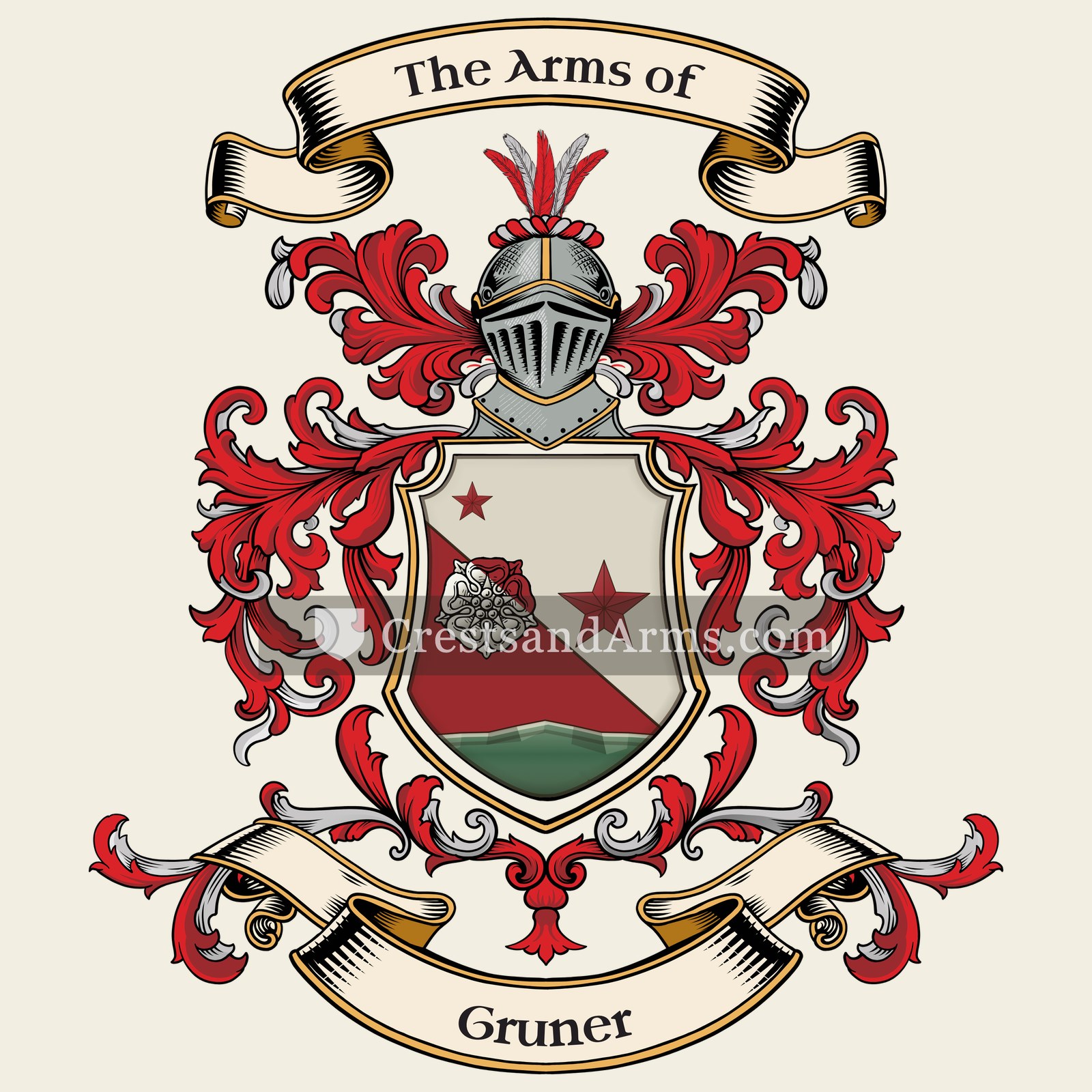

 fessThe military belt, and readiness to serve
 crownSovereignty, authority and just reward
 trefoilPerpetuity, and the Trinity