Map of Germany showing where the Guarneros arms are recorded
The Guarneros arms were recorded in Westphalia, c. 1765.
Westphalia was a land of small estates and fortified farmhouses in western Germany. Its families were numerous and not especially rich, but each held its own ground, and holding ground was what brought arms.
This is where the arms were entered in the register. Families often moved to other parts of the country, so the same name can turn up in more than one region.
The body that granted and recorded arms in Germany in this period.
Francis I, Holy Roman Emperor
Sovereign of the period
Francis I, Holy Roman Emperor
1745–1765
Reigning in Germany when the Guarneros arms are first recorded.
How Arms Worked in Germany
In the Holy Roman Empire, coats of arms were often granted to individuals by the Emperor or his representatives. These arms were then passed down through the generations to all legitimate descendants of the original holder. Younger branches of a family usually kept the same shield design without needing to change it, as the arms belonged to the entire lineage.
Granting authority
The Holy Roman Emperor held the sole power to grant new coats of arms throughout his vast imperial territories.
How they got arms
Families typically obtained their coats of arms through a formal imperial grant or by proving their noble status to the authorities.
Where arms were recorded
These grants were officially recorded in the Imperial Chancery registers, which began keeping formal records of such honors during the Middle Ages.
The family's standing
Recorded among the armigerous families of Westphalia.
Origin & History of the Guarneros Family in Germany
The family name Guarneros carries a distinct history that traces back to the region of Westphalia by the year 1765. During this period, Westphalia was a central part of the Holy Roman Empire, characterized by a landscape of small principalities and rural farming communities. Families with this surname were likely part of the local agrarian society, living in a time when the region was recovering from the long-term effects of the Seven Years' War. Because surnames were often tied to specific geographic locations or local occupations, the presence of the name in Westphalia suggests that the family was deeply rooted in the social and economic structure of the German countryside. Over the following generations, the name persisted as families moved through the changing political borders of Europe, eventually spreading to other parts of the continent and beyond.
Guarneros Meaning & Related Branches
Root word
Warin
Derived from the Germanic element meaning guard or protection.
This name
GuarnerosA locative or patronymic surname indicating a descendant of one who serves as a protector.
also spelled
Garnier
Garnere
Garnar
Documented Sources
J. B. Rietstap, Armorial Général, Gouda: G. B. van Goor Zonen, 1884–87
Klocke, Friedrich von, Das Patriziat in Westfalen, 1965
LWL-Archivamt für Westfalen, Kirchenbücher der westfälischen Gemeinden, 1765


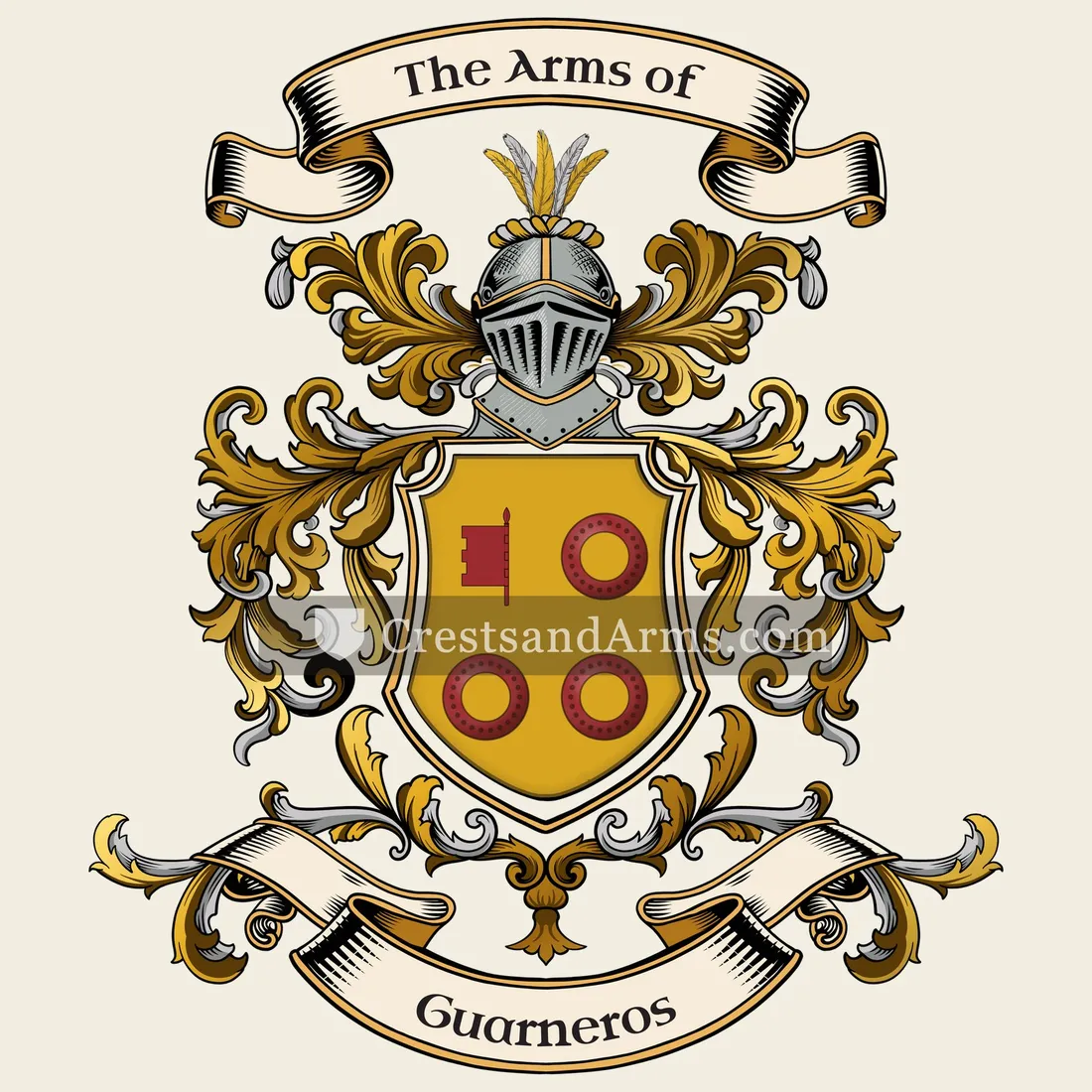
 flag / pennantA command held, and a following kept
 ringFidelity, and a promise kept
 flag / pennantA command held, and a following kept
 ringFidelity, and a promise kept