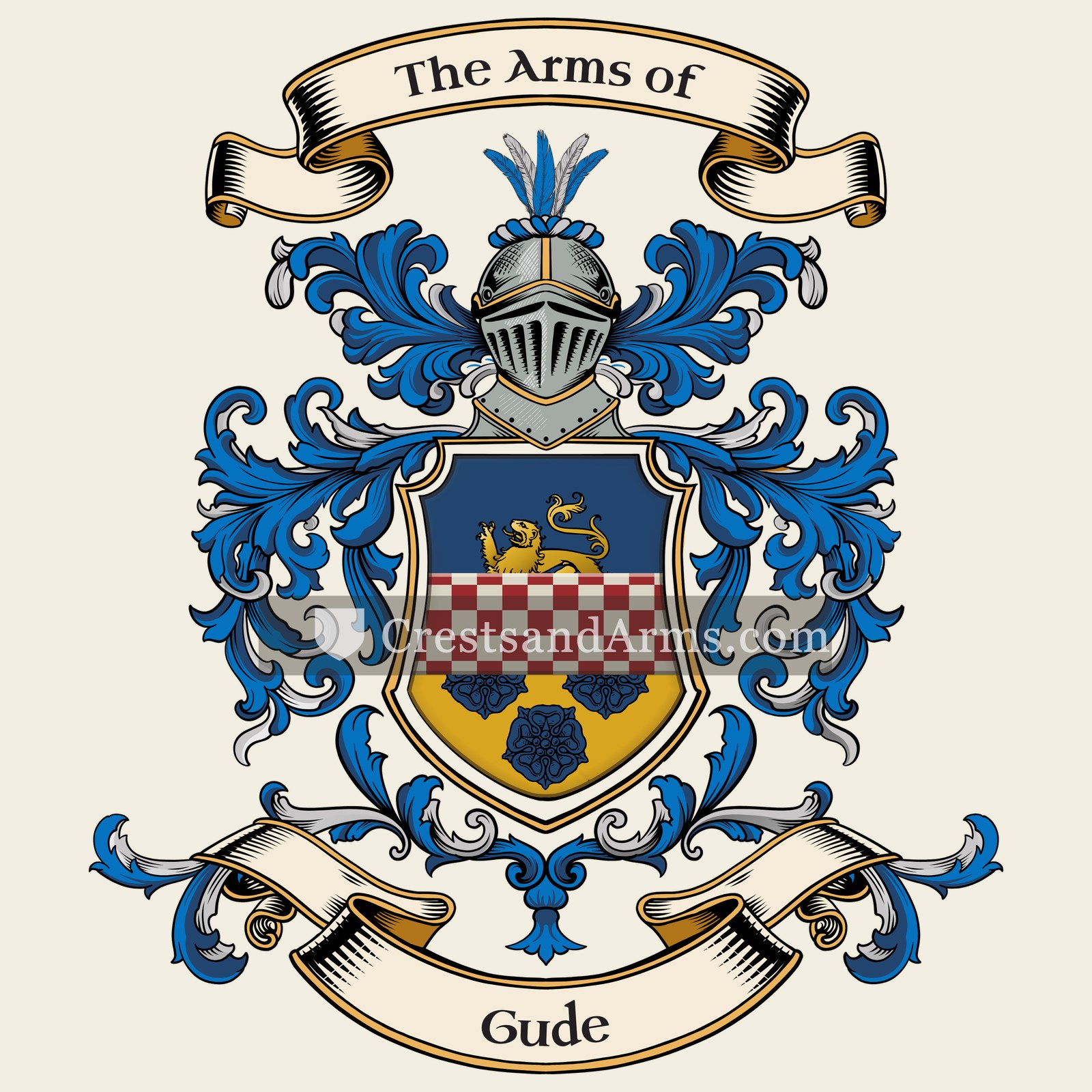
A record of documented arms, meaning and origin, researched for the Gude family of Denmark.
Reg. 9708 · Danish, G–I
Coat of Arms & Family Crest Details
Symbols on this shield
fessThe military belt, and readiness to serve
chequyConstancy, and the counting-board
lionCourage, strength and royalty
roseThe seventh son, and beauty with grace
Colours
Blue (Azure)Means: Loyalty and truth
Gold (Or)Means: Generosity
Silver (Argent)Means: Peace and sincerity
Historical info
Source
J. B. Rietstap, Armorial Général, Gouda: G. B. van Goor Zonen, 1884–87
Blazon (the actual original written record)
“Coupé, d'azur au lion naiss. d'or, mouv. du coupé, sur or à trois roses d'azur; à la fasce échiq. de gu. et d'arg. de trois tires, br. sur le coupé. Cq. cour. C.: le lion, iss., entre un vol d'or, chaque aile ch. de la fasce de l'écu.”
Denmarkc. 1581
Digital archive packCoat of arms PNG, gold border print PDF, vector SVG and the certificate of authenticity. Sent to your email in minutes.
Map of Denmark showing where the Gude arms are recorded
The Gude arms were recorded in Denmark, c. 1581.
Arms such as these were typically recorded in Sjaælland.
Zealand held the Danish court, the crown's offices and Copenhagen itself. Families who served the king kept estates within reach of it, and royal service was the ordinary route to a coat of arms.
This is where the arms were entered in the register. Families often moved to other parts of the country, so the same name can turn up in more than one region.
The body that granted and recorded arms in Denmark in this period.
Frederick II of Denmark
Sovereign of the period
Frederick II of Denmark
1559–1588
Reigning in Denmark when the Gude arms are first recorded.
How Arms Worked in Denmark
Danish heraldry during this period was closely tied to noble status and royal favor rather than being open to all citizens. Arms were typically granted by the monarch to individuals, and these symbols were then shared by all members of the noble house. If a family line died out, the right to use those specific arms ended with them.
Granting authority
The Danish royal chancery held the power to issue and regulate official coats of arms for the kingdom.
How they got arms
Families usually received their arms through a formal royal grant that confirmed their noble status and rights.
Where arms were recorded
These grants were officially recorded in the Danish Royal Chancery records starting in the sixteenth century.
The family's standing
Recorded among the armigerous families of Denmark.
Origin & History of the Gude Family in Denmark
The Gude family name has deep roots in the Danish island of Sjælland, where records confirm members of the family were established by 1581. During this period, the name was often associated with individuals who held roles of local importance, such as farmers, church officials, or minor administrators. In the sixteenth century, surnames in Denmark were still evolving and often functioned as patronymics, meaning they were based on a father’s first name. The name Gude likely stems from the Old Norse name Gudi, which originally referred to a priest or a person who held a position of religious authority. As the family grew, they became part of the social fabric of rural Sjælland, contributing to the agricultural and local governance systems that defined life in the region during the late Renaissance.
Gude Meaning & Related Branches
Root word
Gud
Old Norse term referring to a deity or divine being.
This name
GudeDerived from a nickname for a pious person or one associated with gods.
also spelled
Gudes
Gud
Related arms
Henflersimilar arms
Documented Sources
J. B. Rietstap, Armorial Général, Gouda: G. B. van Goor Zonen, 1884–87
Nielsen, O., Kjøbenhavns Diplomatarium, 1872
Steenstrup, Johannes, Danmarks Riges Historie, 1896
Rigsarkivet (Danish National Archives), Danske Kancelli, Sjællandske Tegnelser
Rigsarkivet (Danish National Archives), Lensregnskaber for Sjælland
Digital archive packCoat of arms PNG, gold border print PDF, vector SVG and the certificate of authenticity. Sent to your email in minutes.


 fessThe military belt, and readiness to serve
 chequyConstancy, and the counting-board
 lionCourage, strength and royalty
 roseThe seventh son, and beauty with grace
 fessThe military belt, and readiness to serve
 chequyConstancy, and the counting-board
 lionCourage, strength and royalty
 roseThe seventh son, and beauty with grace