Map of Wales showing where the Guest arms are recorded
The Guest arms were recorded in Glamorgan, c. 1647.
Glamorgan was the richest part of Wales, with good coastal farmland and Norman castles along it. The families who held those castles kept their land for centuries, and long holding brought recorded arms.
This is where the arms were entered in the register. Families often moved to other parts of the country, so the same name can turn up in more than one region.
The body that granted and recorded arms in Wales in this period.
Charles I of England
Sovereign of the period
Charles I of England
1625–1649
Reigning in Wales when the Guest arms are first recorded.
How Arms Worked in Wales
English heraldry allowed arms to be shared by all legitimate descendants of the original owner. These symbols were treated as personal property that moved through the generations to all children. While the eldest son kept the original design, other family members could use the same shield without needing to change it or register their own unique versions.
Granting authority
The College of Arms in London has regulated the use of coats of arms throughout England and Wales since 1484.
How they got arms
Families typically obtained their coats of arms through a formal grant from the Crown or by proving their ancient right to them.
Where arms were recorded
All official coats of arms are recorded in the registers kept at the College of Arms, which date back to the fifteenth century.
The family's standing
Recorded among the armigerous families of Glamorgan.
Origin & History of the Guest Family in Wales
The history of the Guest family in Wales is deeply rooted in the industrial and social landscape of Glamorgan. While the name itself is of English origin, meaning a stranger or a visitor, the family established a firm presence in South Wales by the mid-seventeenth century. Records confirm that members of the family were living in the region as early as 1647, likely settling in areas that would later become central to the iron industry. Over the following generations, the family transitioned from local inhabitants to influential figures who helped shape the economy of the Welsh valleys. Their story is closely tied to the growth of towns like Merthyr Tydfil, where they played a significant role in the development of ironworks. By integrating into the Welsh community, the family moved beyond their status as newcomers to become a permanent part of the regional history.
Coat of Arms & Family Crest Details
Symbols on this shield
fessThe military belt, and readiness to serve
cross symbolChristian faith and service
Colours
Silver (Argent)Means: Peace and sincerity
Black (Sable)Means: Constancy
Historical info
Source
Sir Bernard Burke, The General Armory of England, Scotland, Ireland and Wales, London: Harrison & Sons, 1884
Blazon (the actual original written record)
“Ar. on a fess sa. three cross crosslets of the field”
DublinDublin, c. 1604
Digital archive packCoat of arms PNG, gold border print PDF, vector SVG and the certificate of authenticity. Sent to your email in minutes.
Map of Ireland showing where the Guest arms are recorded
The Guest arms were recorded in Dublin, c. 1604.
Dublin was the seat of government in Ireland and the place where grants were sought and recorded. Families with business at the castle or the courts settled nearby, and settling there put their arms on record.
This is where the arms were entered in the register. Families often moved to other parts of the country, so the same name can turn up in more than one region.
The body that granted and recorded arms in Ireland in this period.
James VI and I
Sovereign of the period
James VI and I
1603–1625
Reigning in Wales when the Guest arms are first recorded.
How Arms Worked in Ireland
The Ulster King of Arms granted coats of arms to individuals who proved their social standing and good character. These symbols were typically inherited by all legitimate descendants of the original holder. If a family branch wanted a unique look, they could apply for a specific change to their design through the office to ensure their identity remained distinct.
Granting authority
The Ulster King of Arms acted as the official body that regulated and issued all coats of arms throughout Ireland.
How they got arms
Families obtained their arms through formal grants issued by the office after proving their eligibility and paying the required fees.
Where arms were recorded
All official grants were recorded in the registers held by the Ulster King of Arms starting from the year 1552.
The family's standing
Recorded among the armigerous families of Dublin.
Origin & History of the Guest Family in Ireland
The history of the Guest family in Ireland is deeply connected to the shifting social landscape of the early seventeenth century. Records confirm that members of the family were established in Dublin by 1604, a time when the city was becoming a central hub for trade and administration under the English Crown. The name itself likely originated as a descriptive term for a stranger or a visitor, which suggests that the earliest ancestors may have arrived in Ireland as part of the waves of migration from Britain during the Tudor and Stuart periods. As these settlers integrated into the local economy, they often took on roles as merchants or craftsmen, helping to build the urban infrastructure of a rapidly growing Dublin. By settling in the capital, the family became part of a new class of residents who navigated the complex political and religious changes of the era. Their presence in the city archives during this time highlights how families often moved across the Irish Sea to seek new opportunities in a changing society.
Coat of Arms & Family Crest Details
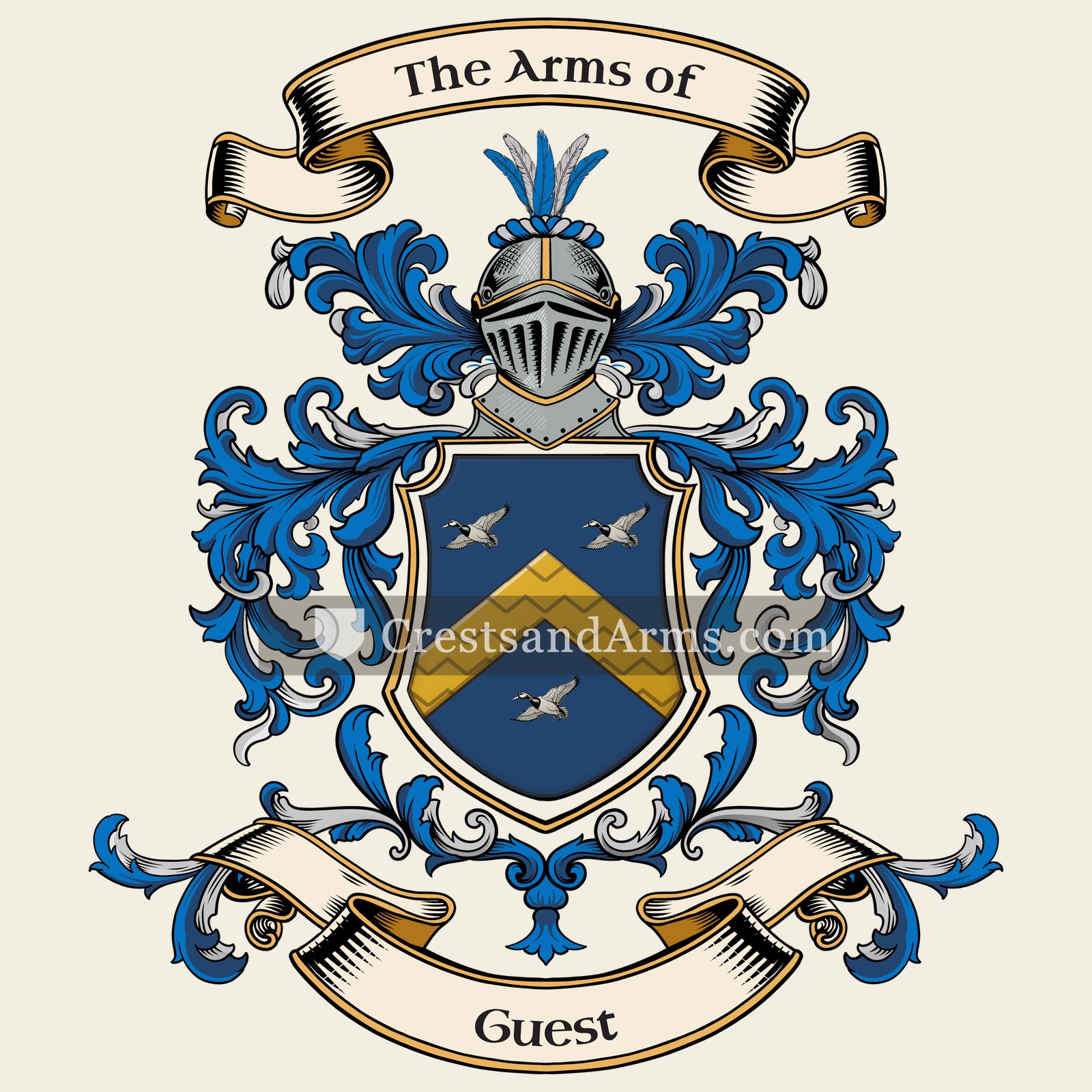
Symbols on this shield
chevronProtection, and faithful service completed
duckResourcefulness on land and water
Colours
Blue (Azure)Means: Loyalty and truth
Gold (Or)Means: Generosity
Historical info
Source
Sir Bernard Burke, The General Armory of England, Scotland, Ireland and Wales, London: Harrison & Sons, 1884
Blazon (the actual original written record)
“Az. a chev. or, betw. three shovellers' heads erased ppr”
Englandc. 1620
Digital archive packCoat of arms PNG, gold border print PDF, vector SVG and the certificate of authenticity. Sent to your email in minutes.
Map of England showing where the Guest arms are recorded
The Guest arms were recorded in England, c. 1620.
Arms such as these were typically recorded in York.
Yorkshire is the largest of the English counties, and it held more gentry families than any other. Land there was split among a great many households rather than a few, so a great many of them carried arms.
This is where the arms were entered in the register. Families often moved to other parts of the country, so the same name can turn up in more than one region.
The body that granted and recorded arms in England in this period.
James VI and I
Sovereign of the period
James VI and I
1603–1625
Reigning in Wales when the Guest arms are first recorded.
How Arms Worked in England
English heraldry allowed arms to be shared by all legitimate descendants of the original owner. These symbols were treated as personal property that moved through the generations to all children. While the eldest son kept the original design, other family members could use the same shield without needing to change it or register their own unique versions.
Granting authority
The College of Arms in London has regulated the use of coats of arms throughout England and Wales since 1484.
How they got arms
Families typically obtained their coats of arms through a formal grant from the Crown or by proving their ancient right to them.
Where arms were recorded
All official coats of arms are recorded in the registers kept at the College of Arms, which date back to the fifteenth century.
The family's standing
Recorded among the armigerous families of England.
Origin & History of the Guest Family in England
The surname Guest originated in England as a descriptive nickname for a stranger or a newcomer to a community. In the Middle Ages, people often received names based on their status or arrival, and those who traveled from distant regions were frequently labeled as guests by the local population. By the early 17th century, the family had established a notable presence in the city of York. Records from 1620 indicate that members of the Guest family were active participants in the social and economic life of this historic northern center. During this period, York served as a vital hub for trade and administration, providing a stable environment for families to grow and integrate into the local society. Over time, the name transitioned from a simple label for a visitor into a permanent family identifier that was passed down through generations of English residents.
Guest Meaning & Related Branches
Root word
gwest
A Welsh term referring to a visitor, lodger, or guest.
This name
GuestAn occupational or descriptive surname originally denoting a stranger, visitor, or someone providing hospitality.
also spelled
Gest
Geste
Geast
Gist
Related arms
Gistvariant spelling
Documented Sources
Sir Bernard Burke, The General Armory of England, Scotland, Ireland and Wales, London: Harrison & Sons, 1884
John, Arthur Henry, The Industrial Development of South Wales, 1750-1850, 1950
Lloyd, John, The Early History of the Old South Wales Iron Works (1760 to 1840), 1906
National Library of Wales, Glamorgan Quarter Sessions Records
Glamorgan Archives, Parish Registers of the Diocese of Llandaff
Digital archive packCoat of arms PNG, gold border print PDF, vector SVG and the certificate of authenticity. Sent to your email in minutes.


 chevronProtection, and faithful service completed
 cross symbolChristian faith and service
 swanGrace, light and the poet's art
 chevronProtection, and faithful service completed
 cross symbolChristian faith and service
 swanGrace, light and the poet's art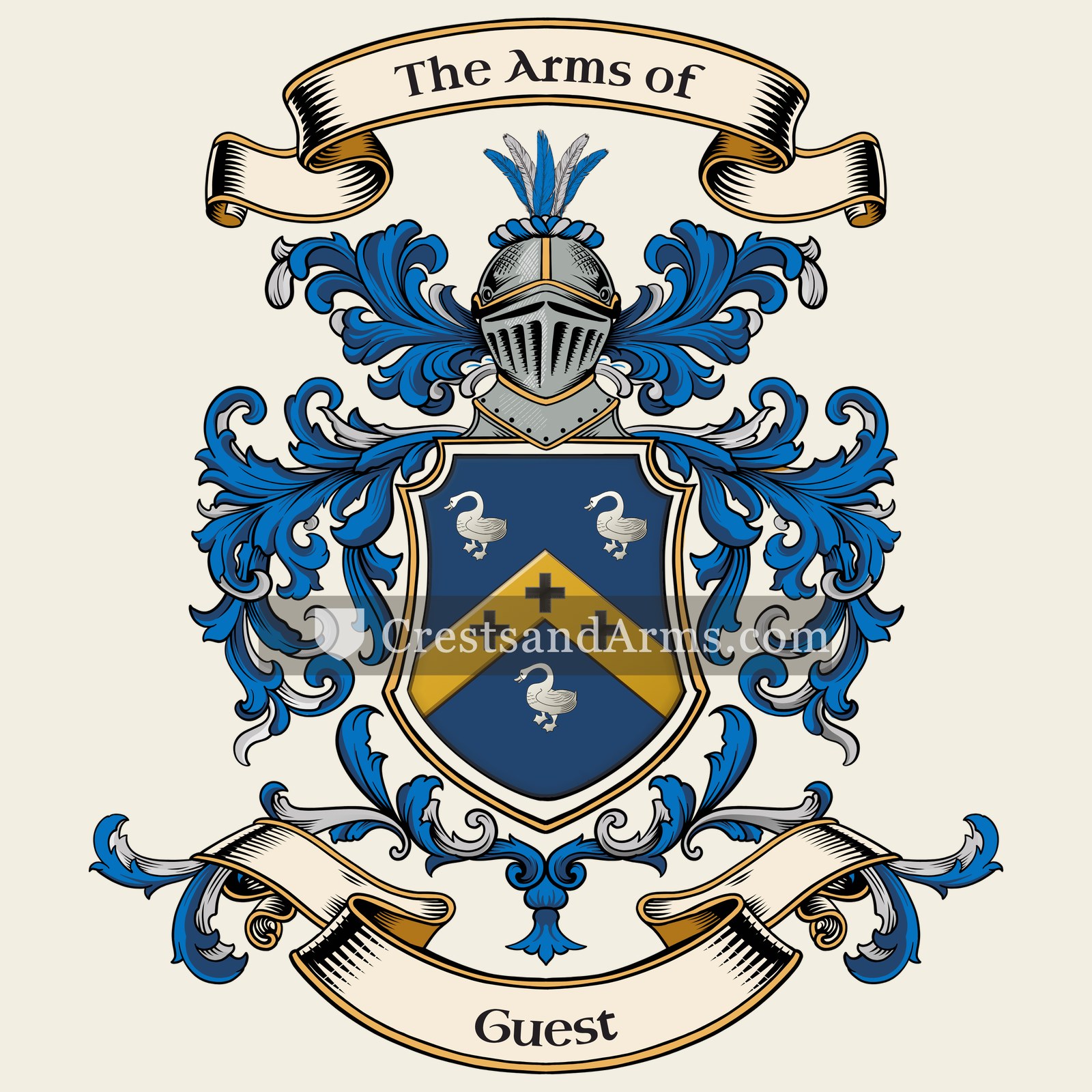


 fessThe military belt, and readiness to serve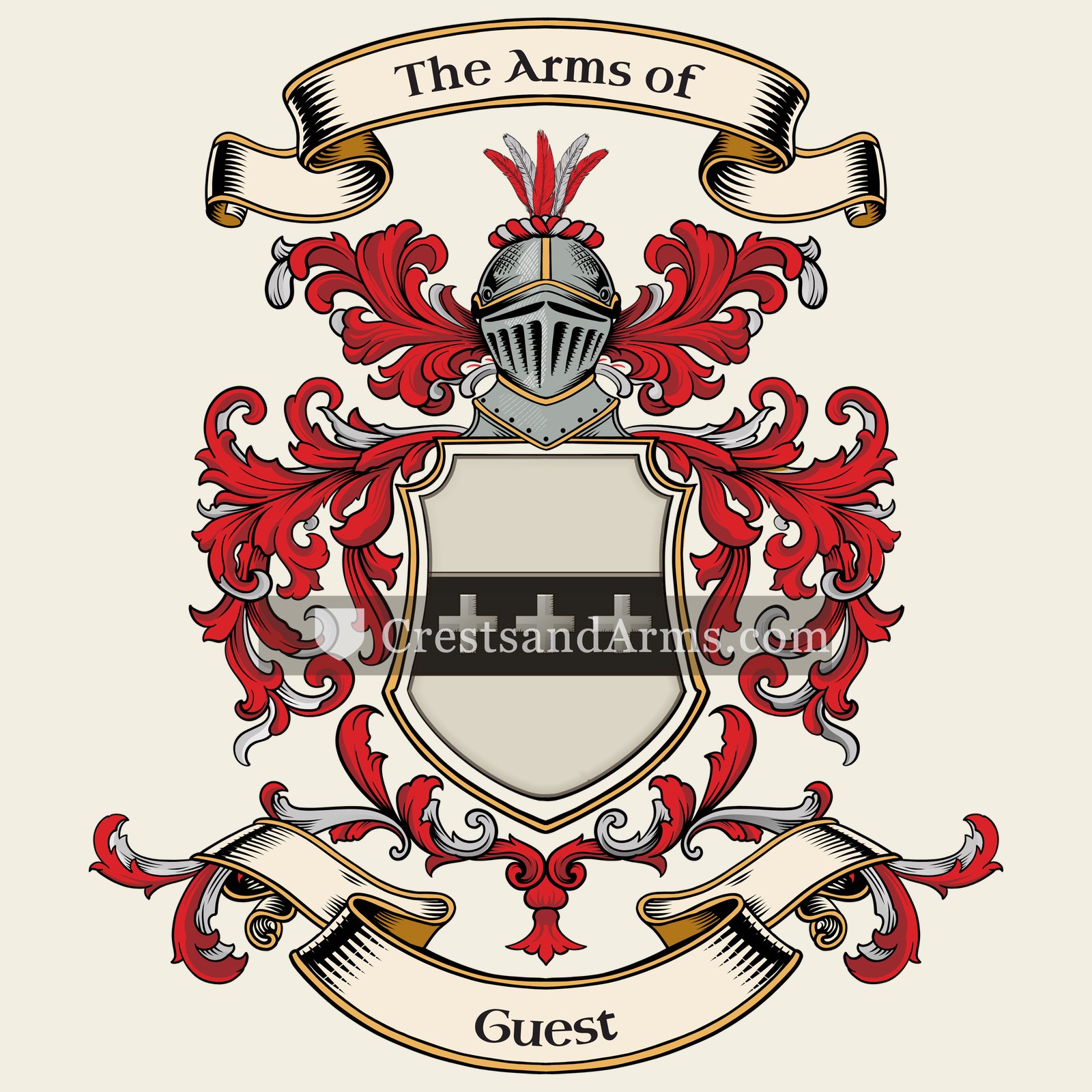


 duckResourcefulness on land and water