Map of France showing where the Gueye arms are recorded
The Gueye arms were recorded in France, c. 1663.
Arms such as these were typically recorded in Bretagne.
More families held coats of arms in Bretagne than anywhere else in France. The land was divided into many small estates rather than a few large ones, so far more households counted as gentry, and each needed a shield of its own to be told apart.
This is where the arms were entered in the register. Families often moved to other parts of the country, so the same name can turn up in more than one region.
The body that granted and recorded arms in France in this period.
Louis XIV of France
Sovereign of the period
Louis XIV of France
1643–1715
Reigning in France when the Gueye arms are first recorded.
How Arms Worked in France
In France, a coat of arms was a mark of honor that passed down through the male line to all legitimate descendants. Families often used the same shield without changes to show their shared heritage. If a branch wanted to stand out, they could add a small mark to their shield to show their specific place in the family tree.
Granting authority
The Juge d'armes de France acted as the official authority that regulated and verified coats of arms across the country.
How they got arms
Families typically inherited their arms from ancestors, though they could also receive them through royal grants or by proving their noble status.
Where arms were recorded
Coats of arms were officially recorded in the Armorial Général de France, which began its main collection in the year 1696.
The family's standing
Recorded among the armigerous families of France.
Origin & History of the Gueye Family in France
The family name Gueye holds a distinct place in the historical records of the Brittany region of France, where documented members were established as early as 1663. During this period, the name appeared in parish registers that tracked the lives of local residents through baptisms, marriages, and burials. Families living in Brittany at this time often worked in agriculture or maritime trades, as the coastal landscape shaped the daily routines and social structures of the local population. The presence of the Gueye name in these seventeenth-century records suggests that the family was well-integrated into the social fabric of their community. By maintaining these records, local officials and clergy helped preserve the lineage of families who lived through the transition from the feudal era to the centralized administration of the French monarchy. This early history reflects the broader patterns of life in northwestern France, where families remained rooted in specific parishes for generations.
Coat of Arms & Family Crest Details
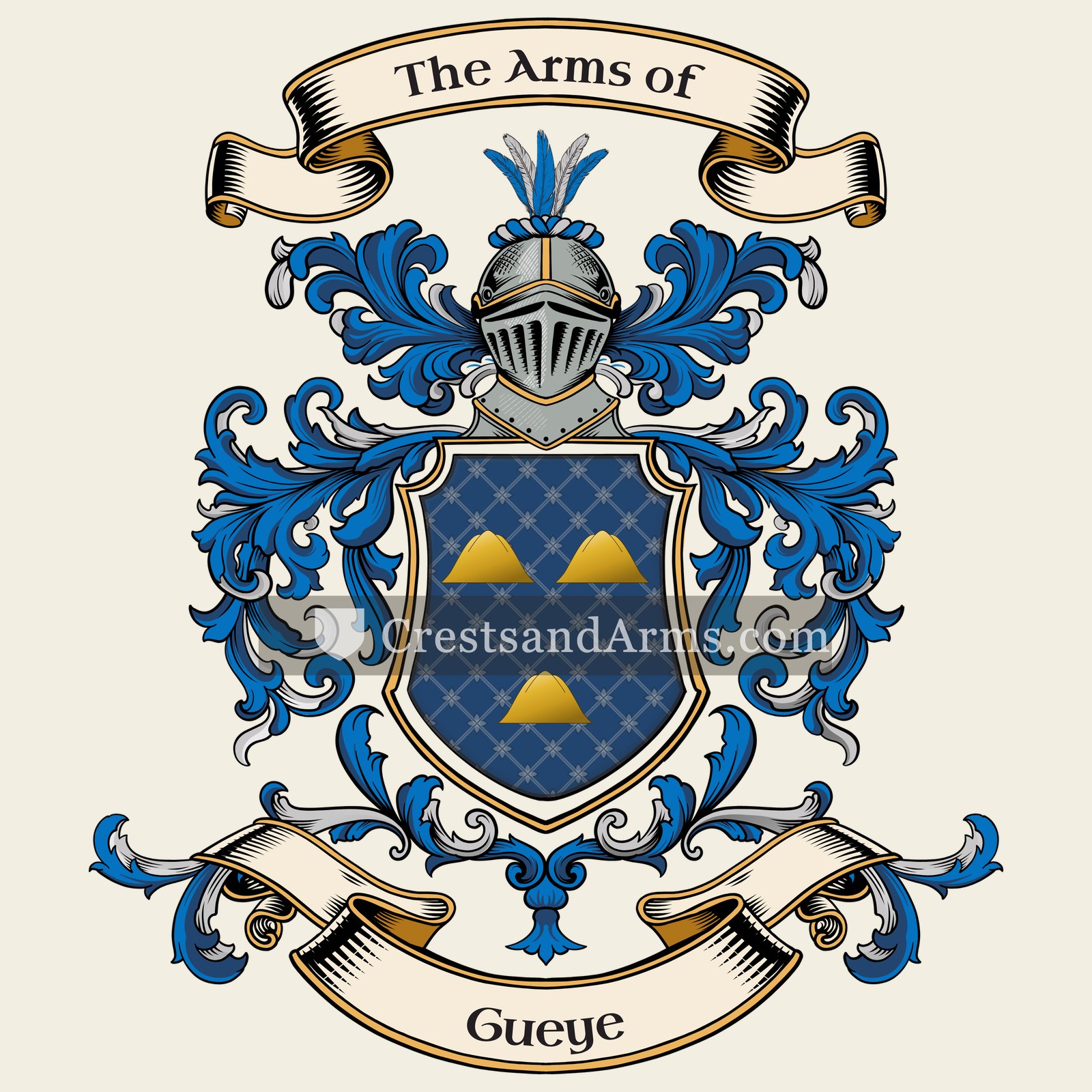
Symbols on this shield
mountThe ground held, and steadfastness upon it
Colours
Blue (Azure)Means: Loyalty and truth
Gold (Or)Means: Generosity
Historical info
Source
J. B. Rietstap, Armorial Général, Gouda: G. B. van Goor Zonen, 1884–87
Blazon (the actual original written record)
“D'azur à trois pics de rocher abaissés d'or, mouv. de la p., sommés chacun d'une petite bannière d'arg., flottante à sen., les trabes avec leurs fers aussi d'arg.”
SwitzerlandNeufchâtel, c. 1745
Digital archive packCoat of arms PNG, gold border print PDF, vector SVG and the certificate of authenticity. Sent to your email in minutes.
Map of Switzerland showing where the Gueye arms are recorded
The Gueye arms were recorded in Neufchâtel, c. 1745.
This is where the arms were entered in the register. Families often moved to other parts of the country, so the same name can turn up in more than one region.
The body that granted and recorded arms in Switzerland in this period.
How Arms Worked in Switzerland
In Switzerland, coats of arms were not restricted to the nobility and were often adopted by common citizens and families. These symbols were passed down through generations to show family identity. When branches of a family grew, they often changed small details of the design to distinguish their own line from the original group.
Granting authority
Cantonal and civic authorities managed the use of coats of arms within their specific regions and local jurisdictions.
How they got arms
Families typically assumed their own coats of arms based on local custom rather than receiving them from a central monarch.
Where arms were recorded
Arms were recorded in various cantonal and civic registers starting from the fourteenth century throughout the Swiss region.
The family's standing
Recorded among the armigerous families of Switzerland.
Origin & History of the Gueye Family in Switzerland
The history of the Gueye family in Switzerland is rooted in the picturesque region of Neuchâtel, where records confirm their presence as early as 1745. During the eighteenth century, Neuchâtel was a unique principality that maintained strong ties to the Prussian monarchy while operating as a distinct Swiss territory. Families like the Gueyes often integrated into the local social fabric by participating in the region’s thriving watchmaking industry and agricultural trade. Because the area served as a crossroads for travelers and merchants moving between France and the Swiss cantons, the family likely benefited from the cultural exchange that defined life in the Jura Mountains. By establishing themselves in this specific landscape, early members of the family helped shape the local community and contributed to the long-standing traditions of the Neuchâtel region.
Related Branches & Arms
Root word
Gueye
Derived from the Wolof word for a noble or respected person.
This name
GueyeA prominent surname of Senegalese origin signifying high social status and ancestral nobility.
also spelled
Guyee
Guy
Gee
Documented Sources
J. B. Rietstap, Armorial Général, Gouda: G. B. van Goor Zonen, 1884–87
Archives départementales du Finistère, Registres paroissiaux et d'état civil, 1663
Gautier, Hervé, Histoire de la Bretagne, 1993
Le Goff, Jacques, La Bretagne au XVIIe siècle, 1985
Digital archive packCoat of arms PNG, gold border print PDF, vector SVG and the certificate of authenticity. Sent to your email in minutes.


 fessThe military belt, and readiness to serve
 roseThe seventh son, and beauty with grace
 fessThe military belt, and readiness to serve
 roseThe seventh son, and beauty with grace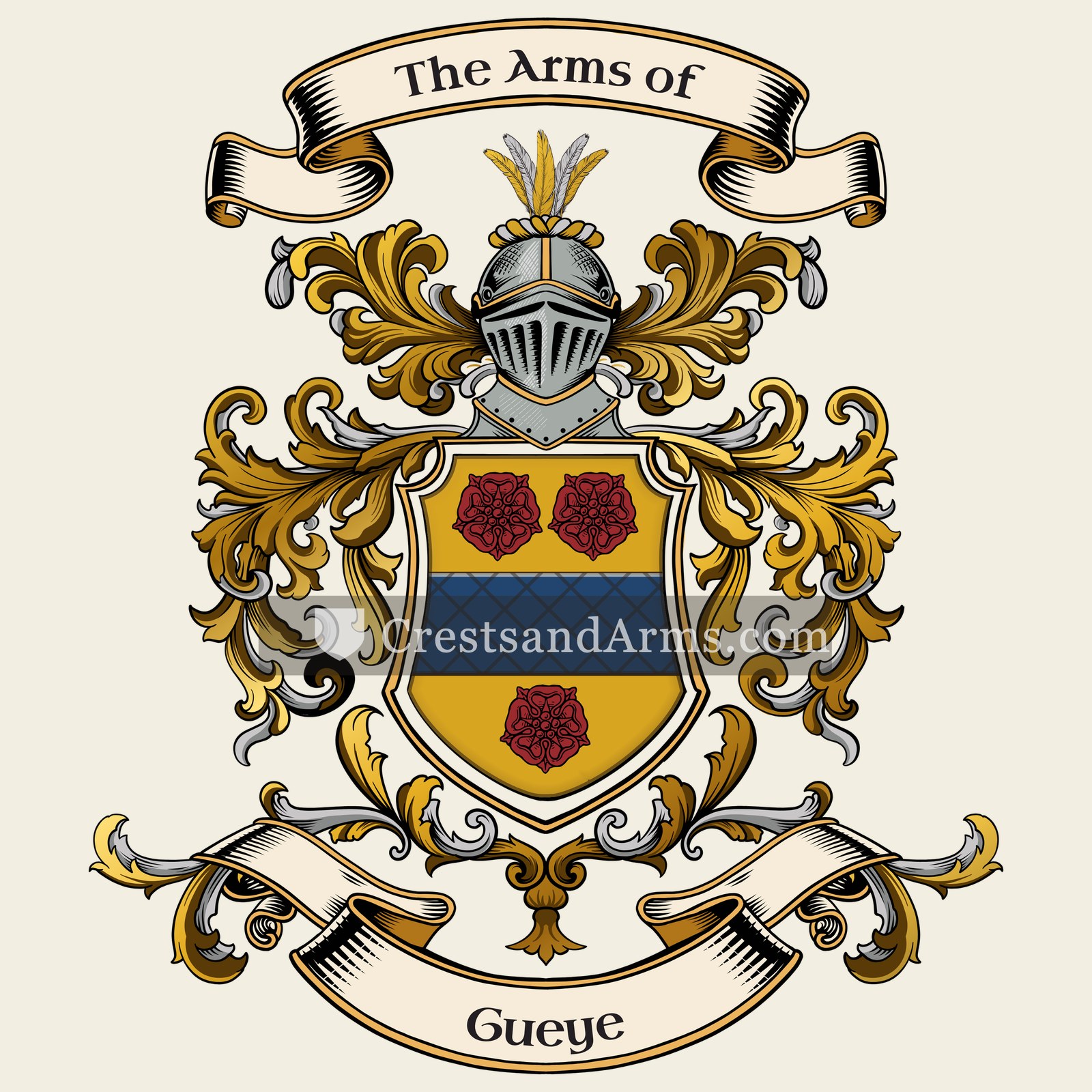


 mountThe ground held, and steadfastness upon it