Map of France showing where the Guilhem arms are recorded
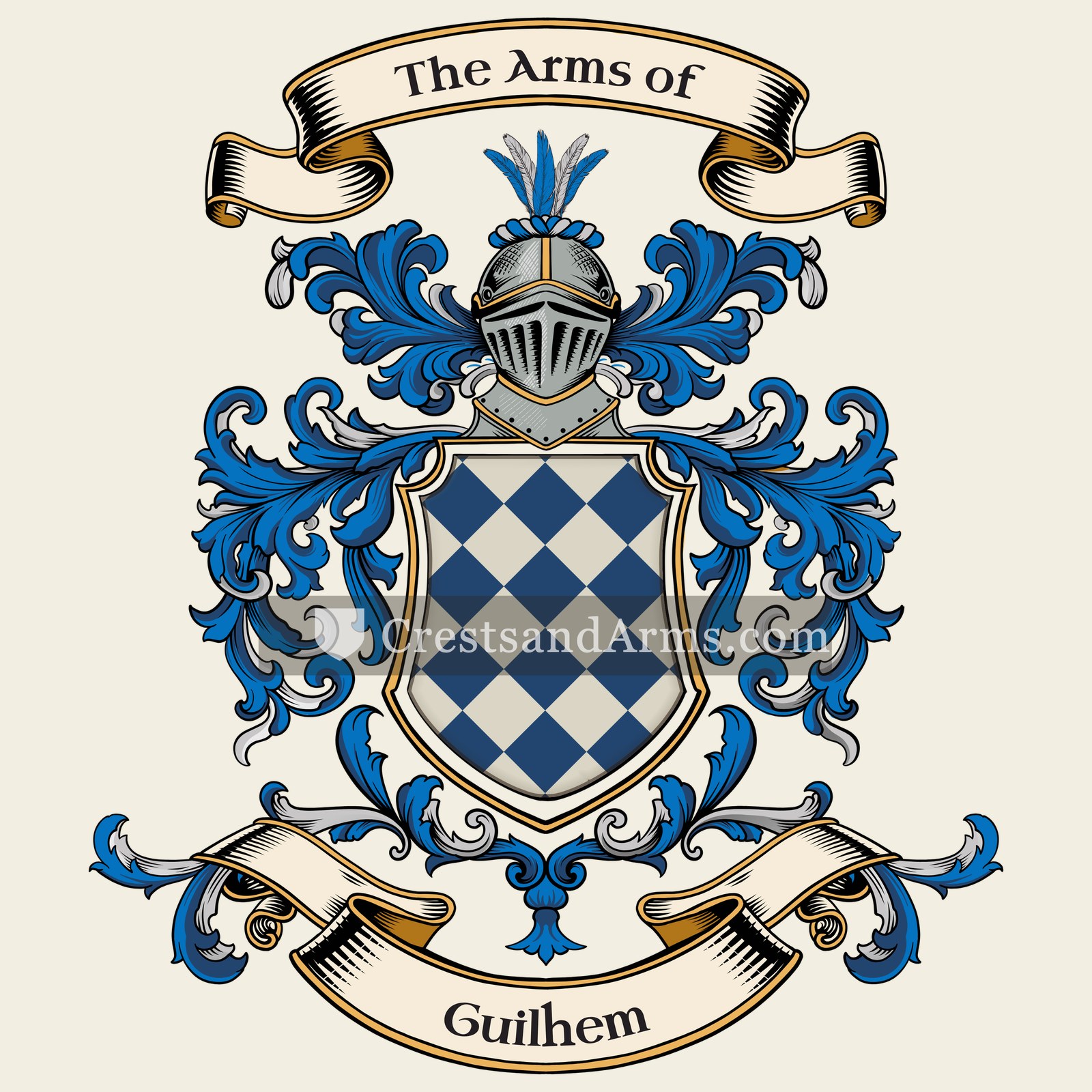
The Guilhem arms were recorded in Quercy, c. 1663.
Quercy was limestone country in southern France, dry and thinly farmed. Its gentry held small estates for centuries, and long unbroken holding is what fills a register of arms.
This is where the arms were entered in the register. Families often moved to other parts of the country, so the same name can turn up in more than one region.
The body that granted and recorded arms in France in this period.
Louis XIV of France
Sovereign of the period
Louis XIV of France
1643–1715
Reigning in France when the Guilhem arms are first recorded.
How Arms Worked in France
In France, a coat of arms was a mark of honor that passed down through the male line to all legitimate descendants. Families often used the same shield without changes to show their shared heritage. If a branch wanted to stand out, they could add a small mark to their shield to show their specific place in the family tree.
Granting authority
The Juge d'armes de France acted as the official authority that regulated and verified coats of arms across the country.
How they got arms
Families typically inherited their arms from ancestors, though they could also receive them through royal grants or by proving their noble status.
Where arms were recorded
Coats of arms were officially recorded in the Armorial Général de France, which began its main collection in the year 1696.
The family's standing
Recorded among the armigerous families of Quercy.
Origin & History of the Guilhem Family in France
The name Guilhem is a classic Occitan form of the Germanic name William, which became deeply rooted in the culture of southern France during the Middle Ages. The name gained significant prestige due to Saint Guilhem of Gellone, a legendary eighth-century figure who founded a famous abbey in the Languedoc region. By the time your ancestors were documented in the Quercy province in 1663, the name had transitioned from a noble given name into a stable hereditary surname. Families living in Quercy during the seventeenth century were often tied to the land as farmers or local tradespeople, navigating a period defined by the agricultural cycles and the social structures of the French countryside. Because the region was a crossroads for trade and migration, the Guilhem family likely benefited from the stability of the local parish records, which were the primary way families tracked their lineage and identity during that era.
Guilhem Meaning & Related Branches
Root word
Willahelm
A Germanic compound meaning will or desire and helmet or protection.
This name
GuilhemA French variant of William, signifying a resolute protector or determined guardian.
also spelled
Guilhem Lansac
Guilhee Lansac
Guilher Lansac
Geelhem de Lansak
Guilhem
Documented Sources
J. B. Rietstap, Armorial Général, Gouda: G. B. van Goor Zonen, 1884–87
Dauzat, Albert, Dictionnaire étymologique des noms et prénoms de France, 1951
Morlet, Marie-Thérèse, Dictionnaire étymologique des noms de famille, 1991
Archives Départementales du Lot, Registres paroissiaux et d'état civil, 1663
Digital archive packCoat of arms PNG, gold border print PDF, vector SVG and the certificate of authenticity. Sent to your email in minutes.