A record of documented arms, meaning and origin, researched for the Gull family lines. Documented in 2 countries.
Reg. 3758 · Britain, G–I
Coat of Arms & Family Crest Details
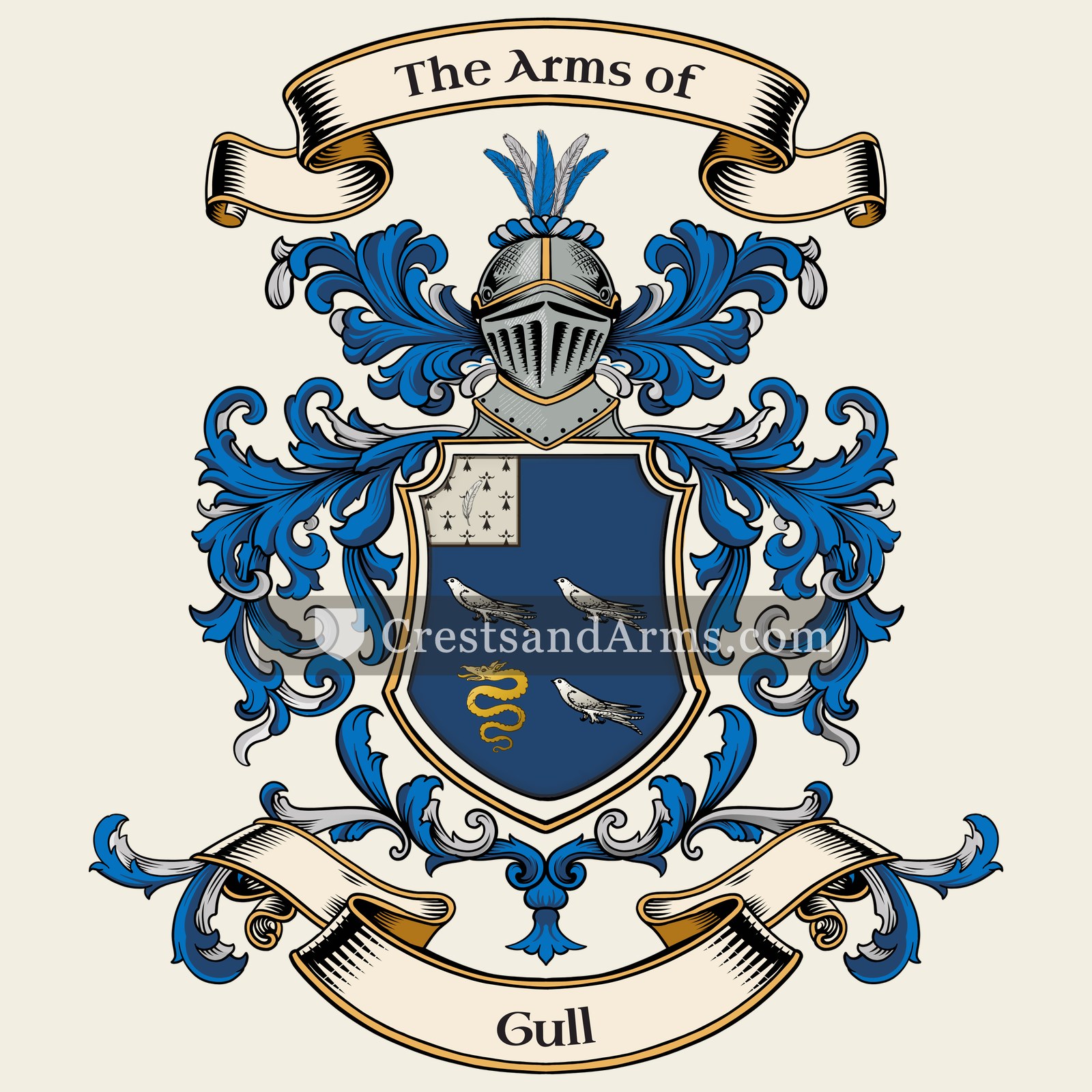
Symbols on this shield
saltireResolution, and St Andrew's cross
serpentWisdom, healing and prudence
martletA younger son, who must win his own land
feathersWilling obedience and serenity
Colours
Blue (Azure)Means: Loyalty and truth
ErmineMeans: Dignity
Gold (Or)Means: Generosity
Silver (Argent)Means: Peace and sincerity
Historical info
Source
J. B. Rietstap, Armorial Général, Gouda: G. B. van Goor Zonen, 1884–87
Blazon (the actual original written record)
“D'azur à un serpent noué en double saut, d'or, acc. de trois mouettes au nat.; au fr.-q. d'herm., ch. d'une plume d'autruche d'arg., le tuyau d'or passé dans une couronne du même, ch. sur le cercle des mots ICH DIEN. C.: 1° un léopard d'or, appuyant la patte dextre sur un écusson triangulaire d'azur ch. des meubles du fr.-q.; 2° deux bras, parés d'azur, rebr. d'arg., les mains de carn. tenant ensemble un flambeau d'or, allumé au nat. D.: SINE DEO FRUSTRA.”
BritainLondres, c. 1872
Where the Gull Arms Were Recorded
Kent
Map of Britain showing where the Gull arms are recorded
The Gull arms were recorded in Londres, c. 1872.
Arms such as these were typically recorded in Kent.
Kent sits between London and the short crossing to Europe, and the trade passing through made it wealthy. Merchant families bought land with that money, and it was landowners who took coats of arms.
This is where the arms were entered in the register. Families often moved to other parts of the country, so the same name can turn up in more than one region.
The body that granted and recorded arms in Britain in this period.
Victoria
Sovereign of the period
Victoria
1837–1901
Reigning in Britain when the Gull arms are first recorded.
How Arms Worked in Britain
English heraldry allowed arms to be shared by all legitimate descendants of the original owner. These symbols were treated as personal property that moved through the generations to all children. While the eldest son kept the original design, other family members could use the same shield without needing to change it or register their own unique versions.
Granting authority
The College of Arms in London has regulated the use of coats of arms throughout England and Wales since 1484.
How they got arms
Families typically obtained their coats of arms through a formal grant from the Crown or by proving their ancient right to them.
Where arms were recorded
All official coats of arms are recorded in the registers kept at the College of Arms, which date back to the fifteenth century.
The family's standing
Recorded among the armigerous families of Britain.
Origin & History of the Gull Family in Britain
The surname Gull is rooted in the linguistic traditions of medieval England, where it likely emerged as a descriptive nickname. In Old English and Middle English, the word referred to the common seabird, and it was often used to label someone who possessed the perceived traits of that bird, such as a loud voice or a migratory nature. By the time the name became established in the southeastern regions of Britain, it was firmly tied to the coastal landscape of Kent. While records confirm a strong presence of the Gull family in Kent by 1872, the name had been circulating in local parish registers and tax rolls for centuries prior. These early ancestors were typically rural laborers or tradespeople who lived close to the sea, reflecting a long history of families who identified with the rugged coastal environment of the English Channel.
Coat of Arms & Family Crest Details
Symbols on this shield
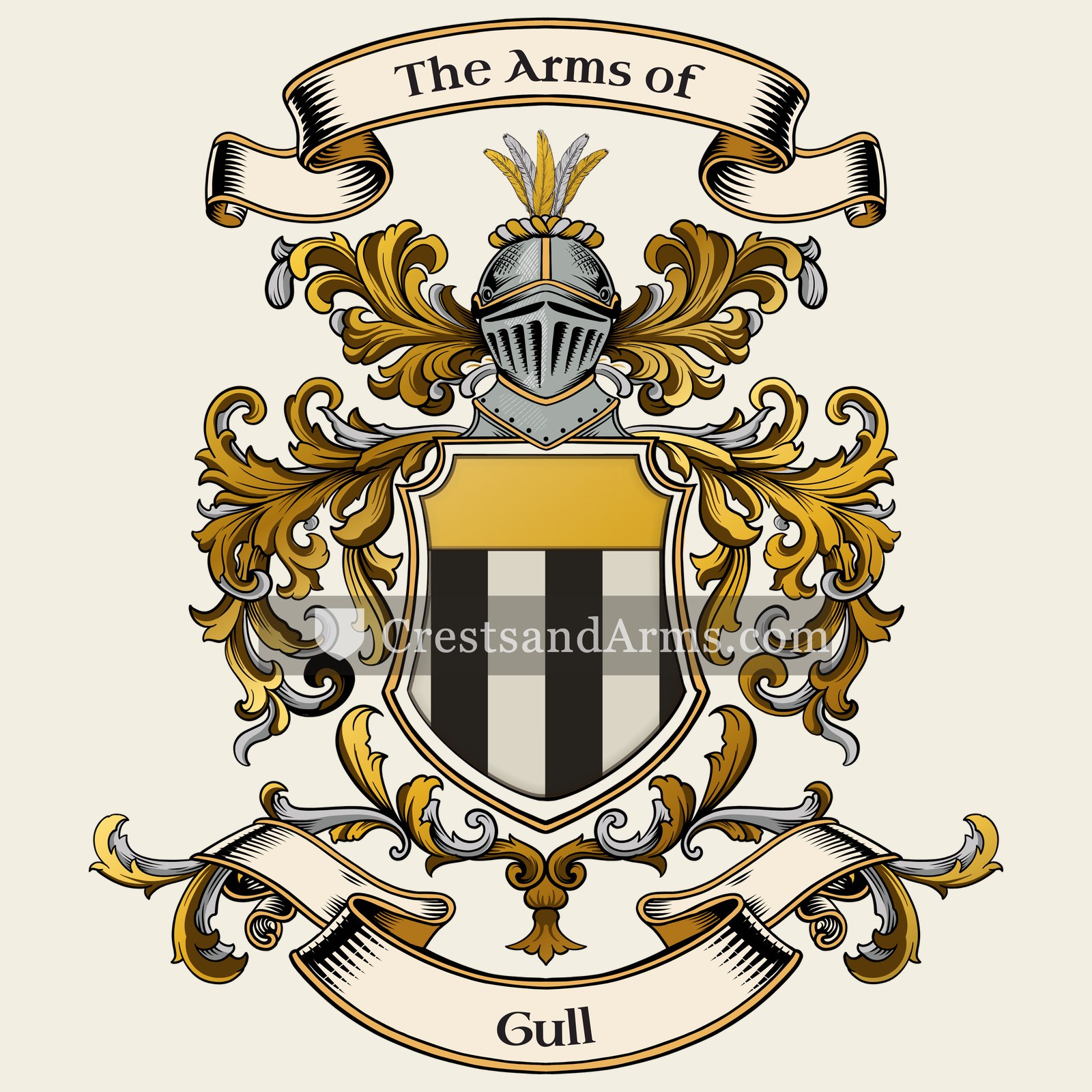
chiefAuthority, wisdom and dominion
Colours
Black (Sable)Means: Constancy
Gold (Or)Means: Generosity
Silver (Argent)Means: Peace and sincerity
Historical info
Source
Sir Bernard Burke, The General Armory of England, Scotland, Ireland and Wales, London: Harrison & Sons, 1884
Blazon (the actual original written record)
“Paly of six sa. and ar. a chief or”
LincolnLincoln, c. 1615
Where the Gull Arms Were Recorded
Lincoln
Map of England showing where the Gull arms are recorded
The Gull arms were recorded in Lincoln, c. 1615.
Lincolnshire was rich farming country, and its wealth was spread across many middling families. Households of that size bought land and took arms, and the county holds a large share of English names.
This is where the arms were entered in the register. Families often moved to other parts of the country, so the same name can turn up in more than one region.
The body that granted and recorded arms in England in this period.
James VI and I
Sovereign of the period
James VI and I
1603–1625
Reigning in Britain when the Gull arms are first recorded.
How Arms Worked in England
English heraldry allowed arms to be shared by all legitimate descendants of the original owner. These symbols were treated as personal property that moved through the generations to all children. While the eldest son kept the original design, other family members could use the same shield without needing to change it or register their own unique versions.
Granting authority
The College of Arms in London has regulated the use of coats of arms throughout England and Wales since 1484.
How they got arms
Families typically obtained their coats of arms through a formal grant from the Crown or by proving their ancient right to them.
Where arms were recorded
All official coats of arms are recorded in the registers kept at the College of Arms, which date back to the fifteenth century.
The family's standing
Recorded among the armigerous families of Lincoln.
Origin & History of the Gull Family in England
The surname Gull emerged in England as a descriptive name, likely originating from a nickname that compared an individual to the common seabird. By the early 17th century, the family had established a notable presence in the city of Lincoln, where records confirm their residence by 1615. During this era, Lincoln served as a vital hub for trade and administration, placing the Gull family within a community deeply connected to the agricultural and mercantile life of the East Midlands. As the name became fixed in local parish registers, it reflected the broader trends of English naming practices where nicknames evolved into permanent hereditary surnames. These early members of the family were part of the social fabric of a historic cathedral city, living through a period of significant religious and political transition in English history.
Related Branches & Arms
Root word
Gull
Derived from the Old Norse word gull meaning gold.
This name
GullA nickname for a person with golden hair or a bright, cheerful disposition.
Documented Sources
J. B. Rietstap, Armorial Général, Gouda: G. B. van Goor Zonen, 1884–87
Bardsley, Charles Wareing, A Dictionary of English and Welsh Surnames, 1901
Reaney, P.H. and Wilson, R.M., A Dictionary of English Surnames, 1991
The National Archives, Census Returns of England and Wales, 1871, HO 107
Digital archive packCoat of arms PNG, gold border print PDF, vector SVG and the certificate of authenticity. Sent to your email in minutes.


 saltireResolution, and St Andrew's cross
 serpentWisdom, healing and prudence
 martletA younger son, who must win his own land
 feathersWilling obedience and serenity
 saltireResolution, and St Andrew's cross
 serpentWisdom, healing and prudence
 martletA younger son, who must win his own land
 feathersWilling obedience and serenity

 chiefAuthority, wisdom and dominion