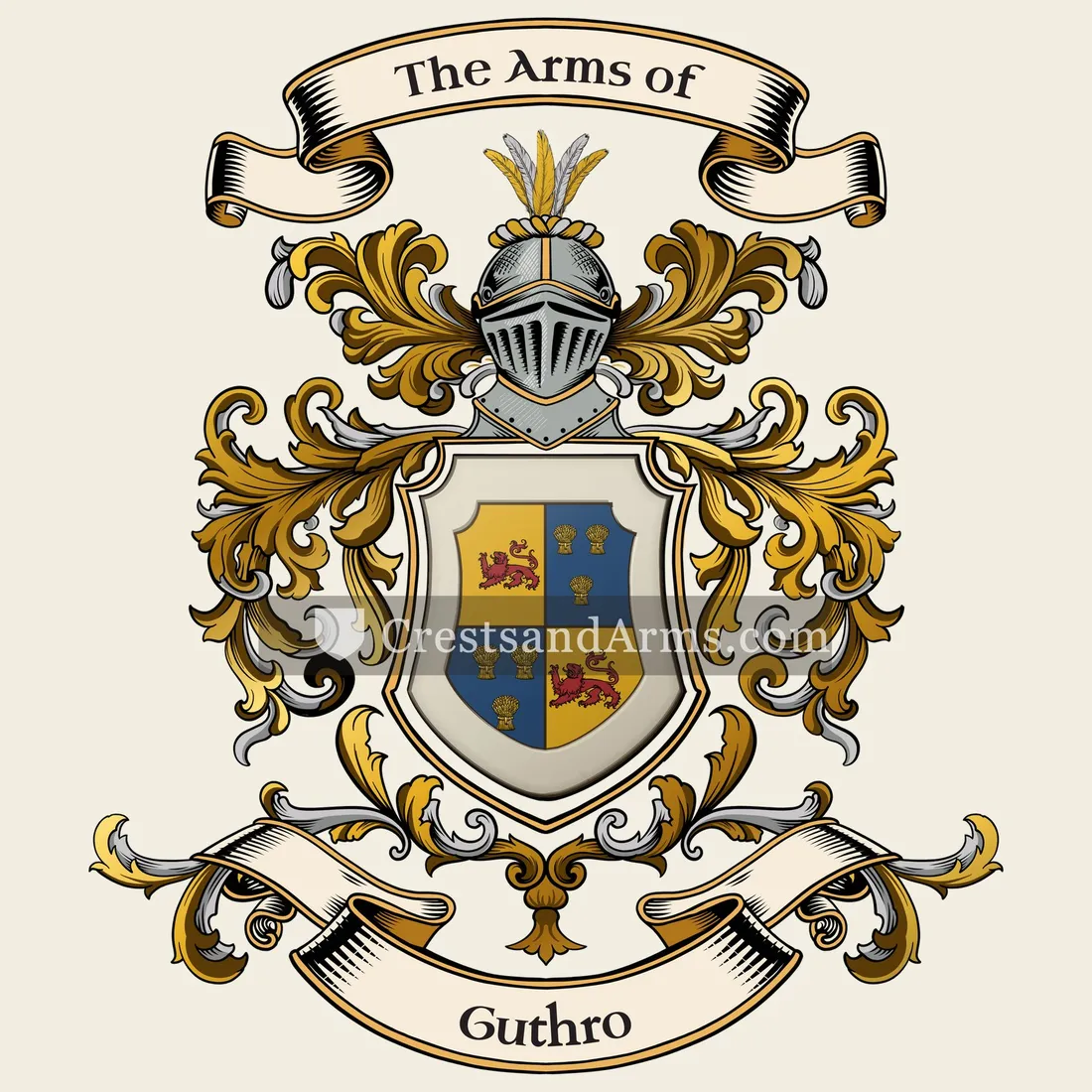
A record of documented arms, meaning and origin, researched for the Guthro family lines. Documented in 2 countries.
Reg. 2255 · French, G–I
Meaning of the Guthro family crest colors & symbols
Symbols on this shield
fessThe military belt, and readiness to serve
mountThe ground held, and steadfastness upon it
lionCourage, strength and royalty
hollyTruth, and protection through winter
wheatsheafPlenty, and the harvest of one's own labour
Colours
Gold (Or)Means: Generosity
Blue (Azure)Means: Loyalty and truth
Silver (Argent)Means: Peace and sincerity
Green (Vert)Means: Hope
Red (Gules)Means: Military strength
Historical info
Source
J. B. Rietstap, Armorial Général, Gouda: G. B. van Goor Zonen, 1884–87
Blazon (the actual original written record)
“Ec.: aux 1 et 4 d'or au lion de gu., arm. et lamp. d'azur; à la fasce d'arg., br. sur le tout et ch. d'un tertre de sin. entre deux feuilles de houx du même, les tiges en bas; aux 2 et 3 d'azur à trois gerbes d'or. C.: une main de carn., en pal, brandissant une épée, et surm. de la Légende: STO PRO VERITATE. T.: à dextre un chevalier, revêtu d'une cotte de mailles, tenant de sa main dextre une hache d'armes et de sa sen. un bouclier triangulaire de gu. ch. de deux léopards d'or, l'un sur l'autre; à sen. un chevalier pareil, portant par dessus sa cotte de mailles une cotte d'armes d'arg., la main dextre posée sur l'écu”
Francec. 1836
Digital archive packCoat of arms PNG, gold border print PDF, vector SVG and the certificate of authenticity. Sent to your email in minutes.
Map of France showing where the Guthro arms are recorded
The Guthro arms were recorded in France, c. 1836.
Arms such as these were typically recorded in Bretagne.
More families held coats of arms in Bretagne than anywhere else in France. The land was divided into many small estates rather than a few large ones, so far more households counted as gentry, and each needed a shield of its own to be told apart.
This is where the arms were entered in the register. Families often moved to other parts of the country, so the same name can turn up in more than one region.
The body that granted and recorded arms in France in this period.
How Arms Worked in France
In France, a coat of arms was a mark of honor that passed down through the male line to all legitimate descendants. Families often used the same shield without changes to show their shared heritage. If a branch wanted to stand out, they could add a small mark to their shield to show their specific place in the family tree.
Granting authority
The Juge d'armes de France acted as the official authority that regulated and verified coats of arms across the country.
How they got arms
Families typically inherited their arms from ancestors, though they could also receive them through royal grants or by proving their noble status.
Where arms were recorded
Coats of arms were officially recorded in the Armorial Général de France, which began its main collection in the year 1696.
The family's standing
Recorded among the armigerous families of France.
Origin & History of the Guthro Family in France
The name Guthro, often appearing in historical records as Gautreau or Gautreaux, carries deep roots within the cultural landscape of western France. By the early 19th century, families bearing this name were well-established in the Brittany region, a coastal area known for its distinct linguistic traditions and maritime heritage. The name itself is thought to derive from ancient Germanic roots, specifically combining elements that suggest a meaning related to "good" and "rule" or "power." As the family lived in Brittany during the 1830s, they were part of a society transitioning through significant social and industrial changes. Life in this region was heavily influenced by the proximity to the Atlantic Ocean, which likely shaped the occupations and daily experiences of early family members. These ancestors lived through a period where local identity was tied closely to the land and the sea, helping to preserve the name as it passed down through generations.
Meaning of the Guthro family crest colors & symbols
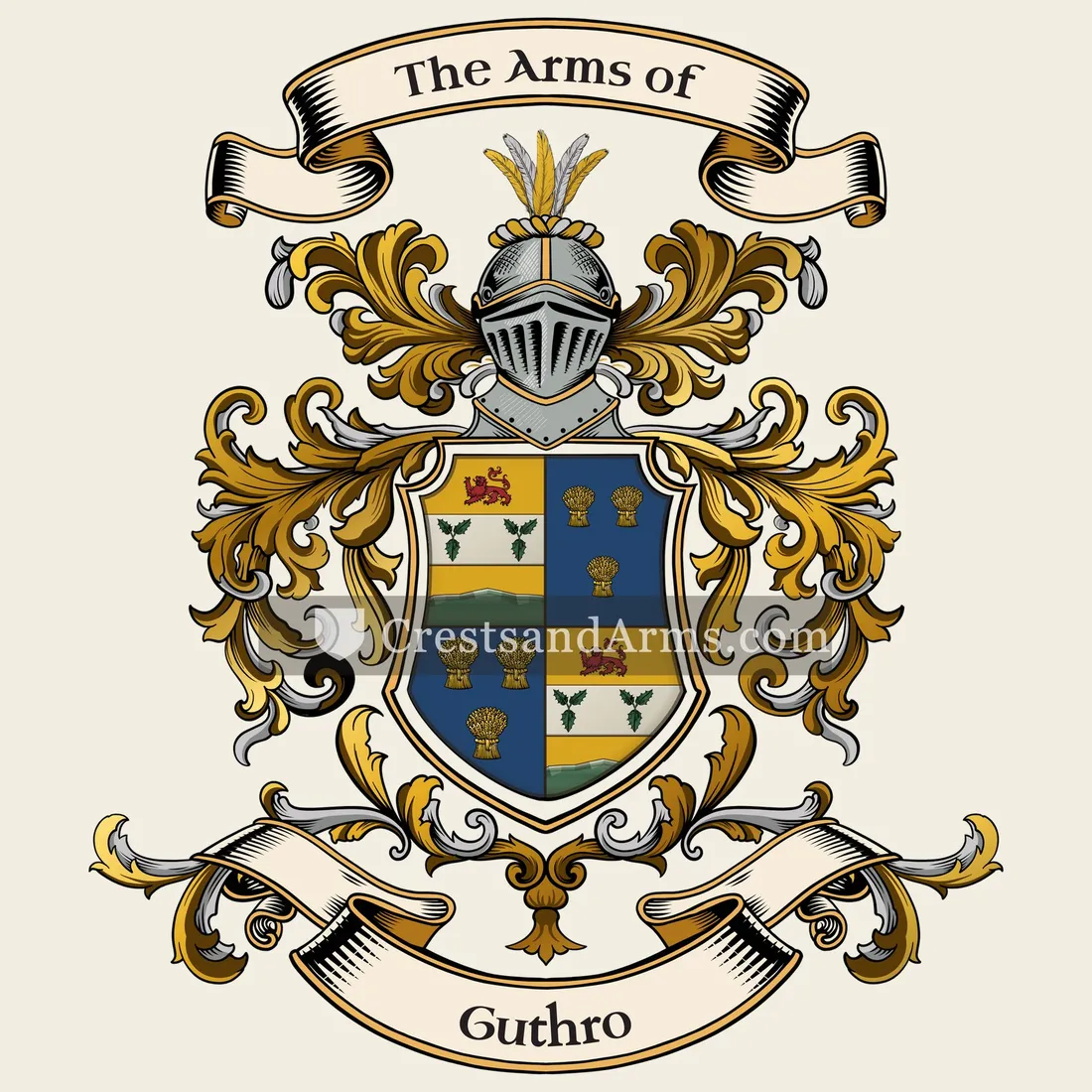
Symbols on this shield
bordureA difference between branches of one family
lionCourage, strength and royalty
wheatsheafPlenty, and the harvest of one's own labour
Colours
Gold (Or)Means: Generosity
Blue (Azure)Means: Loyalty and truth
Silver (Argent)Means: Peace and sincerity
Red (Gules)Means: Military strength
Historical info
Source
Sir Bernard Burke, The General Armory of England, Scotland, Ireland and Wales, London: Harrison & Sons, 1884
Blazon (the actual original written record)
“Quarterly, 1st and 4th, or, a lion ramp. reguard. gu.; 2nd and 3rd, az. three garbs or, all within a bordure indented ar”
ForfarProvost · Forfar, c. 1672
Digital archive packCoat of arms PNG, gold border print PDF, vector SVG and the certificate of authenticity. Sent to your email in minutes.
Map of Scotland showing where the Guthro arms are recorded
The Guthro arms were recorded in Forfar, c. 1672.
Forfar, now called Angus, was farming country on Scotland's east coast between the hills and the sea. Its landed families were long-settled, and long settlement is exactly what fills a register of arms.
This is where the arms were entered in the register. Families often moved to other parts of the country, so the same name can turn up in more than one region.
The body that granted and recorded arms in Scotland in this period.
Charles II of England
Sovereign of the period
Charles II of England
1660–1685
Reigning in France when the Guthro arms are first recorded.
How Arms Worked in Scotland
Scottish heraldry is unique because it treats a coat of arms as a piece of personal property protected by law. Only one person can own a specific design at any given time. When a family grows, the head keeps the original shield while other relatives must apply for their own distinct version with slight changes to prove their specific identity.
Granting authority
The Court of the Lord Lyon acts as the official body that regulates and controls all heraldic matters throughout Scotland.
How they got arms
Individuals obtain a legal right to their arms through a formal petition process that confirms their identity and family connection.
Where arms were recorded
All valid coats of arms are officially entered into the Public Register of All Arms and Bearings starting from 1672.
The family's standing
Recorded among the armigerous families of Forfar.
Origin & History of the Guthro Family in Scotland
The family name Guthro, often recorded in early Scottish documents as Guthrie or variations thereof, has deep roots in the eastern regions of Scotland. By the late seventeenth century, the family established a notable presence in the town of Forfar, which served as a significant administrative center in the county of Angus. Records from 1672 confirm that individuals bearing this name were active participants in the local community during a time of great social and political transition. The name itself is thought to be locational in origin, likely derived from lands in the Scottish Lowlands. As the family settled in Forfar, they became part of the fabric of burgh life, engaging in the trades and civic duties that defined the era. This regional history highlights the family's long-standing connection to the Scottish landscape and their integration into the structured society of the seventeenth-century kingdom.
Guthro Meaning & Related Branches
Root word
Gautier
Derived from Germanic elements meaning ruler of the army.
This name
GuthroA French-Canadian variant of the name Gautreau, signifying a powerful army leader.
also spelled
Guthry
Guthree
Guthrey
Documented Sources
J. B. Rietstap, Armorial Général, Gouda: G. B. van Goor Zonen, 1884–87
Dauzat, Albert. Dictionnaire étymologique des noms de famille et prénoms de France. 1951
Morvan, Françoise. La douce Bretagne. 2007
Archives départementales du Morbihan. Recensement de la population, 1836
Digital archive packCoat of arms PNG, gold border print PDF, vector SVG and the certificate of authenticity. Sent to your email in minutes.


 fessThe military belt, and readiness to serve
 mountThe ground held, and steadfastness upon it
 lionCourage, strength and royalty
 hollyTruth, and protection through winter
 wheatsheafPlenty, and the harvest of one's own labour
 fessThe military belt, and readiness to serve
 mountThe ground held, and steadfastness upon it
 lionCourage, strength and royalty
 hollyTruth, and protection through winter
 wheatsheafPlenty, and the harvest of one's own labour

 bordureA difference between branches of one family