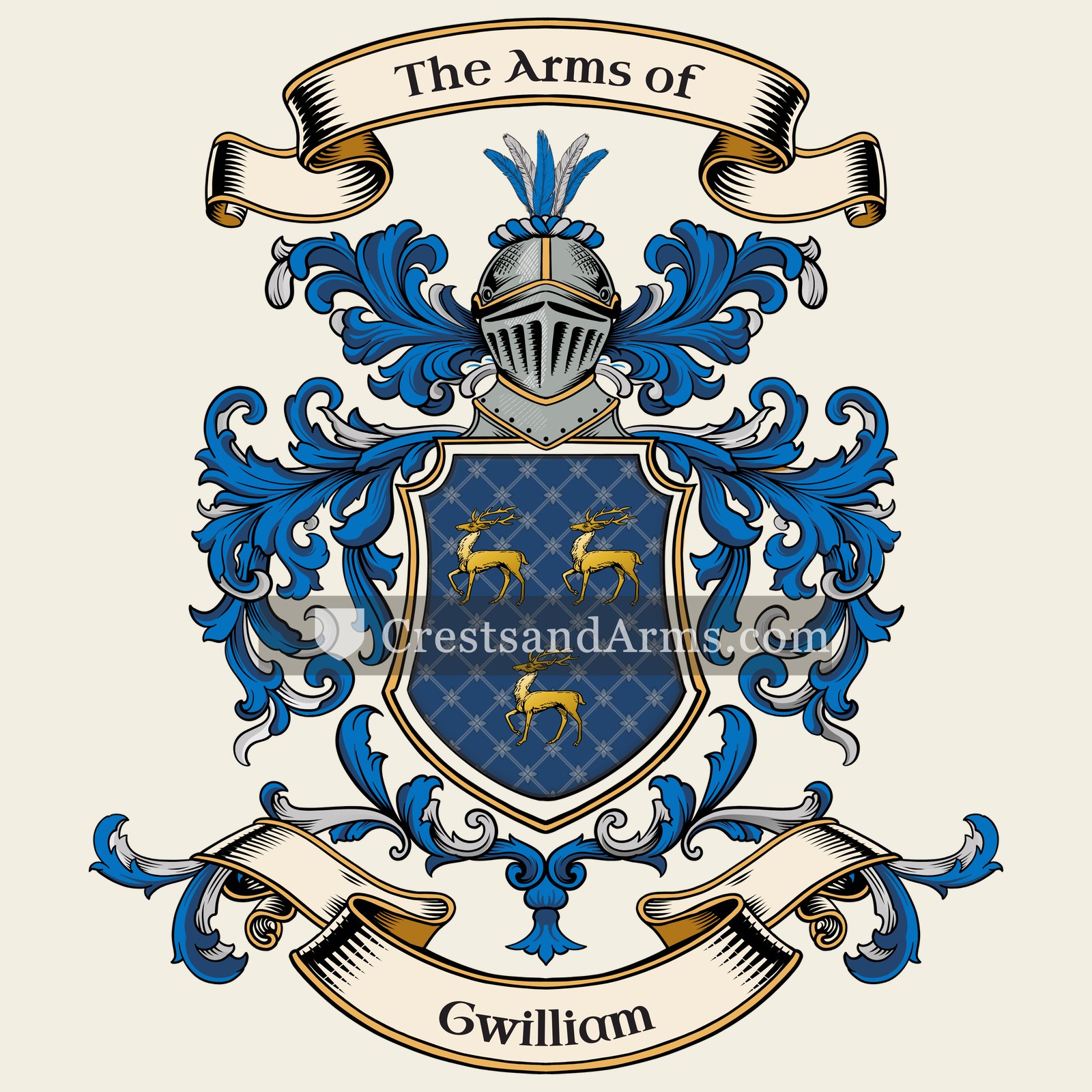
A record of documented arms, meaning and origin, researched for the Gwilliam family of Wales.
Reg. 9165 · Welsh, G–I
Coat of Arms & Family Crest Details
Symbols on this shield
stagPeace and harmony, and one who will not fight unprovoked
Colours
Blue (Azure)Means: Loyalty and truth
Gold (Or)Means: Generosity
Historical info
Source
Sir Bernard Burke, The General Armory of England, Scotland, Ireland and Wales, London: Harrison & Sons, 1884
Blazon (the actual original written record)
“Az. three bucks' heads cabossed or”
Walesc. 1647
Where the Gwilliam Arms Were Recorded
Denbigh
Map of Wales showing where the Gwilliam arms are recorded
The Gwilliam arms were recorded in Wales, c. 1647.
Arms such as these were typically recorded in Denbigh.
Denbighshire was north Welsh country of hills and small estates. Land was held by a great many families rather than a few, and each holding brought its own claim to a coat of arms.
This is where the arms were entered in the register. Families often moved to other parts of the country, so the same name can turn up in more than one region.
The body that granted and recorded arms in Wales in this period.
Charles I of England
Sovereign of the period
Charles I of England
1625–1649
Reigning in Wales when the Gwilliam arms are first recorded.
How Arms Worked in Wales
English heraldry allowed arms to be shared by all legitimate descendants of the original owner. These symbols were treated as personal property that moved through the generations to all children. While the eldest son kept the original design, other family members could use the same shield without needing to change it or register their own unique versions.
Granting authority
The College of Arms in London has regulated the use of coats of arms throughout England and Wales since 1484.
How they got arms
Families typically obtained their coats of arms through a formal grant from the Crown or by proving their ancient right to them.
Where arms were recorded
All official coats of arms are recorded in the registers kept at the College of Arms, which date back to the fifteenth century.
The family's standing
Recorded among the armigerous families of Wales.
Origin & History of the Gwilliam Family in Wales
The surname Gwilliam is a patronymic name, which means it originated as a way to identify a person as the son of someone named William. It is deeply rooted in the Welsh language and culture, evolving from the Welsh version of the name William, which is Gwilym. By the middle of the 17th century, the family had established a clear presence in the historic market town of Denbigh in North Wales. During this period, families in the region often lived in close-knit communities where names were passed down through generations to maintain a sense of lineage. The transition from Gwilym to the anglicized spelling of Gwilliam likely occurred as the family interacted more frequently with English-speaking administration and record-keeping systems. This evolution reflects the broader linguistic shifts occurring in Wales during the 1600s as families adapted their traditional names to fit into a changing social landscape.
Related Branches & Arms
Root word
Guillaume
Derived from the Germanic elements for will and helmet or protection.
This name
GwilliamA Welsh patronymic form of William, signifying a resolute protector or strong-willed guardian.
also spelled
Gwillyam
Related arms
Guillimvariant spelling
Gwillimvariant spelling
Documented Sources
Sir Bernard Burke, The General Armory of England, Scotland, Ireland and Wales, London: Harrison & Sons, 1884
Morgan, P. and Morgan, R., Welsh Surnames, 1985
Denbighshire Archives, Parish Registers of Denbigh, 1647
Digital archive packCoat of arms PNG, gold border print PDF, vector SVG and the certificate of authenticity. Sent to your email in minutes.


 stagPeace and harmony, and one who will not fight unprovoked
 stagPeace and harmony, and one who will not fight unprovoked