A record of documented arms, meaning and origin, researched for the Gwinn family lines. Documented in 3 countries.
Reg. 8473 · Welsh, G–I
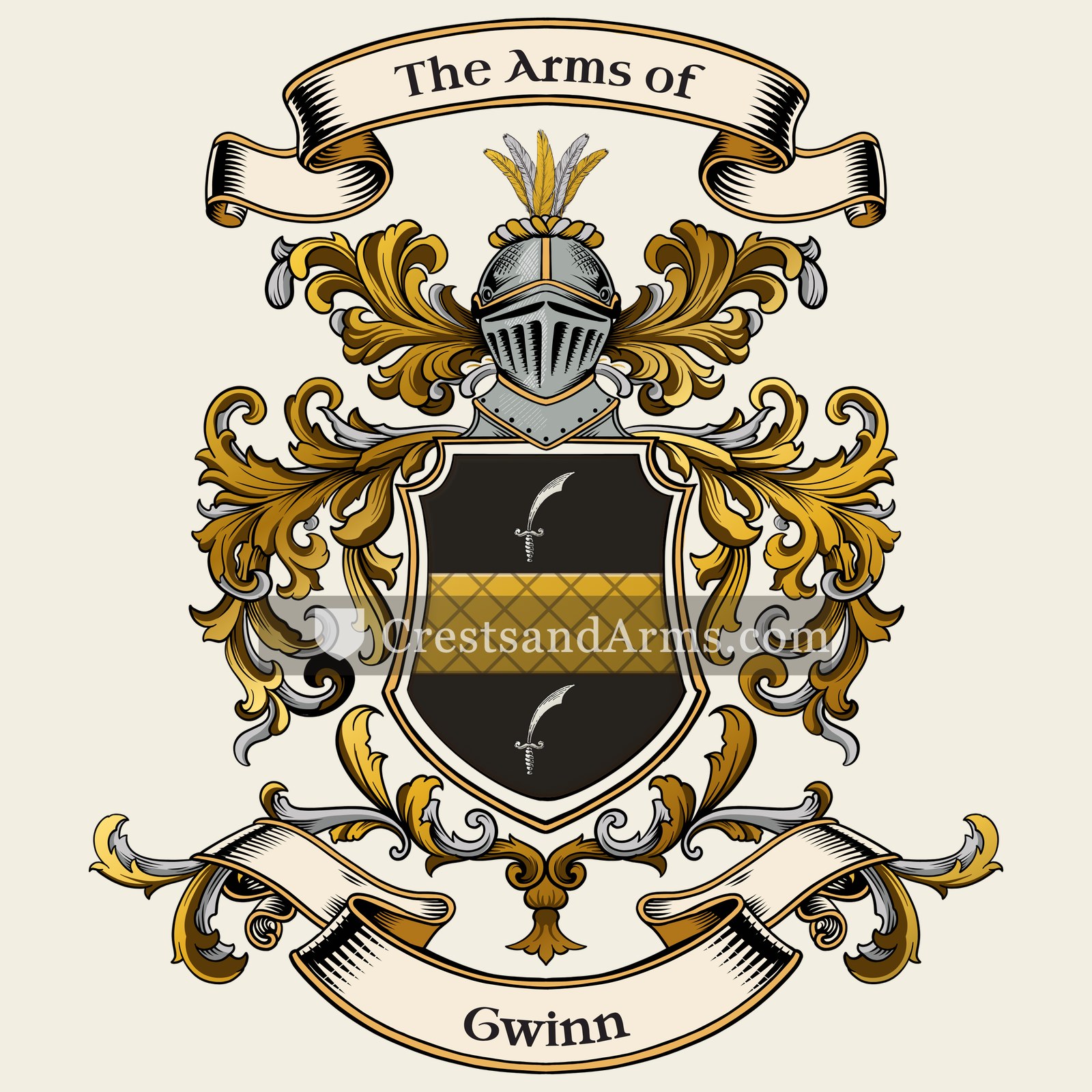
Coat of Arms & Family Crest Details
Symbols on this shield
fessThe military belt, and readiness to serve
swordJustice, and military honour
Colours
Black (Sable)Means: Constancy
Gold (Or)Means: Generosity
Silver (Argent)Means: Peace and sincerity
Historical info
Source
Sir Bernard Burke, The General Armory of England, Scotland, Ireland and Wales, London: Harrison & Sons, 1884
Blazon (the actual original written record)
“Sa. a fesse or, betw. two swords, the point of that in chief upwards, the other downwards, both in pale ar. hilted of the second”
GlamorganDyffryn · Glamorgan, c. 1647
Where the Gwinn Arms Were Recorded
Glamorgan
Map of Wales showing where the Gwinn arms are recorded
The Gwinn arms were recorded in Glamorgan, c. 1647.
Glamorgan was the richest part of Wales, with good coastal farmland and Norman castles along it. The families who held those castles kept their land for centuries, and long holding brought recorded arms.
This is where the arms were entered in the register. Families often moved to other parts of the country, so the same name can turn up in more than one region.
The body that granted and recorded arms in Wales in this period.
Charles I of England
Sovereign of the period
Charles I of England
1625–1649
Reigning in Wales when the Gwinn arms are first recorded.
How Arms Worked in Wales
English heraldry allowed arms to be shared by all legitimate descendants of the original owner. These symbols were treated as personal property that moved through the generations to all children. While the eldest son kept the original design, other family members could use the same shield without needing to change it or register their own unique versions.
Granting authority
The College of Arms in London has regulated the use of coats of arms throughout England and Wales since 1484.
How they got arms
Families typically obtained their coats of arms through a formal grant from the Crown or by proving their ancient right to them.
Where arms were recorded
All official coats of arms are recorded in the registers kept at the College of Arms, which date back to the fifteenth century.
The family's standing
Recorded among the armigerous families of Glamorgan.
Origin & History of the Gwinn Family in Wales
The family name Gwinn finds its linguistic roots in the Welsh word gwyn, which translates to white, fair, or blessed. In the context of early Welsh naming traditions, this term was often used as a descriptive nickname for an ancestor with light hair or a pale complexion. By the middle of the seventeenth century, the name was firmly established in the region of Glamorgan. Records from 1647 confirm that members of the family were active residents in this area during a time of significant political and social upheaval in Britain. As the family grew, they became part of the local fabric of South Wales, living among the hills and valleys that shaped the unique culture and language of the region. Over time, the spelling evolved from its original descriptive form into the surname recognized today, marking the transition from a personal identifier to a permanent family name passed down through generations.
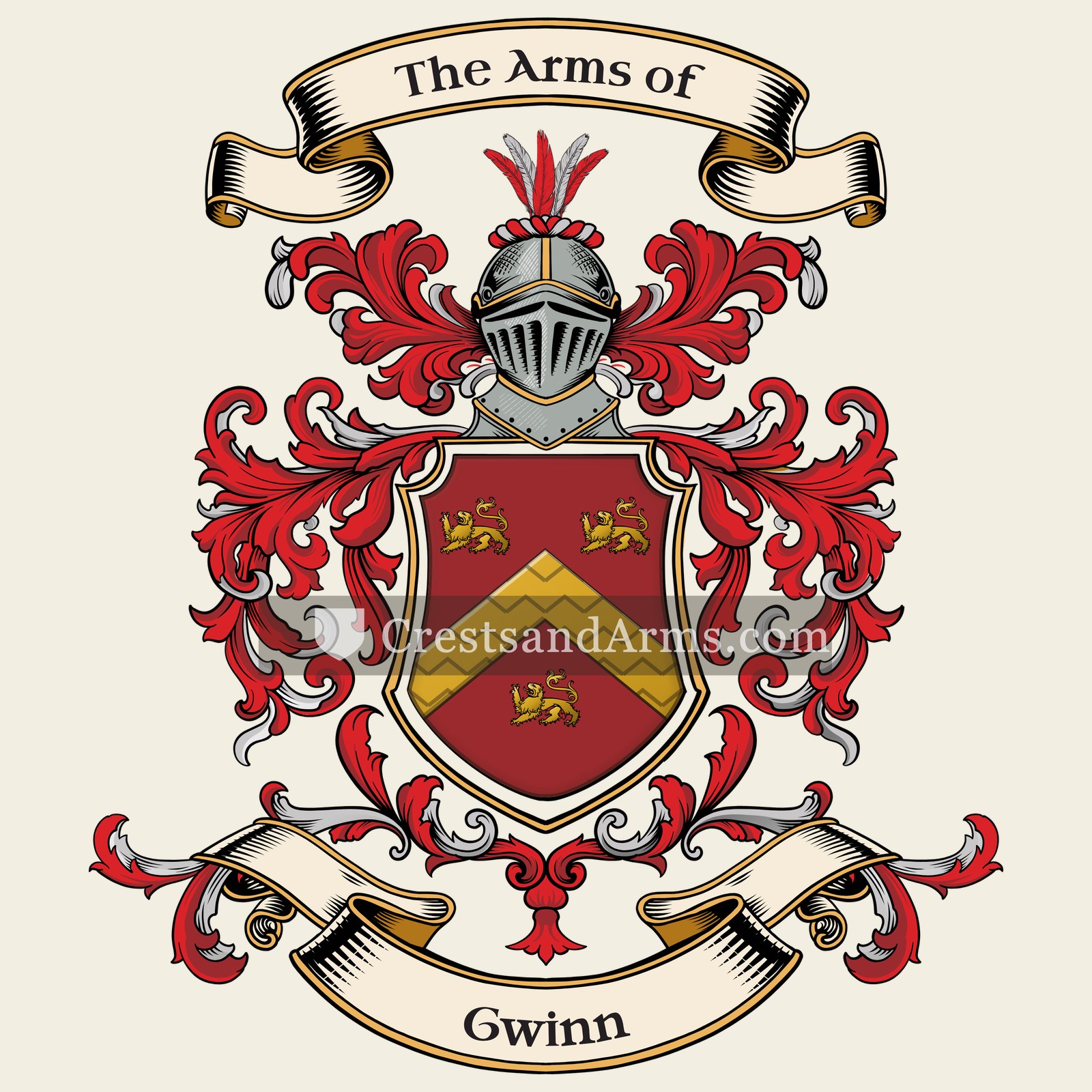
Coat of Arms & Family Crest Details
Symbols on this shield
chevronProtection, and faithful service completed
lionCourage, strength and royalty
Colours
Red (Gules)Means: Military strength
Gold (Or)Means: Generosity
Historical info
Source
Sir Bernard Burke, The General Armory of England, Scotland, Ireland and Wales, London: Harrison & Sons, 1884
Blazon (the actual original written record)
“Gu. a chev. betw. three lions ramp. or”
NorfolkNorfolk, c. 1620
Where the Gwinn Arms Were Recorded
Norfolk
Map of England showing where the Gwinn arms are recorded
The Gwinn arms were recorded in Norfolk, c. 1620.
Norfolk grew rich on wool and grain, and its wealth was spread among many middling families rather than a few great ones. Households of that kind bought land and took arms, and the county holds a large share of English names.
This is where the arms were entered in the register. Families often moved to other parts of the country, so the same name can turn up in more than one region.
The body that granted and recorded arms in England in this period.
James VI and I
Sovereign of the period
James VI and I
1603–1625
Reigning in Wales when the Gwinn arms are first recorded.
How Arms Worked in England
English heraldry allowed arms to be shared by all legitimate descendants of the original owner. These symbols were treated as personal property that moved through the generations to all children. While the eldest son kept the original design, other family members could use the same shield without needing to change it or register their own unique versions.
Granting authority
The College of Arms in London has regulated the use of coats of arms throughout England and Wales since 1484.
How they got arms
Families typically obtained their coats of arms through a formal grant from the Crown or by proving their ancient right to them.
Where arms were recorded
All official coats of arms are recorded in the registers kept at the College of Arms, which date back to the fifteenth century.
The family's standing
Recorded among the armigerous families of Norfolk.
Origin & History of the Gwinn Family in England
The surname Gwinn is rooted in the linguistic traditions of the British Isles, often associated with the Welsh word gwyn, which translates to white, fair, or blessed. While the name has deep connections to Wales, historical records confirm that members of the family were well-established in the county of Norfolk by 1620. During this period, Norfolk was a bustling center of trade and agriculture, and families like the Gwinns were often involved in the local parish life and the shifting social structures of the seventeenth century. As the family settled into this region, they became part of the local community, leaving their mark in church registers and legal documents that tracked births, marriages, and land ownership. This migration from the western regions of Britain to the eastern coast of England reflects the broader movement of people who sought new opportunities in the changing economic landscape of the early modern era.
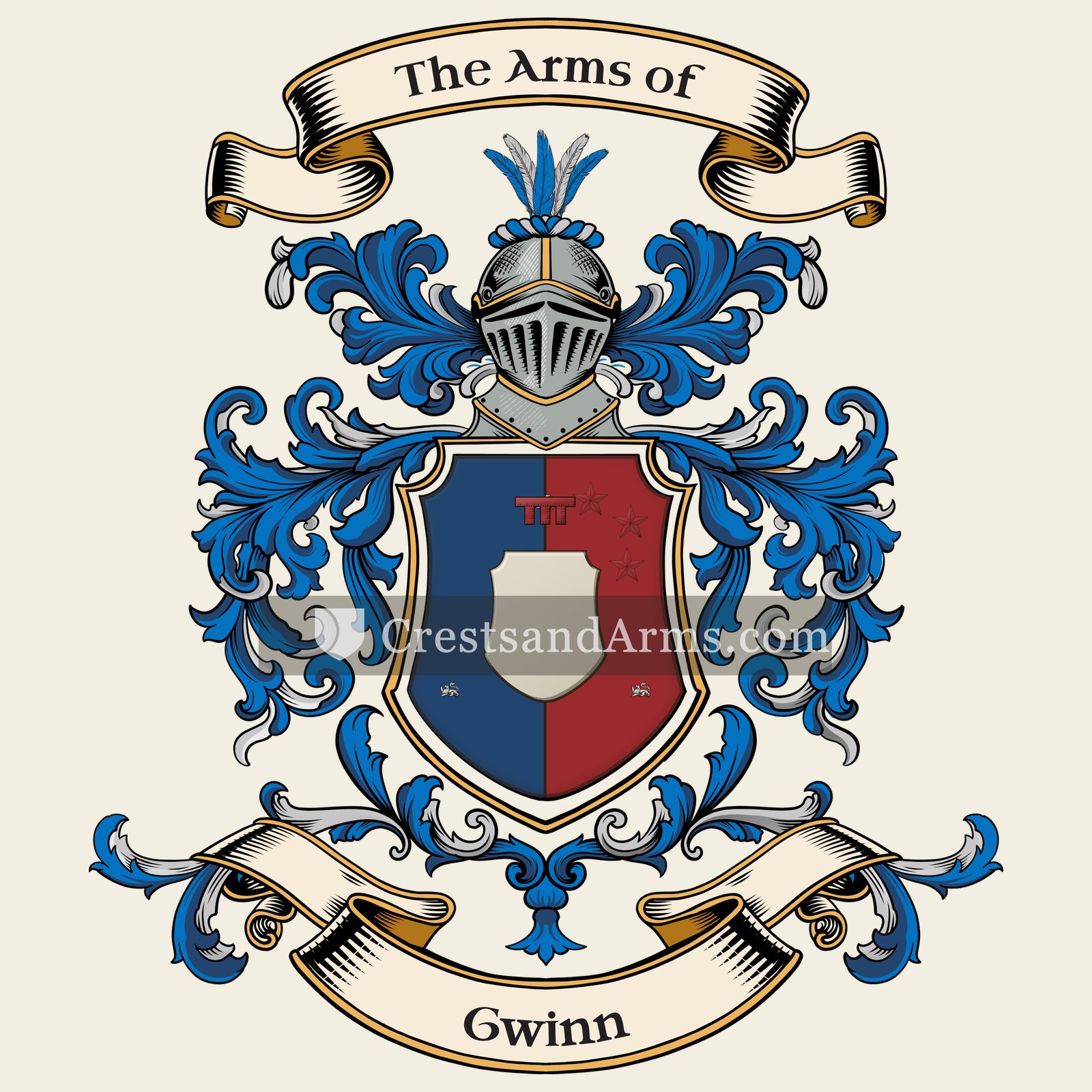
Coat of Arms & Family Crest Details
Symbols on this shield
paleMilitary strength, and a fortified defence
chevronProtection, and faithful service completed
labelThe eldest son, during his father's life
lionCourage, strength and royalty
mulletThe third son, and a divine quality from above
Colours
Blue (Azure)Means: Loyalty and truth
Red (Gules)Means: Military strength
Silver (Argent)Means: Peace and sincerity
Historical info
Source
Sir Bernard Burke, The General Armory of England, Scotland, Ireland and Wales, London: Harrison & Sons, 1884
Blazon (the actual original written record)
“Per pale az. and gu. three lions ramp. ar., an escutcheon of pretence, quarterly, 1st and 4th, ar. a chev. sa. in chief a label of three points gu.; 2nd and 3rd, ar. a chev. betw. three mullets gu”
IrelandRochester, c. 1701
Where the Gwinn Arms Were Recorded
Dublin
Map of Ireland showing where the Gwinn arms are recorded
The Gwinn arms were recorded in Rochester, c. 1701.
Arms such as these were typically recorded in Dublin.
Dublin was the seat of government in Ireland and the place where grants were sought and recorded. Families with business at the castle or the courts settled nearby, and settling there put their arms on record.
This is where the arms were entered in the register. Families often moved to other parts of the country, so the same name can turn up in more than one region.
The body that granted and recorded arms in Ireland in this period.
William III of England
Sovereign of the period
William III of England
1694–1702
Reigning in Wales when the Gwinn arms are first recorded.
How Arms Worked in Ireland
The Ulster King of Arms granted coats of arms to individuals who proved their social standing and good character. These symbols were typically inherited by all legitimate descendants of the original holder. If a family branch wanted a unique look, they could apply for a specific change to their design through the office to ensure their identity remained distinct.
Granting authority
The Ulster King of Arms acted as the official body that regulated and issued all coats of arms throughout Ireland.
How they got arms
Families obtained their arms through formal grants issued by the office after proving their eligibility and paying the required fees.
Where arms were recorded
All official grants were recorded in the registers held by the Ulster King of Arms starting from the year 1552.
The family's standing
Recorded among the armigerous families of Ireland.
Origin & History of the Gwinn Family in Ireland
The family name Gwinn has deep roots in Ireland, where it evolved from the older Gaelic name Mag Fhinn, meaning son of the fair one. By the turn of the eighteenth century, the name was firmly established in the bustling city of Dublin. Records from 1701 confirm that members of the family were active participants in the urban life of the capital during a period of significant social and economic change. As the family settled into the city, they became part of the diverse population that defined Dublin as a center of trade and administration. While the name originated in the Gaelic tradition, its presence in Dublin shows how the family adapted to the changing landscape of Ireland. Over time, the spelling shifted to the form we recognize today, reflecting the broader linguistic transitions occurring across the country during that era.
Related Branches & Arms
Root word
gwyn
A Welsh adjective meaning white, fair, or blessed.
This name
GwinnA descriptive surname for someone with a fair complexion or light-colored hair.
also spelled
Gwinn
Gwin
Guin
Gwine
Gwynne
Documented Sources
Sir Bernard Burke, The General Armory of England, Scotland, Ireland and Wales, London: Harrison & Sons, 1884
Morgan, T. J. and Morgan, Prys. Welsh Surnames. 1985


 fessThe military belt, and readiness to serve
 swordJustice, and military honour
 fessThe military belt, and readiness to serve
 swordJustice, and military honour

 chevronProtection, and faithful service completed
 lionCourage, strength and royalty
 paleMilitary strength, and a fortified defence
 labelThe eldest son, during his father's life
 mulletThe third son, and a divine quality from above