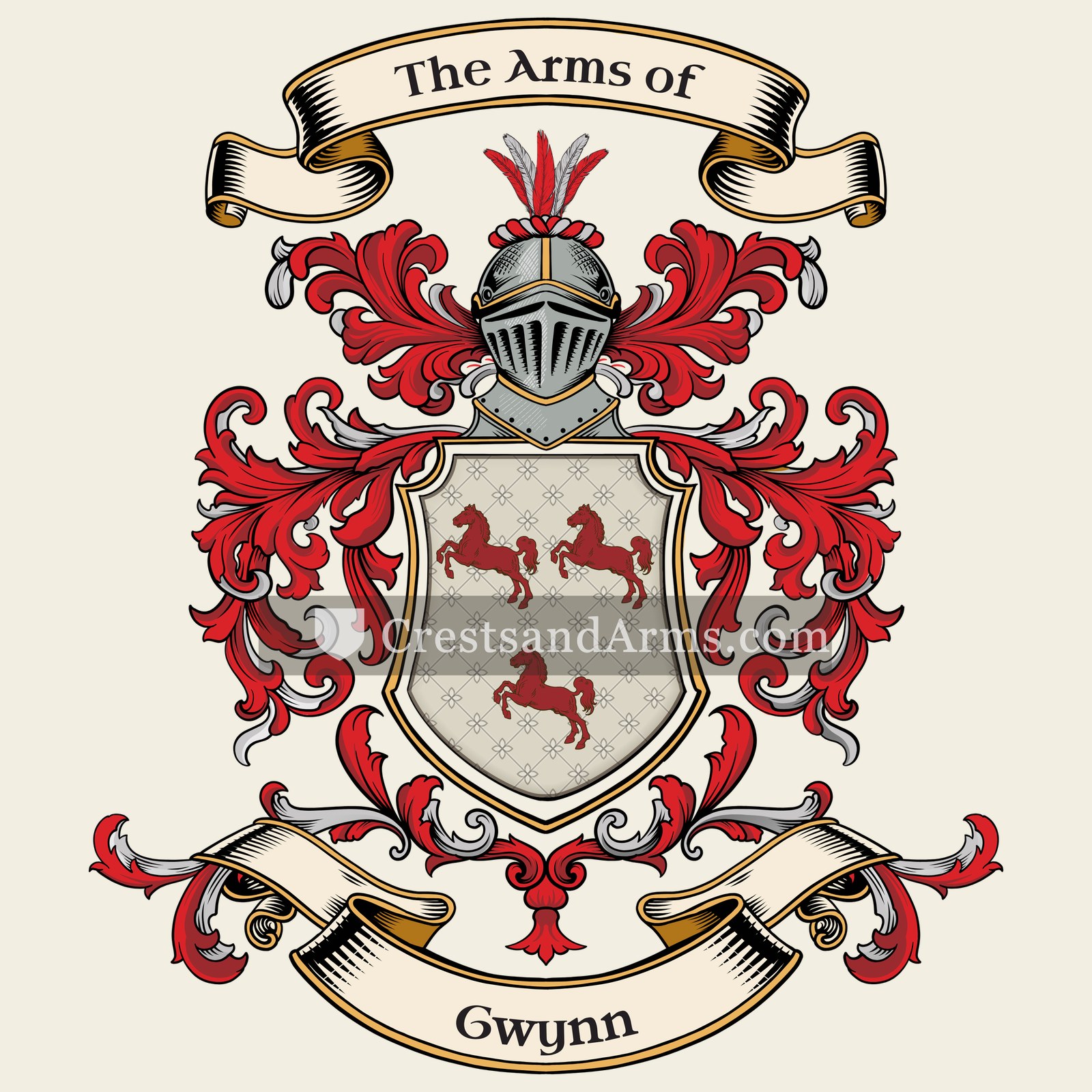
A record of documented arms, meaning and origin, researched for the Gwynn family of Ireland.
Reg. 9091 · Irish, G–I
Coat of Arms & Family Crest Details
Symbols on this shield
horseReadiness to serve king and country
Colours
Silver (Argent)Means: Peace and sincerity
Red (Gules)Means: Military strength
Historical info
Source
Sir Bernard Burke, The General Armory of England, Scotland, Ireland and Wales, London: Harrison & Sons, 1884
Blazon (the actual original written record)
“Ar. three nags' heads erased gu”
MontgomeryMontgomery, c. 1698
Where the Gwynn Arms Were Recorded
Map of Ireland showing where the Gwynn arms are recorded
The Gwynn arms were recorded in Montgomery, c. 1698.
Montgomeryshire was mid-Welsh border country where land was held in return for keeping it quiet. Families were expected to arm, and an armed household carried a shield.
This is where the arms were entered in the register. Families often moved to other parts of the country, so the same name can turn up in more than one region.
The body that granted and recorded arms in Ireland in this period.
William III of England
Sovereign of the period
William III of England
1694–1702
Reigning in Ireland when the Gwynn arms are first recorded.
How Arms Worked in Ireland
The Ulster King of Arms granted coats of arms to individuals who proved their social standing and good character. These symbols were typically inherited by all legitimate descendants of the original holder. If a family branch wanted a unique look, they could apply for a specific change to their design through the office to ensure their identity remained distinct.
Granting authority
The Ulster King of Arms acted as the official body that regulated and issued all coats of arms throughout Ireland.
How they got arms
Families obtained their arms through formal grants issued by the office after proving their eligibility and paying the required fees.
Where arms were recorded
All official grants were recorded in the registers held by the Ulster King of Arms starting from the year 1552.
The family's standing
Recorded among the armigerous families of Montgomery.
Origin & History of the Gwynn Family in Ireland
The surname Gwynn originates from the Welsh word gwyn, which translates to white, fair, or blessed. Historically, this name was often used as a descriptive nickname for an ancestor who had a fair complexion or light-colored hair. By the time the family established a presence in Montgomery County, Pennsylvania, in 1698, the name had been used in Wales for many generations. These early settlers were part of a wave of Welsh Quakers who sought religious freedom and new opportunities in the American colonies. They settled in an area that became known as the Welsh Tract, where they maintained their cultural traditions and language for many years. This migration helped preserve the history of the name as it transitioned from a descriptive Welsh term into a permanent family identity in the New World.
Related Branches & Arms
Root word
gwyn
An ancient Brythonic or Welsh word meaning white, fair, or blessed.
This name
GwynnA descriptive surname referring to a person with a fair complexion or white hair.
also spelled
Gwinn
Gwin
Gwine
Related arms
Gwinevariant spelling
Documented Sources
Sir Bernard Burke, The General Armory of England, Scotland, Ireland and Wales, London: Harrison & Sons, 1884
Browning, Charles H., Welsh Settlement of Pennsylvania, 1912
Glenn, Thomas Allen, Merion in the Welsh Tract, 1896
Montgomery County Archives, Montgomery County Deed Records, 1698
Digital archive packCoat of arms PNG, gold border print PDF, vector SVG and the certificate of authenticity. Sent to your email in minutes.


 horseReadiness to serve king and country
 horseReadiness to serve king and country