A record of documented arms, meaning and origin, researched for the Haack family lines. Documented in 3 countries.
Reg. 2497 · Dutch, G–I
Coat of Arms & Family Crest Details
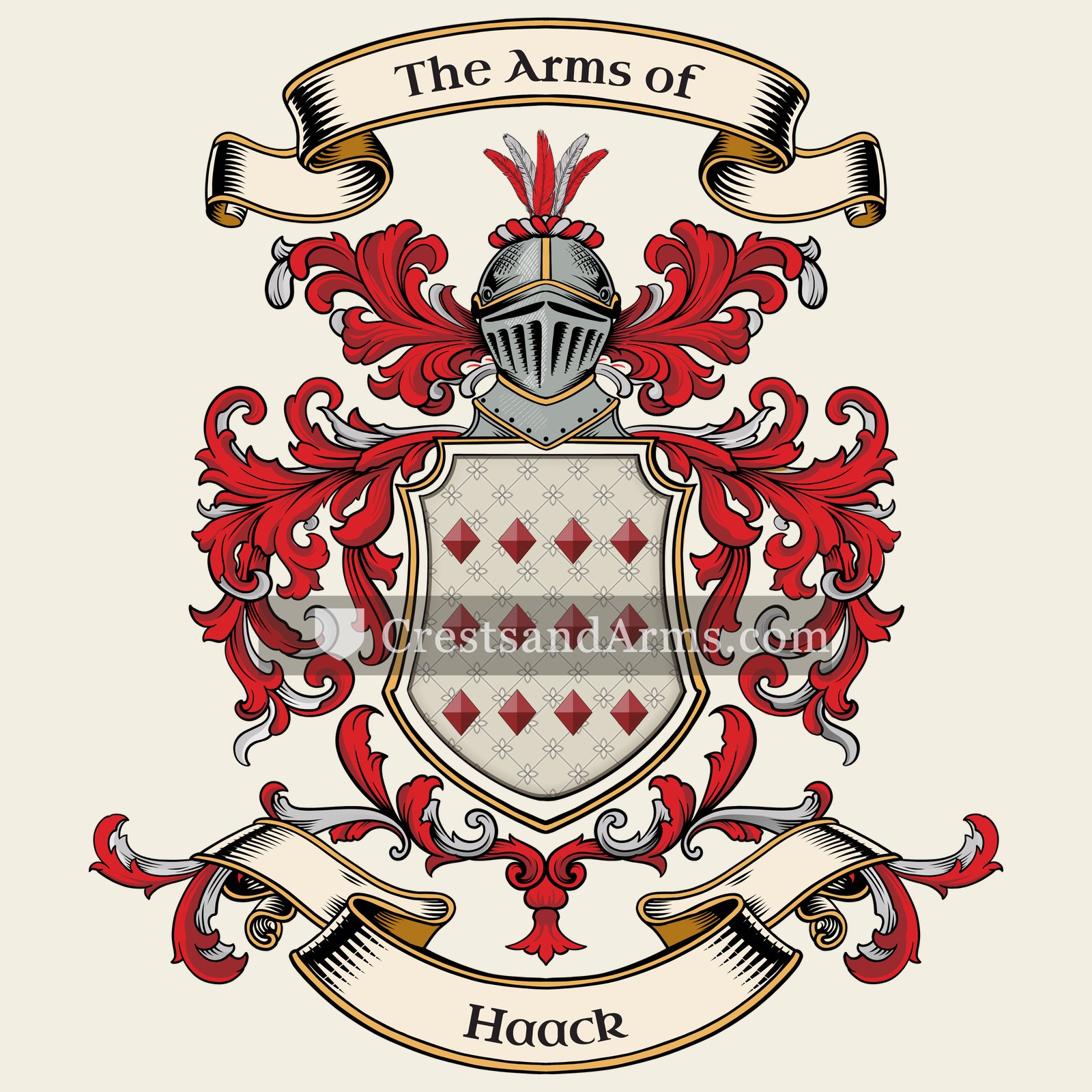
Symbols on this shield
saltireResolution, and St Andrew's cross
lozengeHonour and nobility, and the arms of a woman
Colours
Silver (Argent)Means: Peace and sincerity
Red (Gules)Means: Military strength
Historical info
Source
J. B. Rietstap, Armorial Général, Gouda: G. B. van Goor Zonen, 1884–87
Blazon (the actual original written record)
“D'arg. à treize carreaux de gu., aboutés en saut.”
NetherlandsBois-le, c. 1815
Where the Haack Arms Were Recorded
Bois-le
Map of Netherlands showing where the Haack arms are recorded
The Haack arms were recorded in Bois-le, c. 1815.
This is where the arms were entered in the register. Families often moved to other parts of the country, so the same name can turn up in more than one region.
Region
Bois-le
Town
Bois-le
First recorded
1815
Granting Authority for the Haack Arms
Hoge Raad van Adel
Photograph made by me · CC BY-SA 3.0
The body that granted and recorded arms in Netherlands in this period.
William I of the Netherlands
Sovereign of the period
William I of the Netherlands
1815–1840
Reigning in Netherlands when the Haack arms are first recorded.
How Arms Worked in Netherlands
In the Netherlands, coats of arms were often used by noble families and those who held specific public offices. These arms were passed down through the generations to legitimate descendants. Younger branches of a family usually kept the original design without needing to add special marks. This system ensured that the family identity remained clear and consistent over many years.
Granting authority
The Hoge Raad van Adel is the official body that regulates and manages noble titles and coats of arms in the Netherlands.
How they got arms
Families typically obtained their coats of arms through official royal grants or by proving their long-standing historical use of the symbols.
Where arms were recorded
Coats of arms are officially recorded in the registers held by the Hoge Raad van Adel, which began its work in 1814.
The family's standing
Recorded among the armigerous families of Netherlands.
Origin & History of the Haack Family in Netherlands
The surname Haack has deep roots in the Low Countries, where it evolved as a descriptive name often linked to the physical landscape or specific trade practices of the region. By the early nineteenth century, the family established a notable presence in the city of Bois-le-Duc, which is known in Dutch as 's-Hertogenbosch. During the turbulent period of 1815, when the United Kingdom of the Netherlands was formed following the defeat of Napoleon, the Haack family was already integrated into the local social and administrative fabric of this historic fortified city. The name likely reflects the linguistic shift of the era, where Germanic and Dutch influences blended to identify families based on their proximity to local landmarks or their roles within the bustling merchant communities of the Brabant province. As the region transitioned into a new era of national independence, the Haack family members in 's-Hertogenbosch were part of a growing urban middle class that helped shape the civic life of the city during the nineteenth century.
Coat of Arms & Family Crest Details
Colours
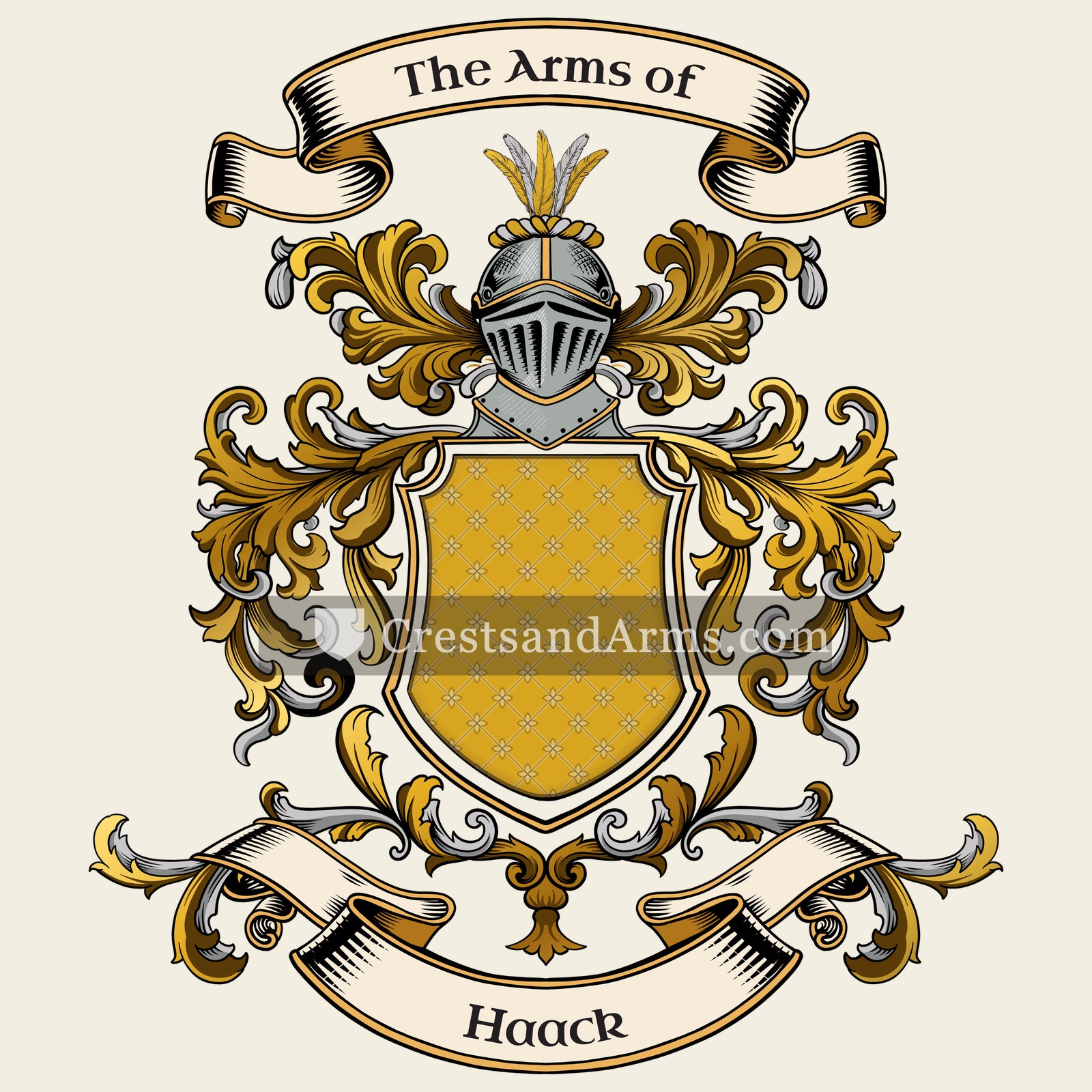
Gold (Or)Means: Generosity
Historical info
Source
J. B. Rietstap, Armorial Général, Gouda: G. B. van Goor Zonen, 1884–87
Blazon (the actual original written record)
“D'or à une roue de moulin de gu. C.: deux bras, parés d'or, les mains de carn. supp. une roue de moulin de gu.”
Denmarkc. 1722
Where the Haack Arms Were Recorded
Sjaælland
Map of Denmark showing where the Haack arms are recorded
The Haack arms were recorded in Denmark, c. 1722.
Arms such as these were typically recorded in Sjaælland.
Zealand held the Danish court, the crown's offices and Copenhagen itself. Families who served the king kept estates within reach of it, and royal service was the ordinary route to a coat of arms.
This is where the arms were entered in the register. Families often moved to other parts of the country, so the same name can turn up in more than one region.
The body that granted and recorded arms in Denmark in this period.
Frederik IV of Denmark
Sovereign of the period
Frederik IV of Denmark
1699–1730
Reigning in Netherlands when the Haack arms are first recorded.
How Arms Worked in Denmark
Danish heraldry during this period was closely tied to noble status and royal favor rather than being open to all citizens. Arms were typically granted by the monarch to individuals, and these symbols were then shared by all members of the noble house. If a family line died out, the right to use those specific arms ended with them.
Granting authority
The Danish royal chancery held the power to issue and regulate official coats of arms for the kingdom.
How they got arms
Families usually received their arms through a formal royal grant that confirmed their noble status and rights.
Where arms were recorded
These grants were officially recorded in the Danish Royal Chancery records starting in the sixteenth century.
The family's standing
Recorded among the armigerous families of Denmark.
Origin & History of the Haack Family in Denmark
The family name Haack has roots that stretch deep into the history of the Danish island of Sjælland. By the year 1722, records confirm that members of the family were already established within this region, living during a time when Denmark was undergoing significant social and agricultural changes. The name itself is thought to be a variation of older Germanic or Low German naming traditions that migrated north through trade and cultural exchange across the Baltic Sea. During the early eighteenth century, families like the Haacks were often tied to the land or local crafts, reflecting the common experiences of rural and semi-urban life in the Danish kingdom. As the family grew, they became part of the broader tapestry of Danish history, navigating the shifts in local administration and the evolving census records that documented the lives of ordinary citizens. Their presence in Sjælland serves as a window into how surnames were solidified and passed down through generations during a period of increasing record-keeping in Denmark.
Coat of Arms & Family Crest Details
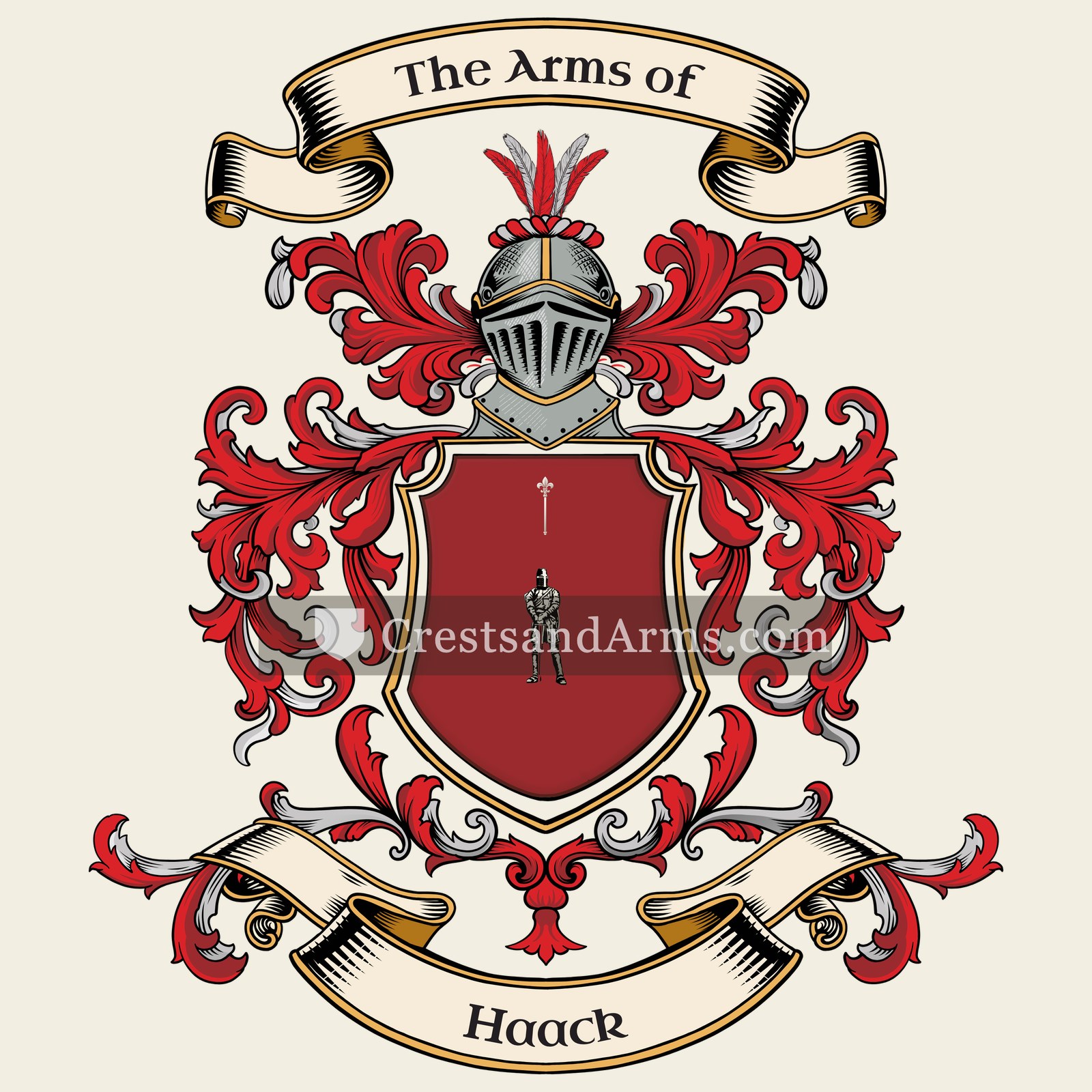
Symbols on this shield
knightChivalry and service in arms
batonAuthority and office held under the crown
Colours
Red (Gules)Means: Military strength
Historical info
Source
J. B. Rietstap, Armorial Général, Gouda: G. B. van Goor Zonen, 1884–87
Blazon (the actual original written record)
“De gu. à un homme iss., posé de profil, hab. d'azur, coiffé d'un bonnet du même, portant un croc sur son épaule. C.: un bouquetin iss. de gu.; entre un vol, coupé de gu sur azur.”
GermanyNördlingen Bav, c. 1765
Where the Haack Arms Were Recorded
Nördlingen
Map of Germany showing where the Haack arms are recorded
The Haack arms were recorded in Nördlingen Bav, c. 1765.
This is where the arms were entered in the register. Families often moved to other parts of the country, so the same name can turn up in more than one region.
The body that granted and recorded arms in Germany in this period.
Francis I, Holy Roman Emperor
Sovereign of the period
Francis I, Holy Roman Emperor
1745–1765
Reigning in Netherlands when the Haack arms are first recorded.
How Arms Worked in Germany
In the Holy Roman Empire, coats of arms were often granted to individuals by the Emperor or his representatives. These arms were then passed down through the generations to all legitimate descendants of the original holder. Younger branches of a family usually kept the same shield design without needing to change it, as the arms belonged to the entire lineage.
Granting authority
The Holy Roman Emperor held the sole power to grant new coats of arms throughout his vast imperial territories.
How they got arms
Families typically obtained their coats of arms through a formal imperial grant or by proving their noble status to the authorities.
Where arms were recorded
These grants were officially recorded in the Imperial Chancery registers, which began keeping formal records of such honors during the Middle Ages.
The family's standing
Recorded among the armigerous families of Germany.
Origin & History of the Haack Family in Germany
The surname Haack is a variation of the Middle High German word "hake," which translates to a hook or a curved tool. In the medieval period, names were often descriptive and referred to a person’s trade, a physical characteristic, or a specific landmark near their home. By the time the family was firmly established in the Bavarian town of Nördlingen in 1765, the name had already been in use for several centuries across German-speaking regions. Nördlingen was a significant center for trade and craftsmanship during the eighteenth century, and families like the Haacks often played roles in the local guilds or civic administration. Because the name was tied to common tools used in farming or blacksmithing, it likely originated among the working class who helped build the infrastructure of early German towns. Over generations, the family name became a permanent fixture in the local records of the region, reflecting the steady growth of middle-class families in the Holy Roman Empire.
Related Branches & Arms
Root word
Hage
A hedge, enclosure, or boundary made of bushes or trees.
This name
HaackA topographic name for someone who lived near a hedge or an enclosed piece of land.
also spelled
Haak
Hack
Hock
Related arms
Haakvariant spelling
Hackvariant spelling
van der Haakvariant spelling
Documented Sources
J. B. Rietstap, Armorial Général, Gouda: G. B. van Goor Zonen, 1884–87
Brabants Historisch Informatie Centrum (BHIC), Bevolkingsregister 's-Hertogenbosch
Nationaal Archief, Burgerlijke Stand van de provincie Noord-Brabant
Bakker, A., Nederlandse Familienamen: Herkomst en Betekenis, 1998
Van Driel, L., Geschiedenis van 's-Hertogenbosch: Van middeleeuwse stad tot moderne gemeente, 2005
Digital archive packCoat of arms PNG, gold border print PDF, vector SVG and the certificate of authenticity. Sent to your email in minutes.


 saltireResolution, and St Andrew's cross
 lozengeHonour and nobility, and the arms of a woman
 saltireResolution, and St Andrew's cross
 lozengeHonour and nobility, and the arms of a woman


 knightChivalry and service in arms
 batonAuthority and office held under the crown