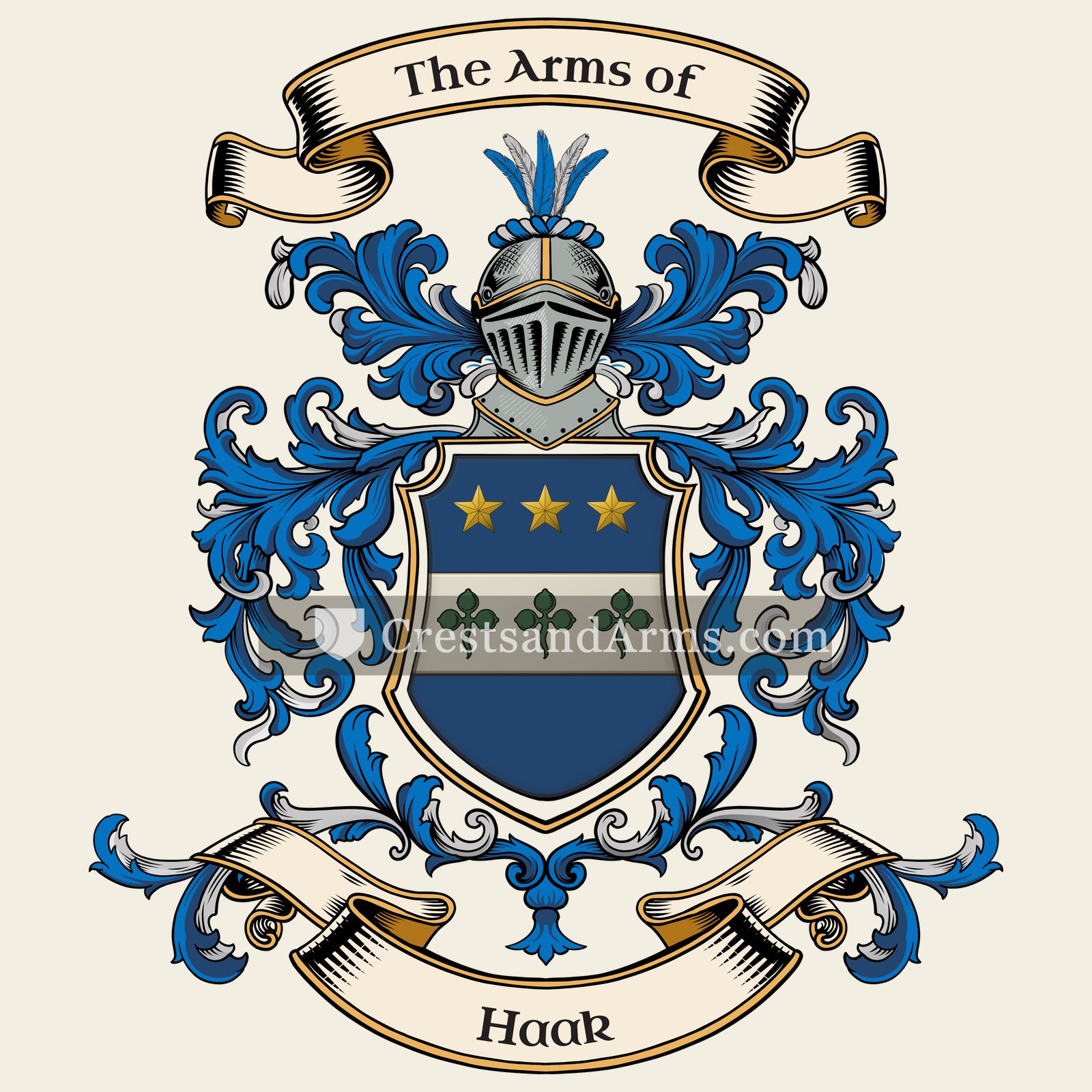
A record of documented arms, meaning and origin, researched for the Haak family of Netherlands.
Reg. 5025 · Dutch, G–I
Coat of Arms & Family Crest Details
Symbols on this shield
fessThe military belt, and readiness to serve
trefoilPerpetuity, and the Trinity
mulletThe third son, and a divine quality from above
Colours
Blue (Azure)Means: Loyalty and truth
Silver (Argent)Means: Peace and sincerity
Green (Vert)Means: Hope
Gold (Or)Means: Generosity
Historical info
Source
J. B. Rietstap, Armorial Général, Gouda: G. B. van Goor Zonen, 1884–87
Blazon (the actual original written record)
“D'azur à la fasce d'arg., ch. de trois trèfles de sin., et acc. en chef de trois étoiles d'or, posées 2 et 1.”
NetherlandsAmsterdam, c. 1815
Where the Haak Arms Were Recorded
Amsterdam
Map of Netherlands showing where the Haak arms are recorded
The Haak arms were recorded in Amsterdam, c. 1815.
This is where the arms were entered in the register. Families often moved to other parts of the country, so the same name can turn up in more than one region.
Region
Amsterdam
Town
Amsterdam
First recorded
1815
Granting Authority for the Haak Arms
Hoge Raad van Adel
Photograph made by me · CC BY-SA 3.0
The body that granted and recorded arms in Netherlands in this period.
William I of the Netherlands
Sovereign of the period
William I of the Netherlands
1815–1840
Reigning in Netherlands when the Haak arms are first recorded.
How Arms Worked in Netherlands
In the Netherlands, coats of arms were often used by noble families and those who held specific public offices. These arms were passed down through the generations to legitimate descendants. Younger branches of a family usually kept the original design without needing to add special marks. This system ensured that the family identity remained clear and consistent over many years.
Granting authority
The Hoge Raad van Adel is the official body that regulates and manages noble titles and coats of arms in the Netherlands.
How they got arms
Families typically obtained their coats of arms through official royal grants or by proving their long-standing historical use of the symbols.
Where arms were recorded
Coats of arms are officially recorded in the registers held by the Hoge Raad van Adel, which began its work in 1814.
The family's standing
Recorded among the armigerous families of Netherlands.
Origin & History of the Haak Family in Netherlands
The surname Haak is deeply rooted in the linguistic traditions of the Low Countries, where it originated as a descriptive name. In Middle Dutch, the word "haak" refers to a hook, which was often used as a nickname for a person who was physically thin or perhaps someone who worked with tools like a boat hook or a fishing implement. By the time the family was firmly established in Amsterdam in 1815, the name had transitioned from a simple nickname into a stable hereditary surname. During the early 19th century, Amsterdam was a bustling center of trade and maritime activity, and families like the Haaks were often integrated into the city’s growing merchant and artisan classes. As the Napoleonic era ended and the Kingdom of the Netherlands was formed, official civil registration became mandatory, which helped solidify the spelling and lineage of the Haak family within the city’s historical records.
Related Branches & Arms
Root word
hake
A Middle Dutch term referring to a hook or a curved object.
This name
HaakAn occupational name for a fisherman or someone who used a hook for trade.
also spelled
Haack
Hack
Hock
Related arms
Arentschildsimilar arms
Haackvariant spelling
Hackvariant spelling
Hakvariant spelling
Documented Sources
J. B. Rietstap, Armorial Général, Gouda: G. B. van Goor Zonen, 1884–87


 fessThe military belt, and readiness to serve
 trefoilPerpetuity, and the Trinity
 mulletThe third son, and a divine quality from above
 fessThe military belt, and readiness to serve
 trefoilPerpetuity, and the Trinity
 mulletThe third son, and a divine quality from above