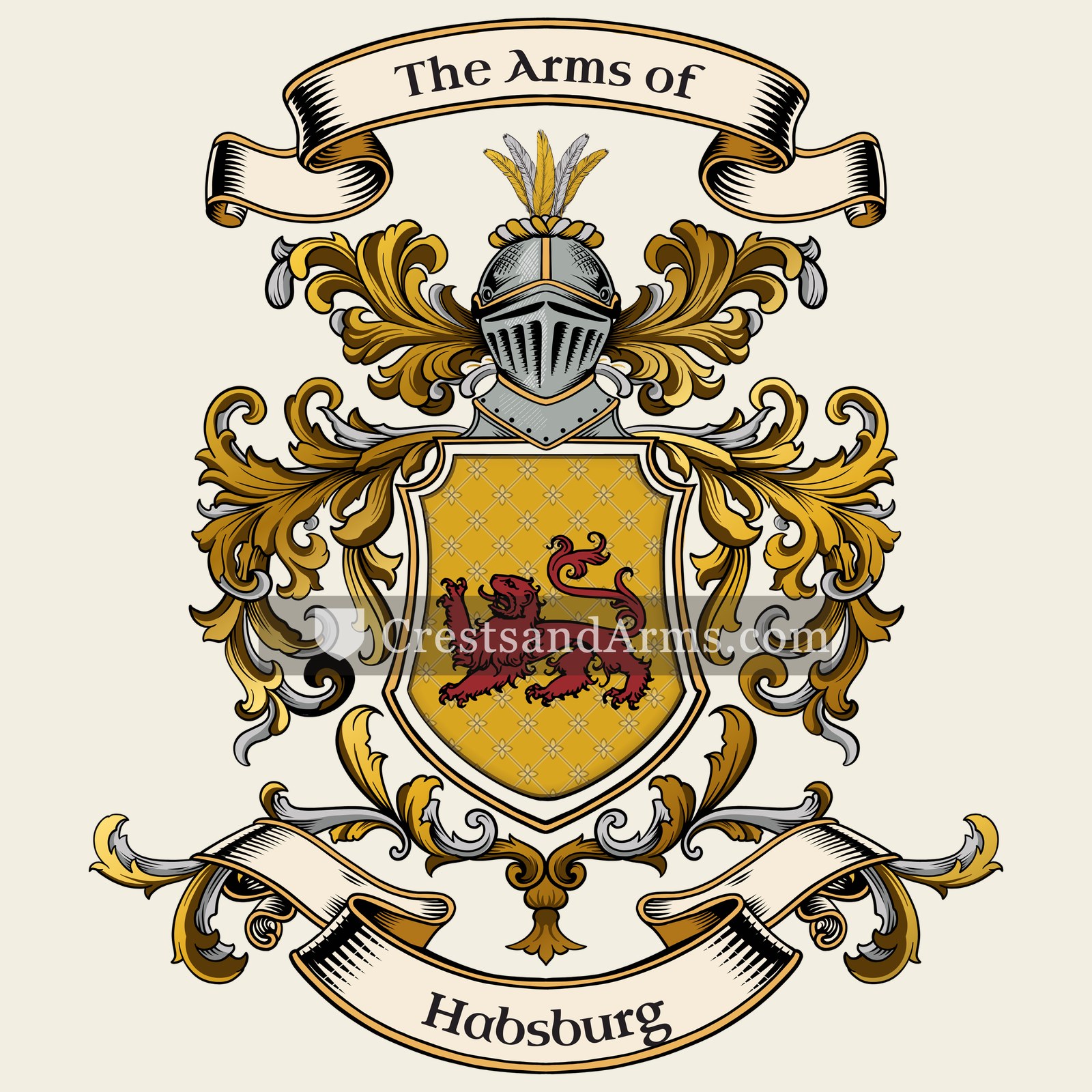
A record of documented arms, meaning and origin, researched for the Habsburg family of Germany.
Reg. 3682 · German, G–I
Coat of Arms & Family Crest Details
Symbols on this shield
lionCourage, strength and royalty
Colours
Gold (Or)Means: Generosity
Red (Gules)Means: Military strength
Historical info
Source
J. B. Rietstap, Armorial Général, Gouda: G. B. van Goor Zonen, 1884–87
Blazon (the actual original written record)
“D'or au lion de gu., arm., lamp. et cour. d'azur. Cq. cour. C.: deux têtes et cols de cygne d'arg., bq. de gu., tenant chacun en son bec une bague d'or (ou : le lion iss., orné le long du dos d'une crête échancrée d'or, ornée de plumes de paon.)”
Germanyc. 1725
Where the Habsburg Arms Were Recorded
Bavaria
Map of Germany showing where the Habsburg arms are recorded
The Habsburg arms were recorded in Germany, c. 1725.
Arms such as these were typically recorded in Bavaria.
Bavaria was a country of old landed families and walled market towns. Estates passed down the same line for centuries, and both the landowners and the leading townsmen kept arms, which is why so many Bavarian names sit in the registers.
This is where the arms were entered in the register. Families often moved to other parts of the country, so the same name can turn up in more than one region.
The body that granted and recorded arms in Germany in this period.
Charles VI, Holy Roman Emperor
Sovereign of the period
Charles VI, Holy Roman Emperor
1711–1740
Reigning in Germany when the Habsburg arms are first recorded.
How Arms Worked in Germany
In the Holy Roman Empire, coats of arms were often granted to individuals by the Emperor or his representatives. These arms were then passed down through the generations to all legitimate descendants of the original holder. Younger branches of a family usually kept the same shield design without needing to change it, as the arms belonged to the entire lineage.
Granting authority
The Holy Roman Emperor held the sole power to grant new coats of arms throughout his vast imperial territories.
How they got arms
Families typically obtained their coats of arms through a formal imperial grant or by proving their noble status to the authorities.
Where arms were recorded
These grants were officially recorded in the Imperial Chancery registers, which began keeping formal records of such honors during the Middle Ages.
The family's standing
Recorded among the armigerous families of Germany.
Origin & History of the Habsburg Family in Germany
The history of the Habsburg family began in the eleventh century in what is now Switzerland. The name comes from a fortress called Habsburg, which was built by a nobleman named Radbot around the year 1020. This castle was located on the banks of the Aare River. The family slowly gained power by acquiring land and forming strategic marriages throughout the region. While they are most famous for ruling large parts of Europe later on, their early ancestors were local counts who managed small territories. Over time, they expanded their influence from these humble beginnings in the Swiss countryside to become one of the most important dynasties in history. By the eighteenth century, branches of the family had established themselves in various parts of the Holy Roman Empire, including regions within Bavaria, where they continued to hold significant social and political status.
Related Branches & Arms
Root word
Habichtsburg
A fortress named after the hawk.
This name
HabsburgDerived from a castle in Switzerland, signifying the hawk's castle or stronghold.
also spelled
Hapsburg
Habsbourg
Documented Sources
J. B. Rietstap, Armorial Général, Gouda: G. B. van Goor Zonen, 1884–87
Wheatcroft, Andrew. The Habsburgs: Embodying Empire. 1995
Vocelka, Karl and Lynne Heller. Die Lebenswelt der Habsburger: Kultur- und Mentalitätsgeschichte einer Familie. 1997
Austrian State Archive (Österreichisches Staatsarchiv), Haus-, Hof- und Familienarchiv
Digital archive packCoat of arms PNG, gold border print PDF, vector SVG and the certificate of authenticity. Sent to your email in minutes.


 lionCourage, strength and royalty
 lionCourage, strength and royalty