Map of Netherlands showing where the Hack arms are recorded
The Hack arms were recorded in Amsterdam, c. 1815.
This is where the arms were entered in the register. Families often moved to other parts of the country, so the same name can turn up in more than one region.
Region
Amsterdam
Town
Amsterdam
First recorded
1815
Granting Authority for the Hack Arms
Hoge Raad van Adel
Photograph made by me · CC BY-SA 3.0
The body that granted and recorded arms in Netherlands in this period.
William I of the Netherlands
Sovereign of the period
William I of the Netherlands
1815–1840
Reigning in Netherlands when the Hack arms are first recorded.
How Arms Worked in Netherlands
In the Netherlands, coats of arms were often used by noble families and those who held specific public offices. These arms were passed down through the generations to legitimate descendants. Younger branches of a family usually kept the original design without needing to add special marks. This system ensured that the family identity remained clear and consistent over many years.
Granting authority
The Hoge Raad van Adel is the official body that regulates and manages noble titles and coats of arms in the Netherlands.
How they got arms
Families typically obtained their coats of arms through official royal grants or by proving their long-standing historical use of the symbols.
Where arms were recorded
Coats of arms are officially recorded in the registers held by the Hoge Raad van Adel, which began its work in 1814.
The family's standing
Recorded among the armigerous families of Netherlands.
Origin & History of the Hack Family in Netherlands
The family name Hack has deep roots in the Netherlands, where it emerged as a descriptive surname during the centuries when fixed family names were becoming standard. In the Dutch language, the term "hack" or "hak" often related to someone who worked with an axe, suggesting that early ancestors may have been woodcutters or skilled craftsmen in the timber industry. By the time the family was firmly established in Amsterdam in 1815, the city was a bustling center of trade and migration. During this period, the Napoleonic era had recently ended, and the Dutch government began enforcing stricter civil registration laws to track its citizens. Families like the Hacks were part of this growing urban population that helped shape the economic life of the capital. As the family settled into life in Amsterdam, they became part of the city's long tradition of record-keeping, which allows us to trace their presence through the transition from the French occupation to the formation of the United Kingdom of the Netherlands.
Coat of Arms & Family Crest Details
Symbols on this shield
mountThe ground held, and steadfastness upon it
armA person of action, industrious and laborious
mulletThe third son, and a divine quality from above
saracens head affronty coupedA crusade fought, and an enemy met in the field
eagleNobility, strength and a keen mind
Colours
Blue (Azure)Means: Loyalty and truth
Gold (Or)Means: Generosity
Black (Sable)Means: Constancy
Historical info
Source
J. B. Rietstap, Armorial Général, Gouda: G. B. van Goor Zonen, 1884–87
Blazon (the actual original written record)
“D'azur à un bras, brandissant un cimeterre, le tout au nat., iss. d'un tertre de sa., acc. en chef d'une étoile d'or, et accosté de deux têtes de Turc affr. de carn., coiffées de turbans au nat., mouv. des flancs; le champ chapé-ployé d'or, à deux aigles de sa., celle à dextre posée en barre et celle à sen. en bande. Cq. cour. C.: le bras, entre deux prob. d'azur. L. d'arg. et de gu.”
Germanyc. 1765
Digital archive packCoat of arms PNG, gold border print PDF, vector SVG and the certificate of authenticity. Sent to your email in minutes.
Map of Germany showing where the Hack arms are recorded
The Hack arms were recorded in Germany, c. 1765.
Arms such as these were typically recorded in Bavaria.
Bavaria was a country of old landed families and walled market towns. Estates passed down the same line for centuries, and both the landowners and the leading townsmen kept arms, which is why so many Bavarian names sit in the registers.
This is where the arms were entered in the register. Families often moved to other parts of the country, so the same name can turn up in more than one region.
The body that granted and recorded arms in Germany in this period.
Francis I, Holy Roman Emperor
Sovereign of the period
Francis I, Holy Roman Emperor
1745–1765
Reigning in Netherlands when the Hack arms are first recorded.
How Arms Worked in Germany
In the Holy Roman Empire, coats of arms were often granted to individuals by the Emperor or his representatives. These arms were then passed down through the generations to all legitimate descendants of the original holder. Younger branches of a family usually kept the same shield design without needing to change it, as the arms belonged to the entire lineage.
Granting authority
The Holy Roman Emperor held the sole power to grant new coats of arms throughout his vast imperial territories.
How they got arms
Families typically obtained their coats of arms through a formal imperial grant or by proving their noble status to the authorities.
Where arms were recorded
These grants were officially recorded in the Imperial Chancery registers, which began keeping formal records of such honors during the Middle Ages.
The family's standing
Recorded among the armigerous families of Germany.
Origin & History of the Hack Family in Germany
The surname Hack is rooted in the linguistic traditions of the German language, where it likely originated as a descriptive name for a person who worked with a hoe or a similar agricultural tool. In the context of medieval Germany, such names were often given to individuals based on their primary occupation or a specific physical trait. By the time members of the family were documented in Bavaria in 1765, the name had already been established for generations within the local community. Families during this period were often tied to the land, and the name Hack reflects a long history of agrarian life in the southern German regions. As the family grew, they became part of the social fabric of their villages, contributing to the agricultural and economic development of the Bavarian countryside. These early ancestors lived through a time of significant change in the Holy Roman Empire, where local records began to track the movement and growth of families with greater precision.
Coat of Arms & Family Crest Details
Symbols on this shield
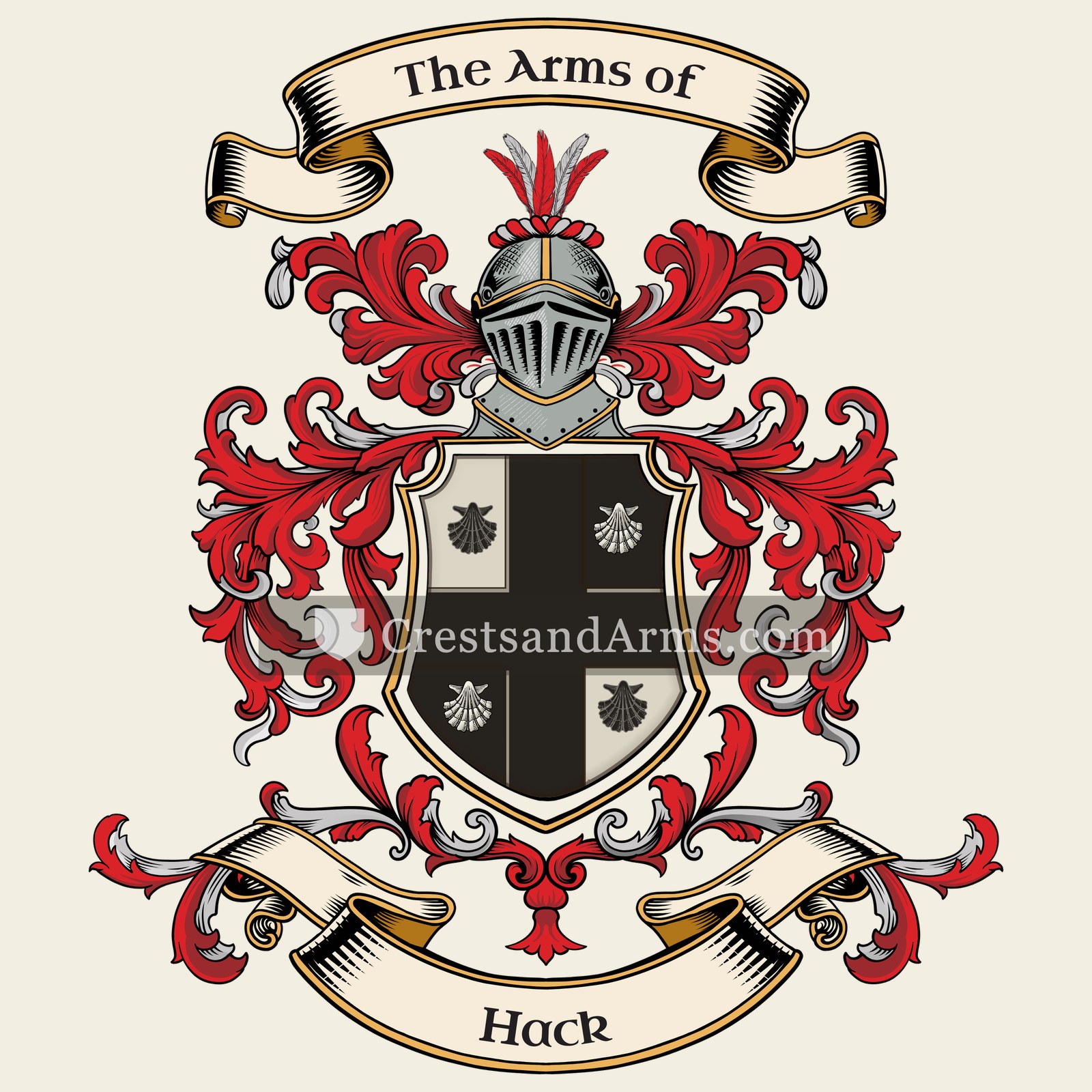
cross symbolChristian faith and service
escallopThe pilgrim's shell, and a long journey made
Colours
Silver (Argent)Means: Peace and sincerity
Black (Sable)Means: Constancy
Historical info
Source
Sir Bernard Burke, The General Armory of England, Scotland, Ireland and Wales, London: Harrison & Sons, 1884
Blazon (the actual original written record)
“Quarterly, ar. and sa. a cross betw. four escallops counterchanged”
EssexEssex, c. 1620
Digital archive packCoat of arms PNG, gold border print PDF, vector SVG and the certificate of authenticity. Sent to your email in minutes.
Map of England showing where the Hack arms are recorded
The Hack arms were recorded in Essex, c. 1620.
Essex lay close enough to London for City money to buy land there. Merchants who prospered moved out to estates within a day's ride, and a new landowner almost always wanted arms to go with the ground.
This is where the arms were entered in the register. Families often moved to other parts of the country, so the same name can turn up in more than one region.
The body that granted and recorded arms in England in this period.
James VI and I
Sovereign of the period
James VI and I
1603–1625
Reigning in Netherlands when the Hack arms are first recorded.
How Arms Worked in England
English heraldry allowed arms to be shared by all legitimate descendants of the original owner. These symbols were treated as personal property that moved through the generations to all children. While the eldest son kept the original design, other family members could use the same shield without needing to change it or register their own unique versions.
Granting authority
The College of Arms in London has regulated the use of coats of arms throughout England and Wales since 1484.
How they got arms
Families typically obtained their coats of arms through a formal grant from the Crown or by proving their ancient right to them.
Where arms were recorded
All official coats of arms are recorded in the registers kept at the College of Arms, which date back to the fifteenth century.
The family's standing
Recorded among the armigerous families of Essex.
Origin & History of the Hack Family in England
The surname Hack is rooted in the linguistic traditions of medieval England, where it likely originated as a descriptive nickname or a locational identifier. Many early families with this name were associated with the agricultural landscapes of East Anglia, particularly within the county of Essex. By the early seventeenth century, the Hack family had established a clear presence in this region, as evidenced by records from 1620. During this period, the name was often linked to individuals who worked the land or lived near specific topographical features like hedges or clearings. As the family grew, they became part of the local social fabric, contributing to the rural economy and community life of Essex. Their history reflects the broader patterns of English migration and settlement, where families remained tied to their ancestral counties for generations while adapting to the changing demands of English society.
Hack Meaning & Related Branches
Root word
Hake
A Germanic term referring to a hook or a curved object.
This name
HackAn occupational name for a maker of hooks or a nickname for a person with a hooked nose.
also spelled
Hacke
Hac
Hake
Related arms
Palladinichsimilar arms
Welcksimilar arms
Haackvariant spelling
Haakvariant spelling
Documented Sources
J. B. Rietstap, Armorial Général, Gouda: G. B. van Goor Zonen, 1884–87
Meertens, P.J., De betekenis van de Nederlandse familienamen, 1958
Van der Schaar, J., Woordenboek van voornamen, 1964


 wheatsheafPlenty, and the harvest of one's own labour
 wheatsheafPlenty, and the harvest of one's own labour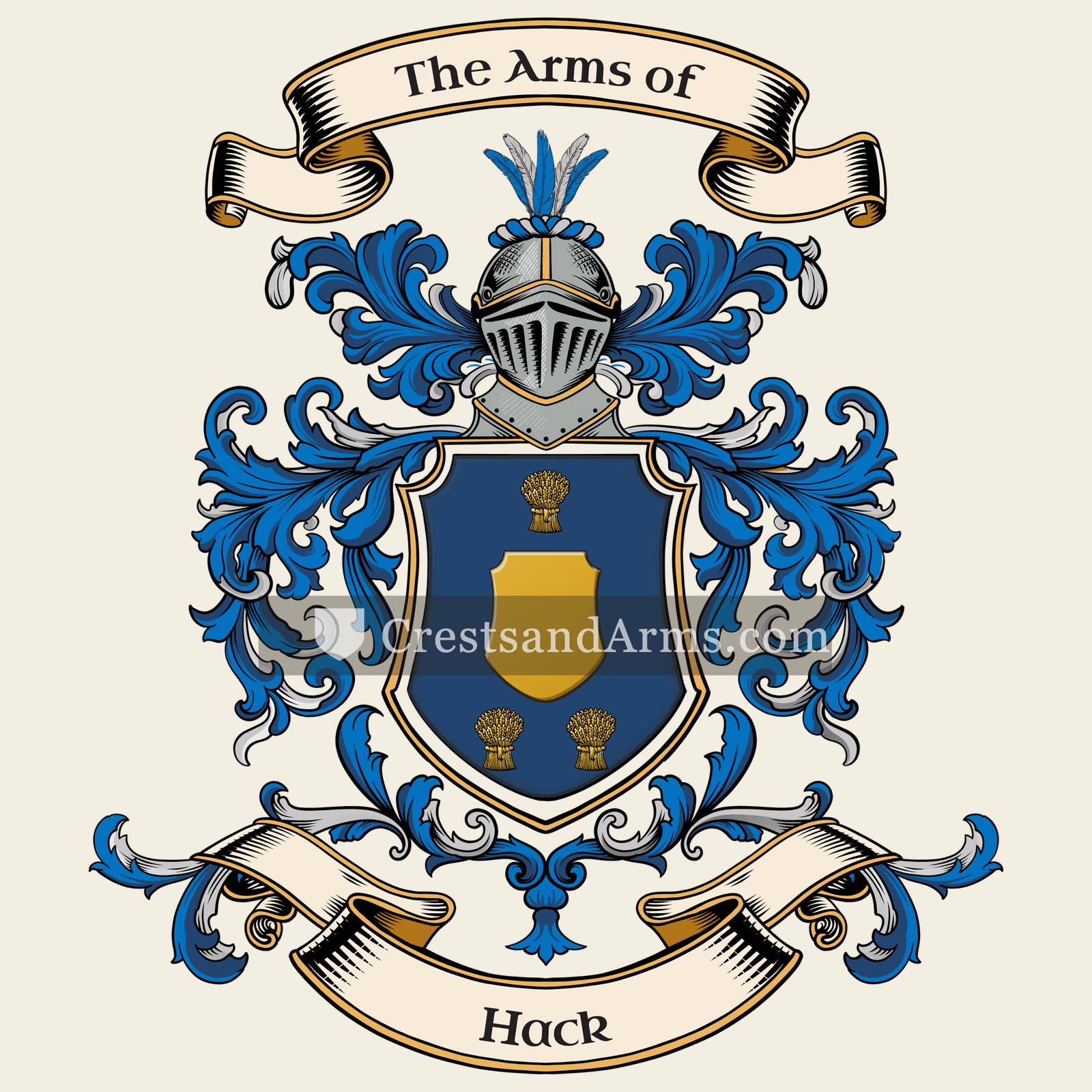


 mountThe ground held, and steadfastness upon it
 armA person of action, industrious and laborious
 mulletThe third son, and a divine quality from above
 saracens head affronty coupedA crusade fought, and an enemy met in the field
 eagleNobility, strength and a keen mind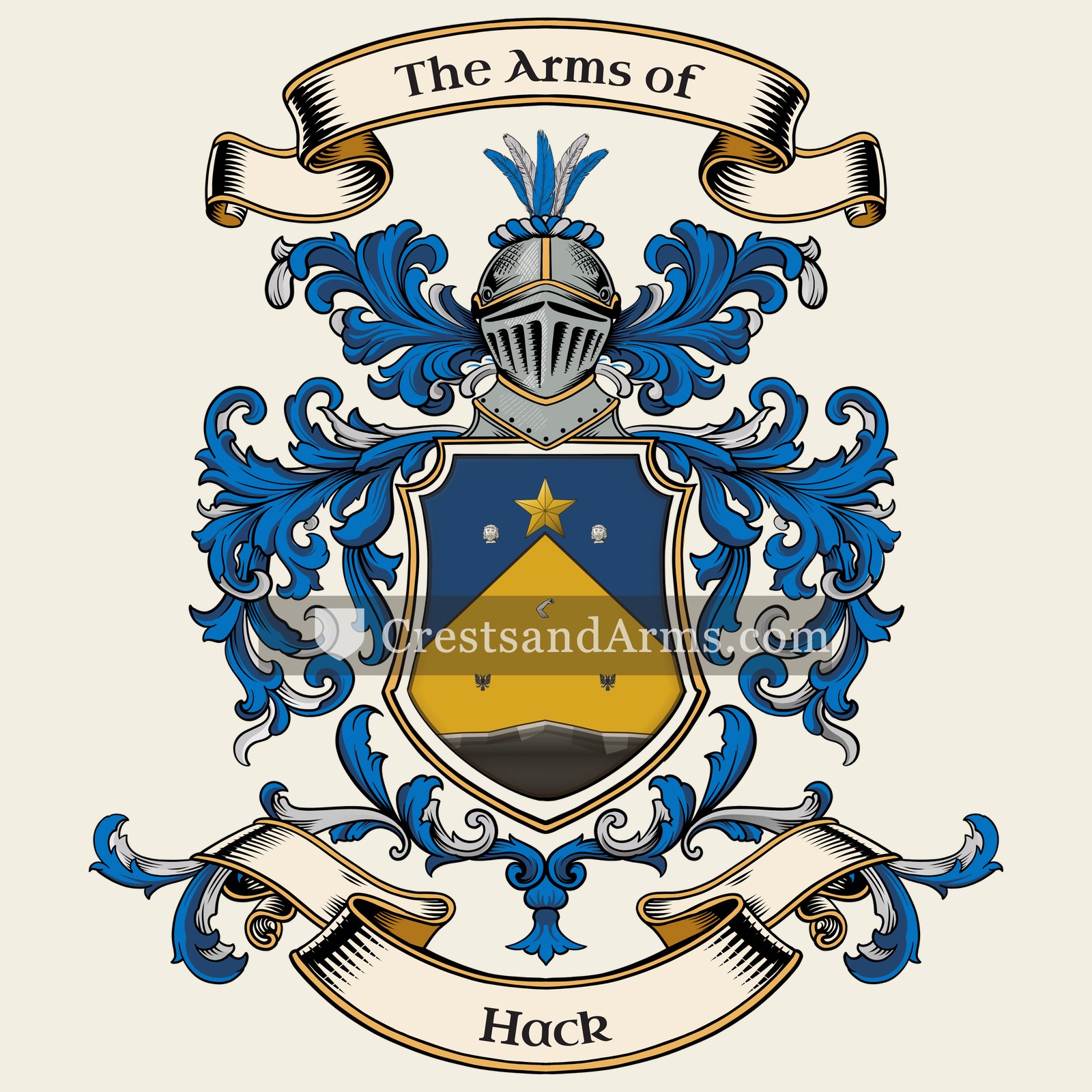


 cross symbolChristian faith and service
 escallopThe pilgrim's shell, and a long journey made