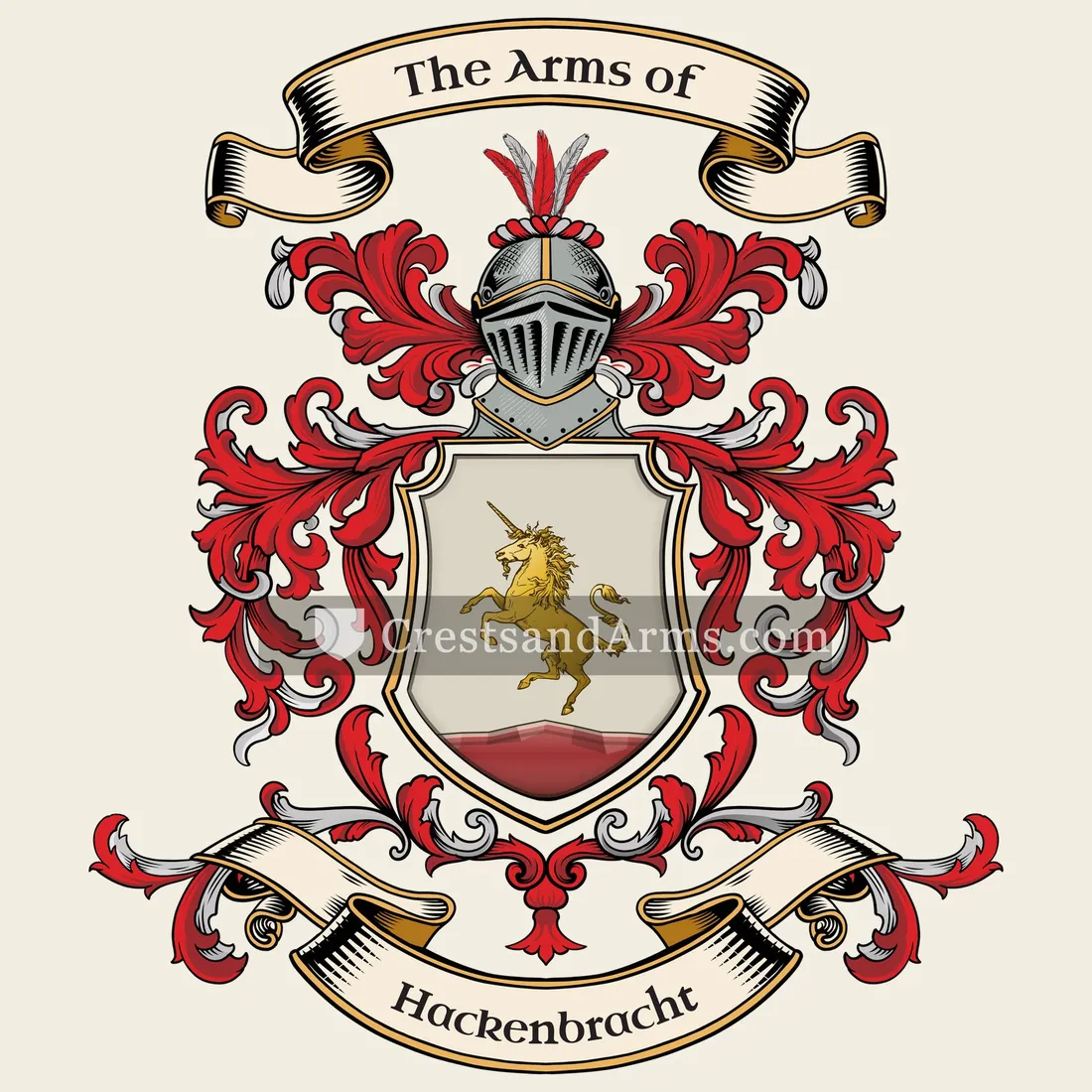
A record of documented arms, meaning and origin, researched for the Hackenbracht family of Switzerland.
Reg. 2125 · Swiss, G–I
Meaning of the Hackenbracht family crest colors & symbols
Symbols on this shield
mountThe ground held, and steadfastness upon it
unicornPurity, and extreme courage in defence of honour
Colours
Silver (Argent)Means: Peace and sincerity
Red (Gules)Means: Military strength
Gold (Or)Means: Generosity
Historical info
Source
J. B. Rietstap, Armorial Général, Gouda: G. B. van Goor Zonen, 1884–87
Blazon (the actual original written record)
“D'arg. à une licorne saillante d'or, iss. d'un rang de dix peupliers de sin. à sen., le tout soutenu d'un tertre de gu. Brl. de gu. et d'or. C.: un licorne iss. d'or. L. d'or et de gu.”
SwitzerlandBâte, c. 1745
Digital archive packCoat of arms PNG, gold border print PDF, vector SVG and the certificate of authenticity. Sent to your email in minutes.
Map of Switzerland showing where the Hackenbracht arms are recorded
The Hackenbracht arms were recorded in Bâte, c. 1745.
This is where the arms were entered in the register. Families often moved to other parts of the country, so the same name can turn up in more than one region.
The body that granted and recorded arms in Switzerland in this period.
How Arms Worked in Switzerland
In Switzerland, coats of arms were not restricted to the nobility and were often adopted by common citizens and families. These symbols were passed down through generations to show family identity. When branches of a family grew, they often changed small details of the design to distinguish their own line from the original group.
Granting authority
Cantonal and civic authorities managed the use of coats of arms within their specific regions and local jurisdictions.
How they got arms
Families typically assumed their own coats of arms based on local custom rather than receiving them from a central monarch.
Where arms were recorded
Arms were recorded in various cantonal and civic registers starting from the fourteenth century throughout the Swiss region.
The family's standing
Recorded among the armigerous families of Switzerland.
Origin & History of the Hackenbracht Family in Switzerland
The family name Hackenbracht is deeply rooted in the historical landscape of the Alsace region, where records confirm the family was well-established in the village of Bâte by 1745. The name itself is likely of Germanic origin, following a linguistic pattern common to the Upper Rhine area where surnames were often derived from specific occupations or descriptive traits. During the mid-18th century, families in this region were typically tied to the land, working as farmers, vintners, or skilled craftsmen in small village communities. Life in Bâte during this period was defined by the rhythms of the agricultural seasons and the influence of local parish administration. As the family grew, they became part of the social fabric of the borderlands, navigating the complex political shifts that defined the history of the Alsace territory throughout the 1700s.
Hackenbracht Meaning & Related Branches
Root word
Hacken-bracht
To chop or cut and to bring or produce.
This name
HackenbrachtA topographic or occupational name referring to someone who clears land by chopping wood.
also spelled
Hagenbak
Hagenbachh
Hagenbache
Hagenbahk
Documented Sources
J. B. Rietstap, Armorial Général, Gouda: G. B. van Goor Zonen, 1884–87
Archives Départementales du Bas-Rhin, Registres paroissiaux de Bâte (1745)
Barth, Médard, Handbuch der elsässischen Kirchengeschichte, 1960
Stoltz, André, Histoire de l'Alsace, 1974
Digital archive packCoat of arms PNG, gold border print PDF, vector SVG and the certificate of authenticity. Sent to your email in minutes.


 mountThe ground held, and steadfastness upon it
 unicornPurity, and extreme courage in defence of honour
 mountThe ground held, and steadfastness upon it
 unicornPurity, and extreme courage in defence of honour