Map of Britain showing where the Hadi arms are recorded
The Hadi arms were recorded in Kent, c. 1700.
Kent sits between London and the short crossing to Europe, and the trade passing through made it wealthy. Merchant families bought land with that money, and it was landowners who took coats of arms.
This is where the arms were entered in the register. Families often moved to other parts of the country, so the same name can turn up in more than one region.
The body that granted and recorded arms in Britain in this period.
William III of England
Sovereign of the period
William III of England
1694–1702
Reigning in Britain when the Hadi arms are first recorded.
How Arms Worked in Britain
English heraldry allowed arms to be shared by all legitimate descendants of the original owner. These symbols were treated as personal property that moved through the generations to all children. While the eldest son kept the original design, other family members could use the same shield without needing to change it or register their own unique versions.
Granting authority
The College of Arms in London has regulated the use of coats of arms throughout England and Wales since 1484.
How they got arms
Families typically obtained their coats of arms through a formal grant from the Crown or by proving their ancient right to them.
Where arms were recorded
All official coats of arms are recorded in the registers kept at the College of Arms, which date back to the fifteenth century.
The family's standing
Recorded among the armigerous families of Kent.
Origin & History of the Hadi Family in Britain
The family name Hadi has roots that stretch back to the early eighteenth century in the county of Kent. During this period, Kent was a bustling region shaped by its proximity to London and its role as a gateway to the European continent. Families living in this area often worked in agriculture or trade, benefiting from the fertile land and the busy ports that connected the region to international markets. By the year 1700, the presence of the Hadi name in local records suggests that these early members were integrated into the social and economic life of their rural parishes. As the family established themselves in the English countryside, they likely adapted to the local customs and traditions of the time. This era was marked by significant social change, and the Hadi family would have witnessed the slow transition toward the industrial advancements that would eventually define the modern age in Britain.
Meaning of the Hadi family crest colors & symbols
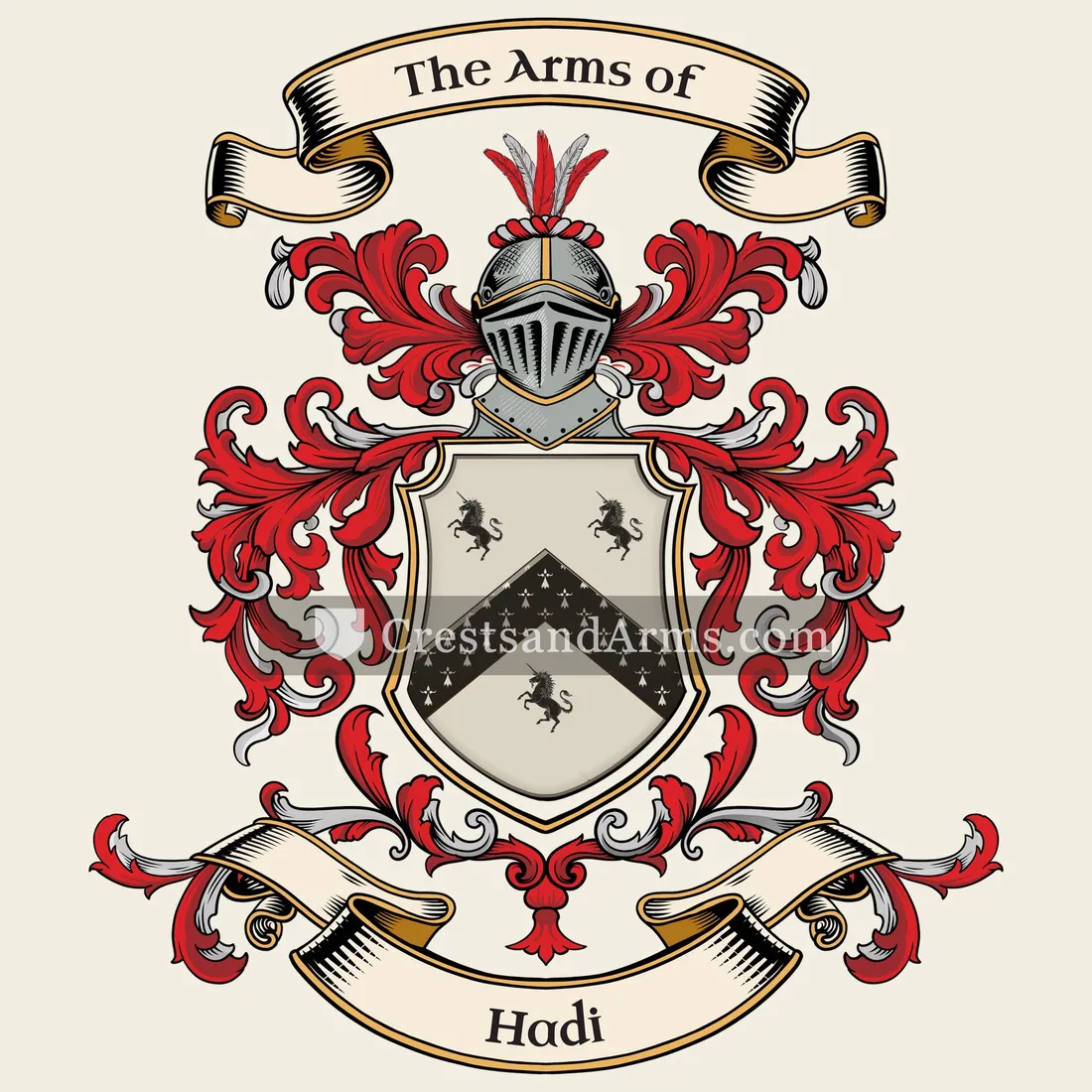
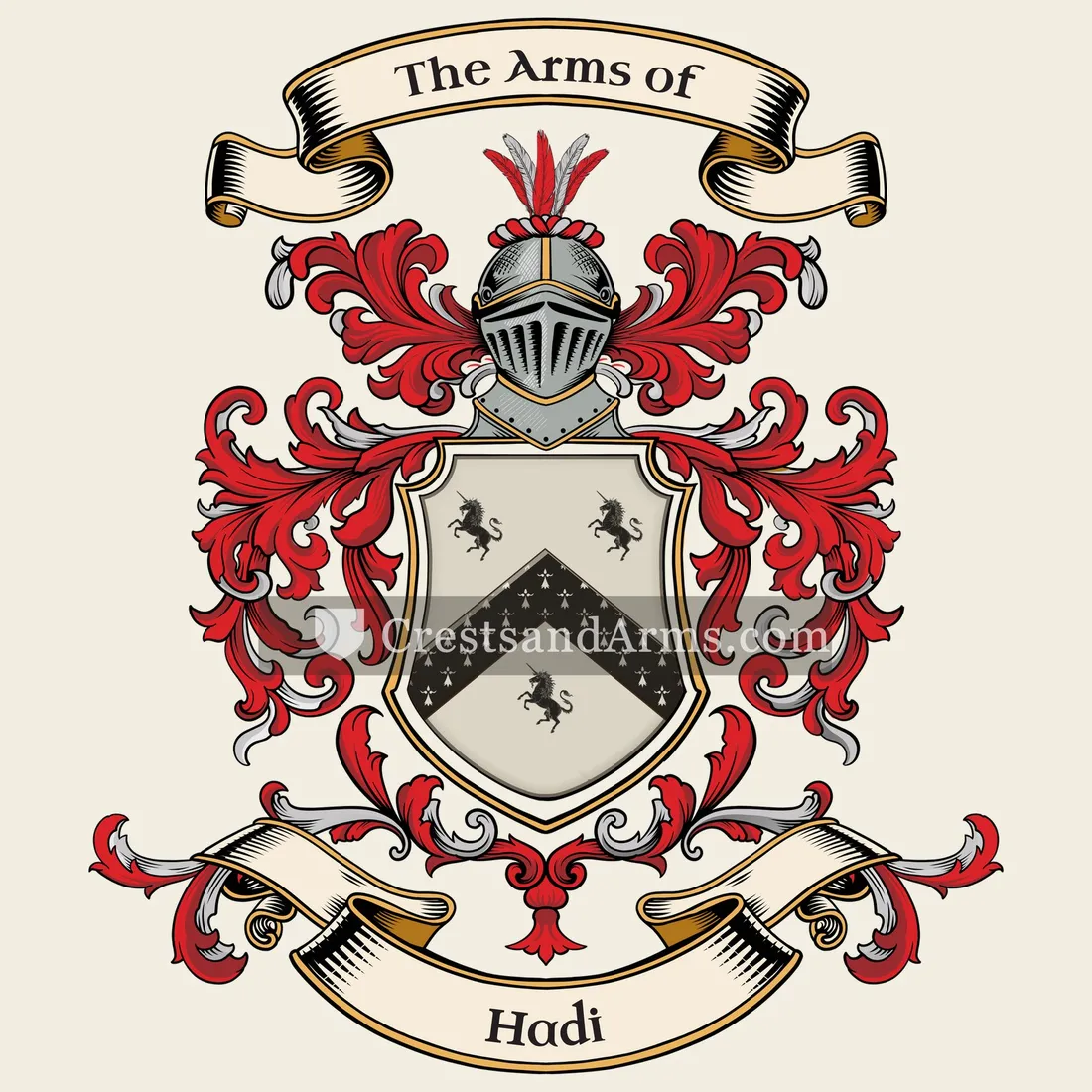
Symbols on this shield
chevronProtection, and faithful service completed
ermineDignity and rank
unicornPurity, and extreme courage in defence of honour
Colours
Silver (Argent)Means: Peace and sincerity
Counter-ermine (Ermines)Means: Dignity
Black (Sable)Means: Constancy
Historical info
Source
Sir Bernard Burke, The General Armory of England, Scotland, Ireland and Wales, London: Harrison & Sons, 1884
Blazon (the actual original written record)
“Ar. a chev. ermines betw. three unicorns' heads couped sa”
KentHermitage · Kent, c. 1620
Digital archive packCoat of arms PNG, gold border print PDF, vector SVG and the certificate of authenticity. Sent to your email in minutes.
Map of England showing where the Hadi arms are recorded
The Hadi arms were recorded in Kent, c. 1620.
Kent sits between London and the short crossing to Europe, and the trade passing through made it wealthy. Merchant families bought land with that money, and it was landowners who took coats of arms.
This is where the arms were entered in the register. Families often moved to other parts of the country, so the same name can turn up in more than one region.
The body that granted and recorded arms in England in this period.
James VI and I
Sovereign of the period
James VI and I
1603–1625
Reigning in Britain when the Hadi arms are first recorded.
How Arms Worked in England
English heraldry allowed arms to be shared by all legitimate descendants of the original owner. These symbols were treated as personal property that moved through the generations to all children. While the eldest son kept the original design, other family members could use the same shield without needing to change it or register their own unique versions.
Granting authority
The College of Arms in London has regulated the use of coats of arms throughout England and Wales since 1484.
How they got arms
Families typically obtained their coats of arms through a formal grant from the Crown or by proving their ancient right to them.
Where arms were recorded
All official coats of arms are recorded in the registers kept at the College of Arms, which date back to the fifteenth century.
The family's standing
Recorded among the armigerous families of Kent.
Origin & History of the Hadi Family in England
The history of the Hadi name in England begins with a small but established presence in the county of Kent by the year 1620. During this period, Kent was a bustling region shaped by its proximity to London and its role as a gateway for trade across the English Channel. Families living in this area often worked in agriculture, local crafts, or maritime industries that supported the growing economy of the seventeenth century. While the name Hadi is often associated with diverse origins, its appearance in early modern English records suggests that these individuals were part of the local parish communities that formed the backbone of English society at the time. These early settlers likely navigated the social and religious changes of the Stuart era while maintaining their family identity within the rural landscape of Kent. By participating in local church life and community trade, the early Hadi family members helped weave their name into the historical fabric of the region.
Hadi Meaning & Related Branches
Root word
Hada
An Arabic verb meaning to guide or lead to the right path.
This name
HadiA title referring to one who guides others toward righteousness and divine truth.
also spelled
Heade
Hedde
Heed
Hed
Hede
Documented Sources
J. B. Rietstap, Armorial Général, Gouda: G. B. van Goor Zonen, 1884–87
Kent Archives, Archdeaconry Court of Canterbury, Probate Records, 1700
The National Archives, Parish Register Transcripts of Kent, 1700
Digital archive packCoat of arms PNG, gold border print PDF, vector SVG and the certificate of authenticity. Sent to your email in minutes.


 chevronProtection, and faithful service completed
 unicornPurity, and extreme courage in defence of honour
 chevronProtection, and faithful service completed
 unicornPurity, and extreme courage in defence of honour


 ermineDignity and rank