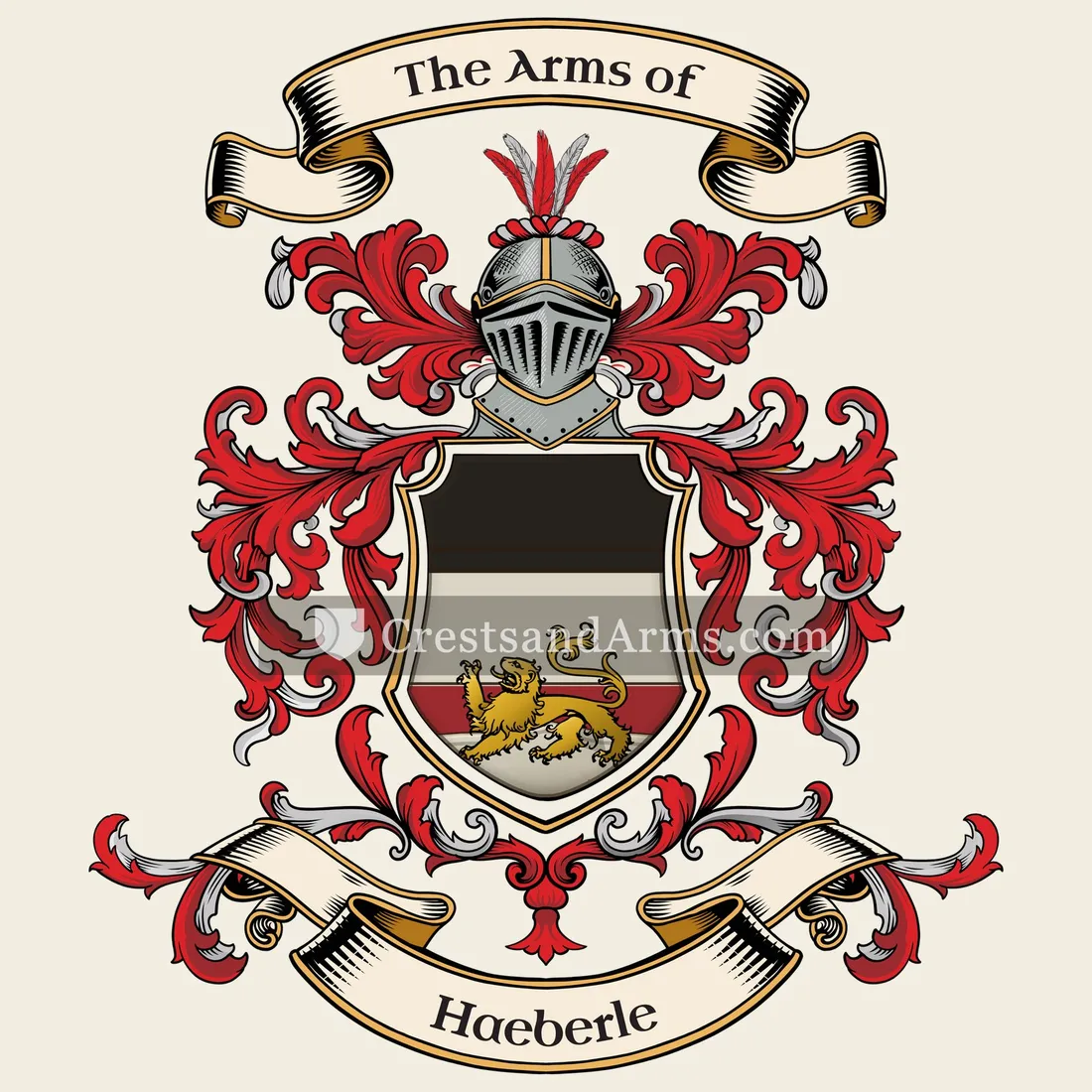
A record of documented arms, meaning and origin, researched for the Haeberle family of Austria.
Reg. 7342 · Austrian, G–I
Meaning of the Haeberle family crest colors & symbols
Symbols on this shield
mountThe ground held, and steadfastness upon it
chiefAuthority, wisdom and dominion
lionCourage, strength and royalty
Colours
Black (Sable)Means: Constancy
Silver (Argent)Means: Peace and sincerity
Red (Gules)Means: Military strength
Gold (Or)Means: Generosity
Historical info
Source
J. B. Rietstap, Armorial Général, Gouda: G. B. van Goor Zonen, 1884–87
Blazon (the actual original written record)
“De sa. au lion d'or, tenant une branche feuillée de sin., et soutenu d'un tertre d'arg.; le champ chapé-ployé d'un tiercé en fasce d'or, d'arg. et de gu. Au chef de l'écu de sa. Cq. cour. C.: le lion, iss.; entre deux prob. coupées, à dextre de gu. sur arg., à sen. d'or sur sa. L.: à dextre d'or et de sa., à sen. d'arg. et de gu.”
StyriaStyria, c. 1772
Digital archive packCoat of arms PNG, gold border print PDF, vector SVG and the certificate of authenticity. Sent to your email in minutes.
Map of Austria showing where the Haeberle arms are recorded
The Haeberle arms were recorded in Styria, c. 1772.
Styria was mountain and forest country in southern Austria, with iron in its hills. Mining and landholding both made money, and families who held either kind of property took arms to seal their papers with.
This is where the arms were entered in the register. Families often moved to other parts of the country, so the same name can turn up in more than one region.
Region
Styria
First recorded
1772
Granting Authority for the Haeberle Arms
Imperial and Royal chancery
Sodacan · CC BY-SA 3.0
The body that granted and recorded arms in Austria in this period.
Joseph II, Holy Roman Emperor
Sovereign of the period
Joseph II, Holy Roman Emperor
1765–1790
Reigning in Austria when the Haeberle arms are first recorded.
How Arms Worked in Austria
Austrian coats of arms were often linked directly to noble titles granted by the Emperor. These symbols belonged to the entire family line rather than just one individual. When a family grew, new branches kept the original design without needing to change it. This system allowed all members of a noble house to share the same identity across many generations.
Granting authority
The Imperial and Royal chancery managed all heraldic matters and controlled the official granting of arms throughout the Austrian lands.
How they got arms
Families typically received their arms through a formal imperial decree that often accompanied the elevation of a person to noble status.
Where arms were recorded
Official records of these grants were kept in the Imperial Register of Nobility which began its formal documentation process in 1453.
The family's standing
Recorded among the armigerous families of Styria.
Origin & History of the Haeberle Family in Austria
The surname Haeberle originates from the German-speaking regions of Central Europe and functions as a diminutive form of the name Habert or Herbert. Historically, names ending in the suffix "le" were common in southern German dialects to indicate affection or to describe a younger member of a family. By the late 18th century, the family established a notable presence in the region of Styria, which is located in modern-day Austria. Records from 1772 confirm that members of the family were living and working within this mountainous area during a time of significant agricultural and social transition. As the family grew, they integrated into the local community life of the Styrian countryside, likely contributing to the regional economy through farming or skilled trades. This period marks a clear point in history where the family name became firmly rooted in the local records of the Austrian Empire.
Haeberle Meaning & Related Branches
Root word
Haber
German word for oats
This name
HaeberleA diminutive form referring to a small-scale oat farmer or merchant.
also spelled
Haberlere
Documented Sources
J. B. Rietstap, Armorial Général, Gouda: G. B. van Goor Zonen, 1884–87
Bahlow, Hans, Deutsches Namenlexikon: Familien- und Vornamen nach Ursprung und Sinn erklärt, 1967
Heintze, Albert, Die deutschen Familien-Namen: geschichtlich, geographisch, sprachlich, 1903
Steiermärkisches Landesarchiv, Styrian Census and Tax Records (Steuerkataster), 1772
Digital archive packCoat of arms PNG, gold border print PDF, vector SVG and the certificate of authenticity. Sent to your email in minutes.


 mountThe ground held, and steadfastness upon it
 chiefAuthority, wisdom and dominion
 lionCourage, strength and royalty
 mountThe ground held, and steadfastness upon it
 chiefAuthority, wisdom and dominion
 lionCourage, strength and royalty