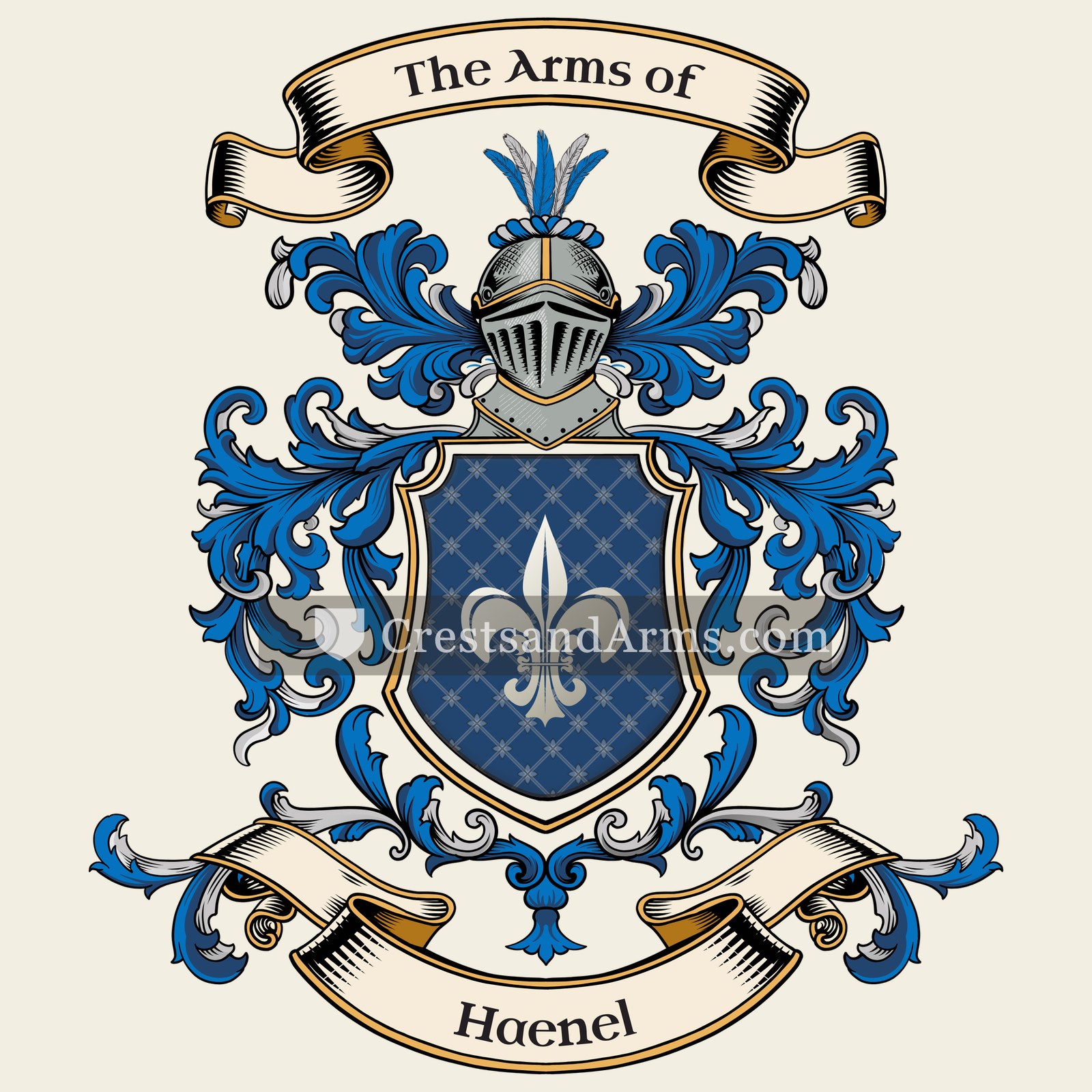
A record of documented arms, meaning and origin, researched for the Haenel family of Germany.
Reg. 9686 · German, G–I
Coat of Arms & Family Crest Details
Symbols on this shield
fleur de lisPurity, light, and the sixth son
Colours
Blue (Azure)Means: Loyalty and truth
Silver (Argent)Means: Peace and sincerity
Historical info
Source
J. B. Rietstap, Armorial Général, Gouda: G. B. van Goor Zonen, 1884–87
Blazon (the actual original written record)
“D'azur à une fleur-de-lis d'arg. C.: un coq d'arg.; entre un vol, d'azur et d'arg.”
Germanyc. 1868
Where the Haenel Arms Were Recorded
Bavaria
Map of Germany showing where the Haenel arms are recorded
The Haenel arms were recorded in Germany, c. 1868.
Arms such as these were typically recorded in Bavaria.
Bavaria was a country of old landed families and walled market towns. Estates passed down the same line for centuries, and both the landowners and the leading townsmen kept arms, which is why so many Bavarian names sit in the registers.
This is where the arms were entered in the register. Families often moved to other parts of the country, so the same name can turn up in more than one region.
The body that granted and recorded arms in Germany in this period.
Wilhelm I
Sovereign of the period
Wilhelm I
1861–1888
Reigning in Germany when the Haenel arms are first recorded.
How Arms Worked in Germany
Prussian heraldry was strictly tied to social rank and noble status rather than being a free choice for every citizen. These symbols were treated as permanent family property that moved through the generations to all legitimate heirs. If a family branch wanted to change their design to stand out, they had to apply for official permission to alter their specific version of the shield.
Granting authority
The Prussian Heroldsamt acted as the central state office that managed and strictly controlled all noble titles and coats of arms.
How they got arms
Families usually obtained their arms through formal royal grants or by proving their long-standing noble status to the state authorities.
Where arms were recorded
All official coats of arms were kept in the rolls of the Prussian Heroldsamt, which functioned from 1706 until 1918.
The family's standing
Recorded among the armigerous families of Germany.
Origin & History of the Haenel Family in Germany
The surname Haenel is a German patronymic name that originated as a diminutive form of the name Johannes or John. Throughout the Middle Ages, families often adopted these short nicknames to distinguish individuals within a community. By the mid-19th century, the Haenel family had established a notable presence in the region of Bavaria. During this era, Bavaria was undergoing significant social and economic shifts as it transitioned into the German Empire. Families like the Haenels were often involved in the local trades and agricultural developments that defined the Bavarian landscape in 1868. As the population grew and moved, the name became a permanent fixture in the local records of the region, reflecting the family's deep roots in the cultural history of southern Germany.
Related Branches & Arms
Root word
Johannes
God is gracious
This name
HaenelA diminutive form of the name John, indicating a descendant of someone named John.
also spelled
Haenele
Hanel
Documented Sources
J. B. Rietstap, Armorial Général, Gouda: G. B. van Goor Zonen, 1884–87
Bahlow, Hans, Deutsches Namenlexikon: Familien- und Vornamen nach Ursprung und Sinn erklärt, 1967
Bayerisches Hauptstaatsarchiv, Generalakten des Staatsministeriums des Innern, 1868
Heintze, Albert, Die deutschen Familien-Namen: geschichtlich, geographisch, sprachlich, 1903
Digital archive packCoat of arms PNG, gold border print PDF, vector SVG and the certificate of authenticity. Sent to your email in minutes.


 fleur de lisPurity, light, and the sixth son
 fleur de lisPurity, light, and the sixth son